



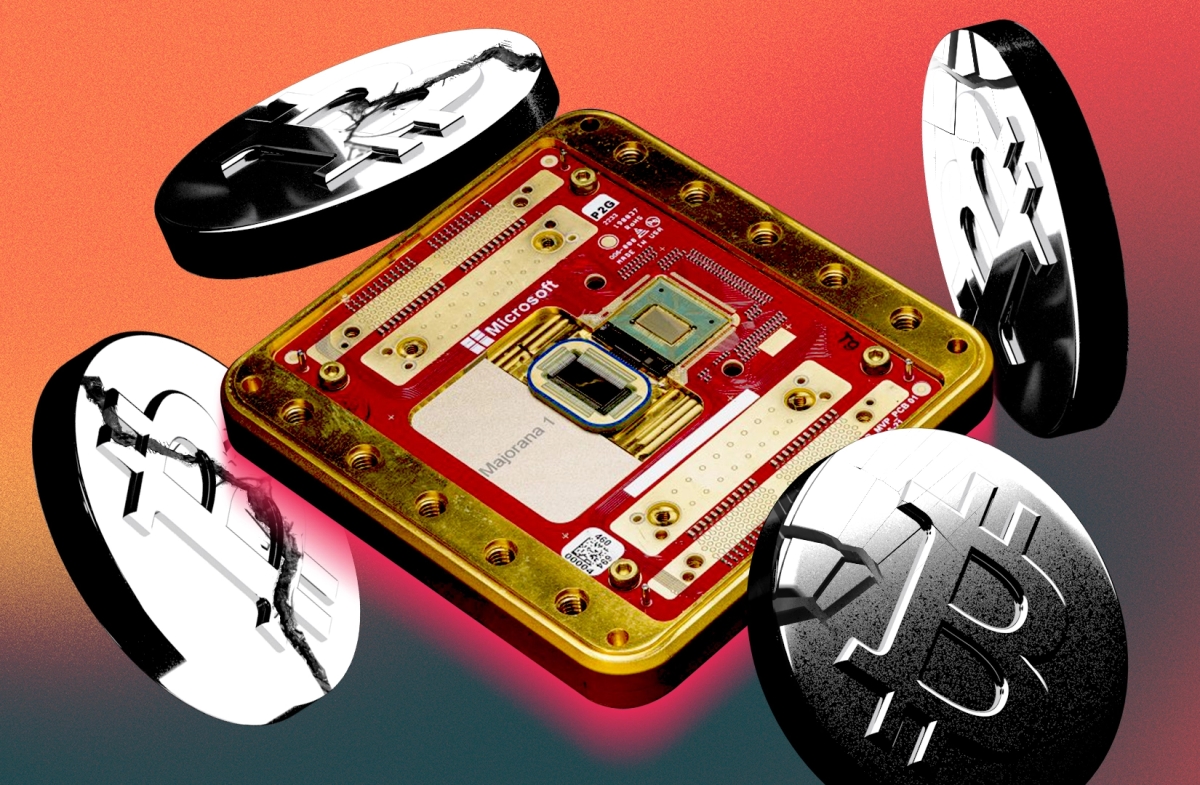
- Long-term threats to Bitcoin’s security are creeping up faster than markets expect, analyst warns.
- About one-third of all Bitcoin “appears vulnerable to long-range quantum attacks.”
- BlackRock also flagged quantum computing risks to the top crypto back in May.
Bitcoin’s long-term security is heading into uncharted waters.
That is the warning from David Duong, global head of investment research at Coinbase, who said that advances in quantum computing are accelerating faster than the $3.3 trillion crypto industry is pricing in.
Even if an outright attack on Bitcoin is not imminent, the quantum threat to Bitcoin has evolved from a distant theoretical concern to a real structural risk already threatening one-third of the supply, Duong argues.
The cryptographic output of wallets holding about one-third of the Bitcoin supply is publicly visible, making them highly vulnerable to brute force attacks.
“Bitcoin’s long-term security may be entering a new regime as quantum computing advances,” Duong wrote on LinkedIn.
“Investors are becoming increasingly concerned that quantum computing risks may be approaching faster than previously thought,” he said.
The fresh warning comes as quantum computing is still in its infancy. Quantum computers are a new class of machines that exploit the laws of quantum mechanics to process information in fundamentally different ways from today’s computers.

They are still experimental, but if they reach sufficient scale, they could break the cryptographic techniques that secure Bitcoin, allowing attackers to steal coins from vulnerable wallets.
Researchers have long disagreed on whether and when quantum computers will threaten Bitcoin’s cryptography.
Pierre-Luc Dallaire-Demers, a quantum computing researcher, told DL News in October that he expects quantum computers to crack Bitcoin’s cryptography within four to five years.
BlackRock explicitly flagged quantum computing as a risk factor in its amended prospectus for its flagship iShares Bitcoin Trust, filed in May.
Two key threats
Bitcoin’s security relies on two cryptographic building blocks.
The first is the Elliptic Curve Digital Signature Algorithm, which ensures that only the owner of a private key can authorise a transaction. The second is SHA-256, the hashing function that underpins proof-of-work mining.
Duong says quantum computers pose two distinct risks. One is economic. If quantum machines become powerful enough, they could mine Bitcoin blocks far more efficiently, potentially distorting the network’s incentive structure.

The second risk is more direct.
Quantum computers could derive private keys from exposed public keys, allowing attackers to drain funds from vulnerable addresses.
“Quantum mining remains a lower-priority concern given current scaling constraints,” Duong wrote.
“Signature security is the central issue.”
Lance Datskoluo is DL News’ Europe-based markets correspondent. Got a tip? Email at lance@dlnews.com.