

SINGAPORE, SINGAPORE, December 8th, 2025, Chainwire
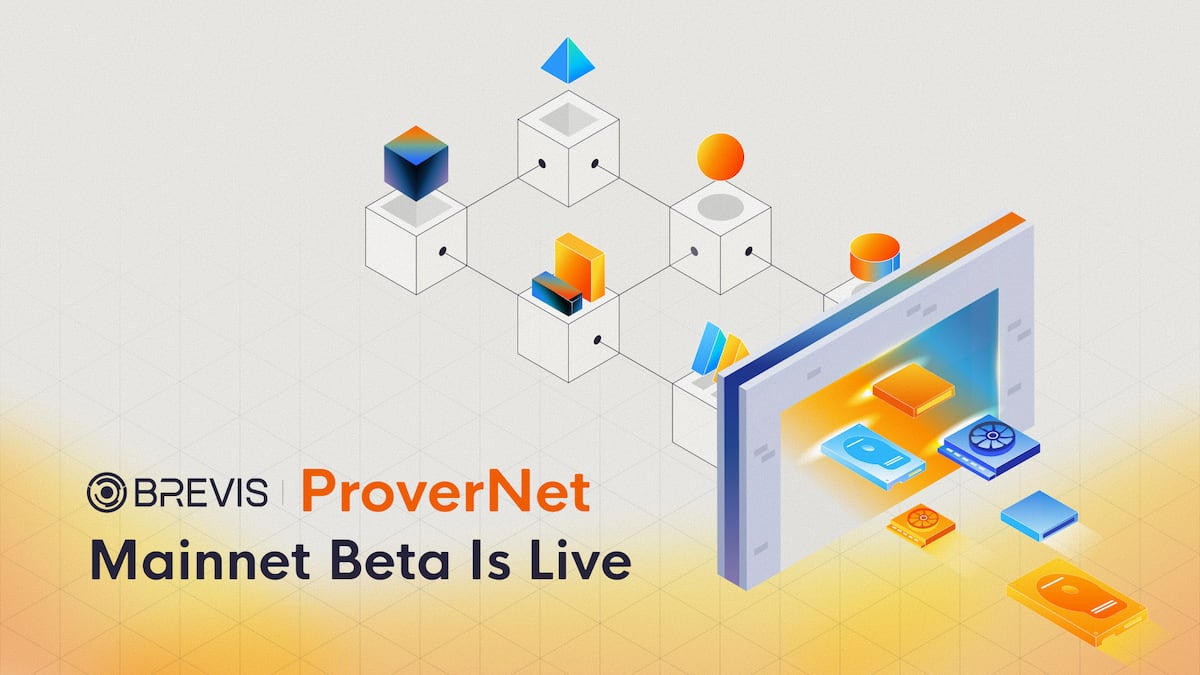
Brevis, a leading infrastructure company powering smart, verifiable applications with zero-knowledge proofs, announced ProverNet, its decentralized marketplace for zero-knowledge (ZK) proof generation, is live on mainnet in beta. The launch comes just weeks after Brevis released the ProverNet whitepaper, introducing the architecture for the world’s first decentralized marketplace with continuous auctions for ZK proof generation.
ProverNet is a decentralized on-chain marketplace that matches ZK proof workloads from applications with provers optimized to execute them. Applications submit proof requests with specific requirements, and provers bid based on their hardware, costs, and performance characteristics. The network’s auction mechanism routes each proof job to the most suitable prover in real time, ensuring efficient, scalable, and economically aligned ZK proof generation.
The mainnet beta is now running in production, matching applications and provers in real time and enabling permissionless access to specialized proving capacity. Built on years of large-scale ZK deployments and more than 250 million proofs generated across over 30 partners, including PancakeSwap, Uniswap, Linea, MetaMask, and BNB Chain, the network is a leap toward making verifiable computation an open, accessible commodity.
“ProverNet is the infrastructure layer we wished existed when we built our first large-scale ZK deployments,” said Michael, CEO and Co-founder of Brevis. “It turns proof generation into a market, letting provers specialize and applications get the right resources instantly, rather than being bottlenecked by one-size-fits-all infrastructure.”
The ProverNet marketplace is fully operational in its beta phase. Continuous proof auctions run on-chain, assigning workloads to provers using TODA: the Truthful Online Double Auction designed to efficiently match heterogeneous ZK jobs across diverse hardware configurations. Payments are settled in USDC during the beta period, while provers can already register nodes and begin competing for tasks using newly published GPU and CPU setup documentation. Applications can now access proving capacity directly, eliminating the need to operate their own proving infrastructure and enabling immediate integration through simple request interfaces.
Going forward, the mainnet beta is the foundation for several upcoming upgrades that will activate at full launch. The BREV token will replace USDC as the native settlement currency and allow provers to secure work, participate in protocol rewards, and reinforce network reliability. Brevis will also migrate production workloads to ProverNet, starting with a subset of Ethereum block execution proofs from ETHProofs.org. As proving volume grows and job heterogeneity increases, the network will transition to a dedicated app-specific rollup designed for high-throughput proving operations. These will bring a complete economic and operational model described in the whitepaper into production.
ZK proving has become core to blockchain infrastructure, but existing proving systems are optimized for single workloads, making them incompatible with the diverse demands of modern ZK applications. Brevis’s experience generating millions of proofs showed that each proof requires a unique combination of hardware, latency tolerance, and proof system parameters. ProverNet’s market-based architecture resolves this mismatch. Applications avoid vendor lock-in, provers gain access to global demand matched to their strengths, and the broader ZK ecosystem benefits from shared infrastructure rather than fragmented silos.
With the marketplace now live, Brevis invites both provers and applications to join the mainnet beta, contribute feedback, and help shape the proving infrastructure the ZK ecosystem has long needed. The full mainnet launch will follow soon.
About Brevis
as the infinite compute layer for Web3. It enables applications to offload data-intensive and expensive computations from constrained on-chain environments to a high-performance off-chain engine where every computation is cheaply and provably verifiable on-chain. The Brevis stack includes Pico zkVM for general-purpose verifiable computation, multiple coprocessors including the ZK Data Coprocessor for trustless access to historical blockchain data, Pico Prism for real-time Ethereum block proving with 99.6% coverage and 6.9 second average proving times, and ProverNet, a decentralized marketplace for ZK proof generation informed by 250+ million proofs generated across 30+ protocols on 6 blockchains.
Website | Blog | Telegram | X | Github | Discord
Contact
Nicolas
Nicolas@brevis.network