




Introduction
In recent months, vote buying has become one of the most widely debated practices in DAO governance. What was once a theoretical or informal occurrence has now been formalised through platforms such as LobbyFi and Event Horizon. These systems provide onchain marketplaces where voting power can be bought and sold, introducing a new layer of strategy and incentives into governance participation.
Proponents view vote buying as a means to activate passive token holders, increase voter turnout, and improve efficiency. Critics worry that it introduces risks around fairness, undue influence, and trust in decentralised processes. As these mechanisms gain traction, the need for a clearer understanding of their implications technical, social, and economic becomes urgent.
This report offers a neutral, in-depth examination of vote buying as it relates to DAO governance.
We structure this report across three main areas of focus:
1. Mapping the landscape and state of vote buying in DAO governance This section provides an overview of the current state of vote buying in DAO governance, examining how the practice has emerged and evolved. It analyses the major platforms facilitating vote buying today, including LobbyFi, Event Horizon, and others. Their models are classified based on key dimensions such as mechanism design, accessibility, transparency, and governance risk. Structural differences are highlighted through a comparative matrix to better understand the varied approaches and implications across platforms.
2. Risks, incentives and governance impact The core of the report focuses on how vote buying affects DAO decision-making. It explores manipulation and attack vectors, considers examples of outcome-aligned or altruistic vote buying, and analyses how pricing structures influence behaviour.
3. Recommendations and design considerations The final section presents a set of flexible recommendations for DAOs navigating vote buying.
Rather than promoting a fixed approach, we offer a menu of strategies that DAOs can adopt depending on their stance whether that is to allow, regulate, or restrict vote buying.
The state of vote buying
Vote buying is not a new phenomenon in governance. Nearly a decade ago, Vitalik Buterin wrote about its role in the future of DAOs, highlighting both its disruptive potential and its ethical and economic complexity. While long discussed in theory, often as a thought experiment around how DAOs might become “markets for influence”, it remained an intellectual curiosity rather than a practical reality.
That is no longer the case. Over the past year, several protocols have launched, offering real-world implementations of vote buying in one form or another. These platforms have created active markets for governance power, allowing voting rights to be monetised. What was once a conceptual debate has now become a tangible reality and DAOs must account for these dynamics within their internal governance processes.
There are clear reasons why vote buying is gaining traction. First, it redistributes influence: power is no longer restricted to those who actively participate or hold long-standing reputations: it can be rented, bought, and sold. Second, it introduces yield opportunities for token holders in ecosystems where governance tokens typically do not generate returns. And third, it adds a new layer of dynamism to DAO operations, encouraging more frequent participation and creating new incentives around voting.
This new dynamism has sparked debate, with some viewing it as a natural evolution of onchain coordination and a tool for broader participation, while others regard it as a potential threat to the integrity and stability of DAOs.
It’s important to clarify what is meant by vote buying, as the term often evokes a narrow image of voters exchanging their votes for direct compensation. In practice, however, the concept is far broader and more nuanced. In this report, vote buying refers to a spectrum of mechanisms that leverage financial incentives to facilitate participation, influence outcomes, or redirect governance power. These mechanisms include private one-to-one deals, public bribe marketplaces, auctions, open vote-selling platforms, and even prediction markets where participants speculate on the outcomes of proposals. Though having in common the financialisation of voting, these mechanisms vary significantly in design, intention, and impact.
In the following section, we present a broader landscape of vote buying mechanisms by examining five protocols. Each takes a distinct approach to the concepts of governance and vote buying, with its own design, purpose, and implications. From LobbyFi’s structured marketplace to MetaDAO’s futarchy model, Butter’s outcome-based funding, Hidden Hand’s bribing mechanism and Event Horizon’s participation-driven delegation, these protocols demonstrate that vote buying is a diverse and evolving field that reimagines how influence is exercised in DAO governance.
Mapping the landscape of vote buying
This section presents the five protocols introduced earlier that revisit DAO governance and are directly or indirectly involved in vote buying. Each takes a unique approach, contributing to the growing trend of financialising participation and influence in decentralised decision-making.
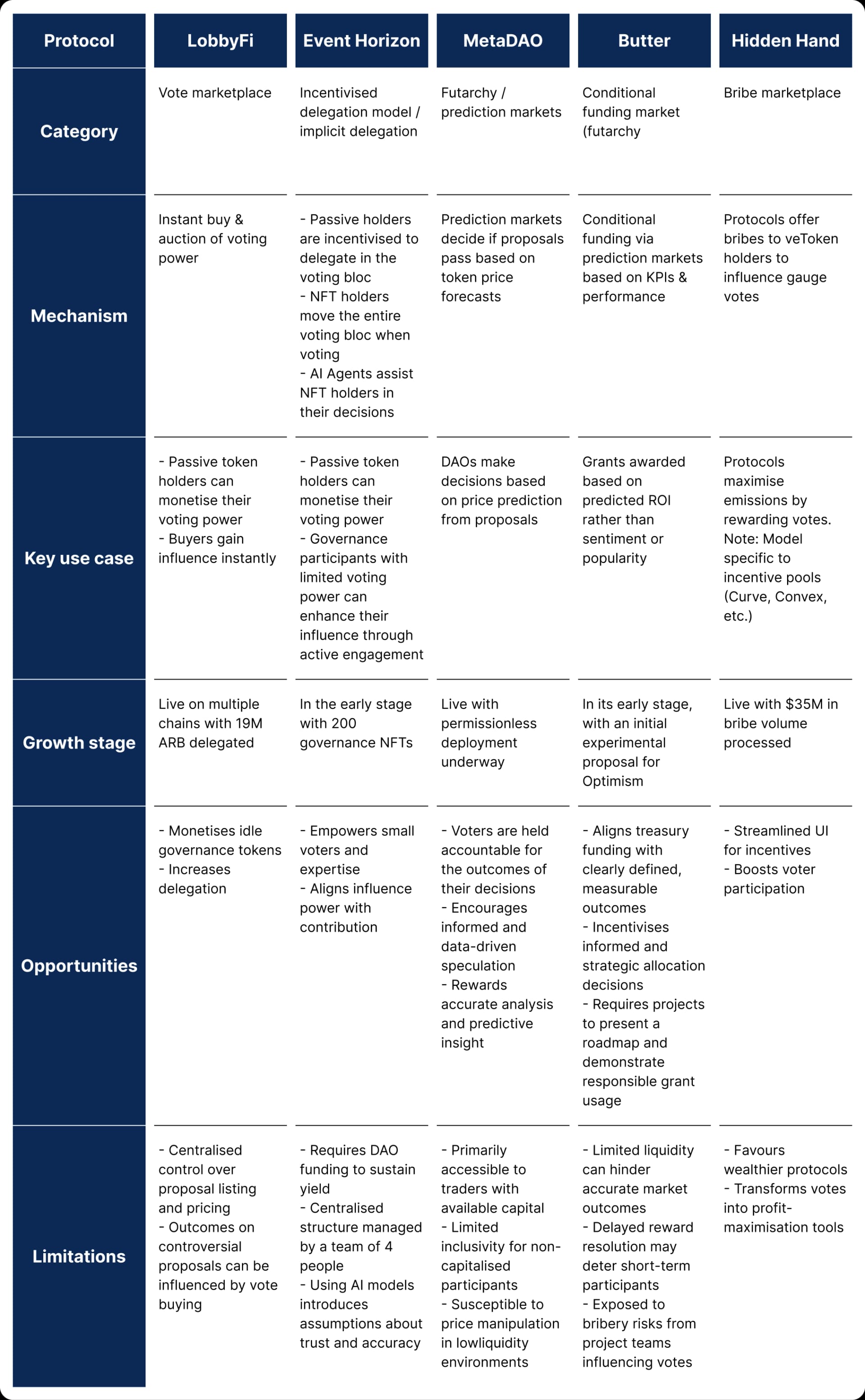
The table below offers a high-level summary of each protocol’s core mechanisms, goals, limitations, and governance implications, helping to situate them within the broader vote buying landscape. This table is followed by a brief presentation of each protocol.
For readers seeking a deeper dive into the technical design, risks, and potential evolution of these platforms, a full analysis is provided in the appendix.
LobbyFi
LobbyFi is a governance protocol that introduces a market-based model for DAO participation, turning voting power into a tradable, yield-generating asset. It enables token holders to delegate their voting rights to third parties through a marketplace, where voting power is acquired on a per-proposal basis via fixed-price purchases or auctions. This framework shifts governance from a purely civic activity toward one shaped by market incentives. The protocol is deployed across multiple chains, including Arbitrum, Optimism, Scroll, and zkSync, and has seen notable activity in the Arbitrum DAO, particularly following a delegation of 18.9 million ARB.
LobbyFi addresses several recurring challenges in DAO governance. First, it provides a mechanism for token holders to earn yield on otherwise idle governance tokens by delegating their votes. Second, it introduces an economic layer to governance participation, which may encourage engagement from previously passive holders. Third, it alters the distribution of influence by linking voting power to demand in a transparent market. Lastly, it brings transparency and structure to practices that often occur informally, such as private vote deals, selling, or bribing.
The protocol operates through two primary mechanisms: Instant Buy and Auctions. Token holders can delegate their votes to LobbyFi, with the ability to revoke delegation at any time. Delegated votes are aggregated and listed for sale. Instant Buy allows a purchaser to acquire the full voting bloc at a fixed price in ETH. Alternatively, auctions enable competing bids across voting options (e.g., “For” vs. “Against”), with the winning side determined by the highest aggregate bid, provided a minimum reserve threshold is met. If that threshold is not met, the protocol votes “abstain,” which still counts toward the quorum.
Proposal listings, voting mechanics, and price settings are currently determined by the LobbyFi team. Proposals flagged as potentially harmful or extractive can be excluded from monetisation, with a default “Against” vote applied. This centralised discretion is framed as a safeguard to protect integrated DAOs. The “Pills” program, which rewards participation with points, may indicate plans for future decentralisation, though specifics are yet to be defined.
LobbyFi’s approach has generated active discussion, particularly regarding its influence within the Arbitrum DAO. Critics have raised concerns that monetising votes could distort governance by allowing capital to override alignment, domain expertise, or broader community values. There is also a risk that the relatively low cost of acquiring voting blocs (based on the team’s assessment of proposal risk, financial impact, and other contextual factors) could create openings for governance manipulation, especially in cases of low participation or contested proposals.
The LobbyFi team has acknowledged these concerns and states that its primary goal is to increase participation while minimising manipulation. They engage with DAOs to clarify listing decisions and avoid monetising votes on proposals perceived as extractive. In a recent interview, the team explained their pricing approach: for proposals with identifiable beneficiaries, prices are generally set at 1% of the proposal’s expected financial gain. For others, they benchmark against the cost of acquiring voting power through alternative methods such as borrowing governance tokens, offering a lower-cost option in the 1 to 2% range. However, the team notes that this approach may evolve as the governance market matures.
LobbyFi reflects a broader shift in DAO governance toward incentive-driven, market-based models.
While its structure introduces new coordination mechanisms, it also presents risks related to influence concentration and vote commodification. Ongoing evaluation will be needed to assess its long-term impact on DAO governance design, participation quality, and institutional integrity.
Event Horizon
Event Horizon is a governance platform that explores alternative models for how influence is earned and exercised within DAOs. Rather than reinforcing capital-weighted voting systems, it introduces mechanisms intended to prioritise participation, domain expertise, and engagement. Its core design offers three elements: yield generation for passive token holders, expanded governance influence for smaller holders through increased voting weight, and the ability for protocol users to participate in governance across a broader range of DAOs.
The platform targets several persistent challenges in DAO governance, including low voter participation, high concentration of power, and the limited influence of domain-specific experts, particularly those without large token holdings. Over time, Event Horizon aims to function as a secondary governance layer, providing an environment where new participants can engage with meaningful influence across multiple DAOs.
At the centre of the system is Implicit Delegation, a model in which token holders delegate their voting power in exchange for yield, while a fixed set of governance NFTs determine how the voting bloc is used. Each NFT represents one vote, decoupling governance from token wealth. When a proposal is active, a majority decision among the NFT holders determines how the full delegated vote is cast. This structure shifts influence toward engaged participants and away from capital accumulation.
The Fraction of voter pass holders who decided to participate will move the entirety of the treasury voter block.
The fewer people that participate, the more authority each person who does will effectively control.
A second mechanism, Sacrificial Specialisation, is under development. It will allow NFT holders to increase their influence in specific governance domains, such as DeFi, gaming, or protocol security.
However, unlike traditional technocratic models that concentrate expertise and capital, this approach introduces trade-offs: deeper specialisation in one domain comes at the cost of general authority elsewhere. The aim is to enable domain experts to lead within their areas of knowledge, while still allowing generalist perspectives to be represented at a more limited level. However, it is important to note that the status of “expert” in this system is determined by participation within the platform, rather than by external credentials or demonstrable domain expertise.
Each governance NFT also functions as an AI agent, assisting its holder by explaining proposals, aligning votes with user preferences, or voting autonomously based on predefined parameters. These agents are designed to reduce common barriers to voter participation, particularly time constraints and lack of subject-matter knowledge. For users willing to engage, they offer a structured way to participate without requiring constant oversight.
At present, Event Horizon offers approximately 15% yield for delegated tokens, funded through Optimism incentives. While the original plan involved deploying DeFi yield strategies, this was reconsidered due to the complexity and relatively low yields associated with DAO tokens. The current model instead depends on DAOs providing incentives to attract users and surface expertise, an approach that reflects the cost of broadening participation beyond traditional capital holders.
Event Horizon remains in an early developmental stage and faces design and operational complexities. Its model depends on sustained financial support from DAOs to fund voter incentives.
Governance remains centralised in a small, four-person team, with no formal community control in place. As voting power consolidates around NFT holders, concerns arise around sybils (safeguards are implemented according to the team), the centralisation of influence, and whether AI agents will accurately represent voter intent.
The platform sits at the intersection of governance-as-a-service and delegation infrastructure, with a focus on reactivating unused voting power and expanding influence for informed, non-wealthy participants. While the system technically allows for the sale of its voting bloc, enabling forms of vote buying, this is not a core feature of the protocol. Its broader objective remains the development of a more inclusive and structured governance model for DAOs.
MetaDAO
MetaDAO is the first project to bring futarchy fully onchain, turning governance decisions into market- based forecasts. Rather than asking the typical DAO question “Should we do this?”, MetaDAO reframes the conversation as “Will this improve the value of our token?”. In doing so, it transforms DAO governance into a system guided by prediction markets, where policy is determined not by sentiment or ideological alignment, but by economic speculation on outcomes.
When a proposal is raised, MetaDAO creates parallel prediction markets: one assumes the proposal will be implemented, and one assumes it will not. Traders then speculate on which version of the future will result in a higher token price. If the “approve” market implies a higher valuation than the “reject” market, the proposal passes. This mechanism introduces a layer of market-based rationality to governance, rewarding participants for accurately predicting which path will create more value.
Unlike traditional governance systems where voter preferences are hard to benchmark, MetaDAO uses token price as the core metric of legitimacy.
MetaDAO offers both binary and scalar markets. In binary markets, participants bet on whether a proposal’s outcome will occur, earning a fixed payout if correct. Scalar markets, on the other hand, allow speculation on the magnitude of impact, capturing more granular expectations. Once trading closes, the system compares the final prices: if the market predicts the proposal will improve value, it’s executed. Traders in the losing market are refunded, while those in the winning market see their trades settled and may receive additional rewards if incentives are distributed (An example with Jito in this tutorial.) Still, MetaDAO’s model introduces trade-offs. By design, it demands financial participation from voters, favouring those with trading knowledge, capital, and a high tolerance for volatility. In its current form, the model tends to prioritise short-term signals over long-term value creation.
Community members who are philosophically aligned with a DAO’s mission but lack the resources, trading skills and risk-appetite to participate in markets may find themselves sidelined.
In low-liquidity environments, MetaDAO’s markets are also vulnerable to manipulation. A single large participant can easily skew prices to sway proposal outcomes. Past proposals have shown irregular price spikes, suggesting that while the markets are functional, they are not always efficient or immune to gaming.
Finally, MetaDAO settles markets immediately after votes conclude, rather than waiting to observe the actual outcomes of policies. As such, the real-world impact of a decision becomes secondary to the speculative dynamics of the market.
Despite these limitations, MetaDAO represents a bold rethinking of governance: one that seeks to replace politics with predictive consensus. Its experiment with onchain futarchy may not be perfect, but it opens new ground for DAOs seeking for new models to boost participation and increase predictability.
Download the full report here
Download the "An Analysis of the Role of Vote Buying in DAO Governance" report here (PDF)