

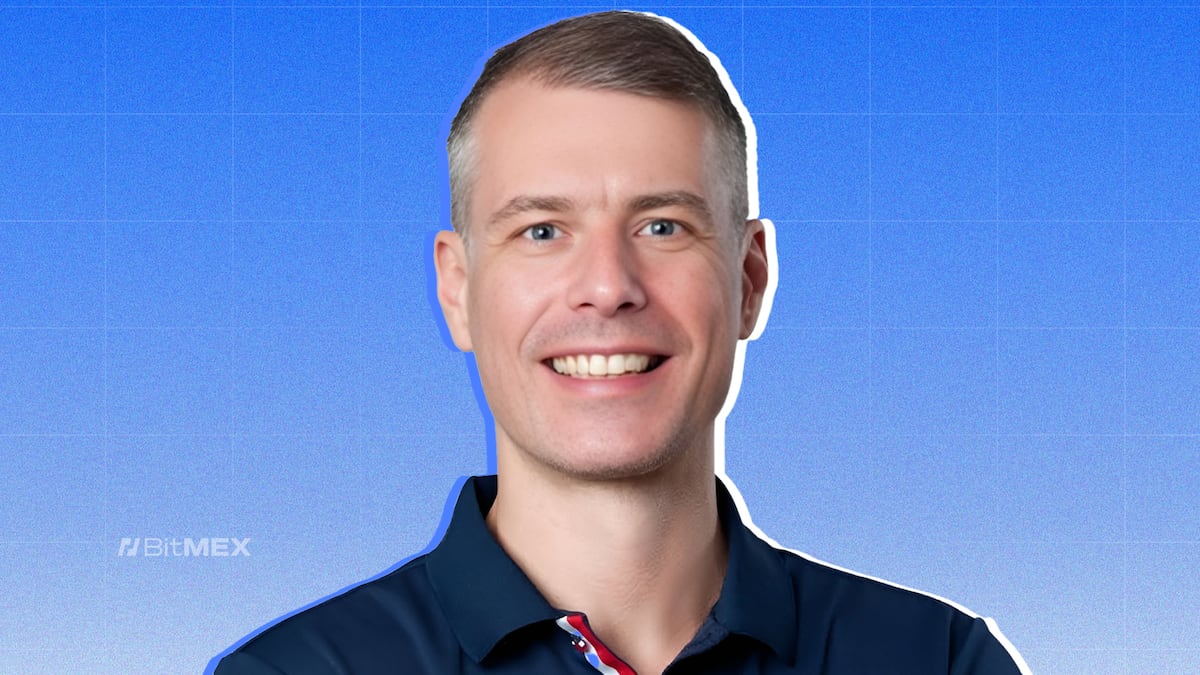
Stephan Lutz is the CEO of BitMEX. He joined the company in 2021 as CFO and was appointed the group CEO in late 2022, during one of crypto’s most vibrant periods. Stephan has been instrumental in driving the exchange’s position as a leader in crypto derivatives, guiding the platform back to its successful roots of serving professional and institutional traders, with a focus on liquidity, performance, and reliability.
Under his leadership, BitMEX marked a decade in 2024 without security breaches, a rare achievement in the crypto industry, while also advancing innovations that improved trader engagement, user trust, and platform efficiency. Before joining BitMEX, he was a Senior Partner at PwC for nearly ten years, advising many of the world’s largest financial institutions. Prior to PwC, he held senior roles with Deutsche Börse. His career started in corporate finance and equities trading at Dresdner Bank AG (now Commerzbank AG).
We recently spoke with Stephan Lutz, CEO of BitMEX, about the exchange’s role in pioneering crypto derivatives and its positioning for the next era of institutional adoption.
Read more about BitMEX’s commitment to neutrality and its vision for the future of trading in the interview below.
BitMEX is celebrating its 11th anniversary. After a decade of market cycles and structural shocks, what do you consider the exchange’s most significant contribution to the evolution of crypto?
Without a doubt, the invention of the Perpetual Swap and its associated settlement mechanism, including but not limited to the so-called socialised loss model, marks a significant development. Prior to this, crypto derivatives were merely imported TradFi products that were ill-suited for a highly volatile asset class that trades 24/7.
The perpetual swap enabled traders to manage positions with less capital and reduced downside risk, facilitating hedging that matched how traders actually intended to use Bitcoin. This is why it became the primary instrument for crypto trading and the model adopted by all subsequent futures exchanges.
Before BitMEX launched XBTUSD (the Bitcoin perpetual swap), the crypto market relied on futures contracts with expiry dates that spread liquidity thin and did not align with the unique properties of digital assets. We created a financial primitive that allowed for continuous liquidity without the need to roll positions. It is impossible to imagine crypto without perpetual swaps today, but that was the case when BitMEX entered the fray in 2014.
BitMEX has operated for over a decade without experiencing a security breach. What specific principles or practices have enabled the platform to uphold this record, and how do you currently stress test those assumptions?
Over time, the challenge with maintaining solid security is complacency and the urge for comfort. Eleven breach-free years can make people forget how quickly one mistake can ruin that record. So our team at BitMEX deliberately assumes that any layer can fail, including the human one.
We actively simulate insider threats and rigorously review our custody design against emerging attack vectors, including those from sophisticated nation-states. To ensure transparency, we also publish proof-of-reserves and liabilities data so users can independently verify what we hold. Our goal is to challenge our own assumptions before an adversary does.
From day one, BitMEX implemented cold storage with multi-sig withdrawals, which were unpopular at the time because they were slower and more operationally complex. However, this was a necessary step to ensure our platform upheld the highest standards of protection and risk management.
Rather than a product, security is an ongoing practice that requires consistent, daily effort. As technology advances, so too do our storage mechanisms, but we always prioritise ensuring that innovations do not compromise the essential goal of protecting user funds.
You stepped in as CEO during a challenging time for the industry. What were the initial internal changes you prioritised to refocus on professional and institutional trading?
When I took on the role of CEO in late 2022, the industry was recovering from several high-profile failures. The noise levels were significant. My top priority was to refocus BitMEX on its core strengths: serving professional, daily active, and institutional traders with a dependable, secure infrastructure and substantial liquidity.
This involved three key points. First, refining our product and listing strategy to focus on more liquid, high-conviction markets rather than chasing every short-lived trend. I aimed for us to be the platform where, when the market moves 10% within minutes, your order executes precisely as shown in the order book. That reliability is what professional traders value, not how many altcoins you hold on a spot list.
Second, it involved reinforcing platform resilience, because professionals do not care about slogans but about order-fill quality and the ability to perform under stress. Third, we aligned BitMEX around a very simple internal message: we are not here to be everything to everyone; we are here to be the most trusted exchange for serious traders. Once that clarity was restored, many other decisions became simpler.
As on-chain derivatives trading becomes more institutionalised, what qualities do you expect institutions to prioritise most when selecting an execution venue?
Institutions dislike surprises, which is why managing risk is their primary focus. They prioritise two aspects above all else: platform reliability and neutrality.
Reliability involves ensuring they can enter and exit positions during extreme volatility. If an exchange’s UI freezes or the API lags during a crash, that venue becomes useless to an institution hedging a large book. Regarding neutrality, institutions need to be confident they are not trading against the house. They scrutinise whether an exchange operates an internal prop desk that trades against its own customers.
Our model, in which we function solely as a matching engine without an internal trading desk to generate profit, is rooted in our core principles of maintaining a genuine peer-to-peer exchange.
Another factor becoming increasingly important is regulatory compliance. Non-crypto-native institutions and money managers need someone else to rubber-stamp rather than conduct their own research. Will it truly enhance quality? We will see. Can it be ignored? Of course not.
The October 11 flash crash highlighted how risk spreads across all venues simultaneously. What did that event reveal about the way risk propagates between venues, and what improvements have you implemented as a result?
The events of 11 October served as a stress test that exposed the risks of depending on a single data source. We observed venues struggle as their price oracles referenced spot markets that had become illiquid or broken down, leading to a chain of largely unnecessary liquidations.
BitMEX weathered that storm with remarkable stability thanks to our Fair Price Marking system, which uses a composite index from multiple exchanges. When a venue spot fails or de-pegs, our system automatically filters out the anomaly, protecting traders from “wicks” that do not reflect genuine market value.
The event showed that our systematic approach to Auto-Deleveraging, which affected only 15 contracts during the crash, worked exactly as intended to safeguard the system’s solvency without wiping out innocent traders.
We also have a robust Multi Asset Margining system that operates differently from peer exchanges: we limit accepted margin to a small set of coins with high haircuts (around 5%) to account for volatility. While this restricts usable margin for traders, a point on which we are criticised during periods of low volatility, it enables us to liquidate later and less often, as the haircut is set aside to manage high volatility during large liquidations.
You cannot eliminate volatility, but you can ensure that when the next black swan arrives, as it inevitably will, you are well positioned to mitigate the second-order effects that cascading liquidations can cause.
Many traders misjudge the real causes of failure. Which risks do you think are still underestimated, and how should traders modify their frameworks?
Traders obsess over liquidation price, but they often underestimate the risk of market structure collapse, particularly Auto-Deleveraging (ADL) and custodial risk. Liquidation is a market risk you can control; simply use stop-loss orders to manage it.
ADL, on the other hand, is a systemic risk in which profitable positions are forcibly closed because the losing side cannot cover its debts, and the insurance fund for a contract is depleted. Traders need to understand the ADL priorities of the platforms they trade on.
Additionally, the risk of “trading against the house” remains underestimated. If you are trading on a CEX where the exchange is also among the largest market makers or prop traders, you are fighting an uneven war. Systemically, making money does not come from fees. As the saying goes on social media, you might be the product rather than the customer.
Serious and consistent traders should adapt their frameworks to prioritise neutrality and transparency: proof of reserves, no internal desks as profit centres, and clear mechanisms for insurance funds. My advice to professional traders is to rigorously audit the platforms they rely on, just as they would backtest a strategy. Run simulations in which your counterparties fail, or your exchange goes offline during peak volatility. This is not covered by any licence obtained or granted. It pertains to business conduct.
BitMEX upholds a strict neutral-venue philosophy with no internal trading as a profit centre. How do you safeguard this approach in jurisdictions that now require tighter oversight and more intrusive controls?
Many of these requirements, such as clearer segregation of functions, assets, and robust KYC, actually strengthen our model rather than threaten it. It is also simpler to comply when you have never operated an internal prop trading book against your own order book from the outset.
Our neutral-venue approach predates the current regulatory wave. BitMEX was created without an internal prop desk because we believe that merging the roles of exchange, broker, and arbitrageur creates structural conflicts of interest that cannot be fully resolved. Of course, under certain market conditions, this can even increase surface liquidity and reduce headline trading fees, as profits are spread across various functions.
To safeguard this approach, it primarily comes down to discipline and continuous explanation. Discipline in the sense that, when commercial opportunities arise that could blur the lines, i.e., taking principal risk to subsidise trading fees, we walk away if they threaten neutrality.
Explanation involves regularly reaffirming what we mean as an executive team, ensuring that the involved functions clearly understand their limitations and the rationale behind our actions. In this sense, it is much like security: a continuous practice rather than a static product or process.
BitMEX pioneered perpetual swaps and remains heavily focused on derivatives. Which product innovations are most likely to shape the next phase of trading, and where is BitMEX directing its efforts?
We are widening access to derivatives for retail traders by implementing advanced automation and replication tools such as Copy Trading and Trading Bots. Copy trading enables users to benefit from the experience and successes of professional traders by automatically copying their strategies.
BitMEX’s specialised implementation enables users to simulate multiple traders at once, preventing them from putting all their eggs in one basket. This system also provides a unique reversal feature, allowing users to counter-trade a trader if they disagree with their strategy.
The philosophy behind this is less about technical automation, which is already available. It is about enabling even serious derivatives traders to invest “passively” because traditional passive investments in Tradfi are not yet accessible to crypto or do not offer sufficient returns.
For example, Spot ETFs are excessively costly compared to direct holdings, and most of the available indices lack representative value and change their composition too frequently. Copying successful traders and curating your own portfolio of these is the best approach for passive crypto investing today.
The next phase focuses on expanding tradable assets with the efficiency of a perpetual swap. We are carefully exploring how to incorporate traditional financial assets and give them the BitMEX approach. Equity perps combined with the high-leverage mechanics of crypto represent a significant untapped market, and if introduced responsibly, there is a strong case for it.
Additionally, integrating it into the settlement mechanism discussed earlier to enable true 24/7 price discovery and collateralising it in crypto would significantly increase traders’ opportunities.
Arthur Hayes recently reflected on the necessity for adaptation in a maturing market. Which evolutionary steps do you believe are crucial for BitMEX in the coming years?
Adaptation for us involves bridging the gap between DeFi’s rapid innovation and TradFi’s trustworthiness. The cycle isn’t over, as Arthur states, but the participants have shifted.
BitMEX aims to be the responsible leader that still understands the thrill of the market. We are committed to providing deep liquidity and low latency while adopting the transparency typically associated with DEXs. Rather than competing directly with decentralised protocols, we position BitMEX as the premier venue for price discovery and large-scale execution. These are critical high-volume operations that DEXs still struggle to manage efficiently.
The other aspect to consider is ensuring non-discriminatory access. What do I mean by this? Crypto has always been, and remains, for individuals. Professionalisation is beneficial as long as it does not exclude legitimate individual traders. Therefore, I am against building barriers to simulate TradFi on CEXs.
Of course, we care deeply about integrity, which is why we pioneered comprehensive KYC and AML procedures before any other exchange. While this early adoption went unnoticed, even by US regulators, our intent was never exclusionary. Instead, these measures are essential to ensuring a smooth and accurate price-discovery process.
We don’t need to engage with every on-chain market, but we must ensure that BitMEX stays the premier platform for pricing risk and hedging exposure to assets across the entire crypto spectrum. If we get those steps right, then the next decade of BitMEX might look different externally, but the core principles will remain exactly the same as on day one, and in my view, that is the right kind of evolution.