




Even the staunchest proponents of blockchain tech would agree that complexity has limited blockchain’s mass adoption despite its transformative potential.
Building a decentralised application (DApp) requires choosing a chain for deployment, identifying supporting protocols, and constructing foundational infrastructure. Interoperability requires developers to build manual integrations for each chain. Yet, they remain constrained by the incompatibility of protocols; tokens, liquidity, and state data are all siloed within their respective ecosystems. It’s like running a marathon in flip-flops – assuming you had to make the flip-flops first.
Intent-based architecture offers an opportunity to lace up a pair of (ready-made) running shoes.It abstracts the complexities developers face, allowing them to focus on what they want to deliver without getting bogged down in the technical details of execution. The system automates the underlying processes needed to achieve the developers’ desired outcome, or their intent.
This adds a new facet to blockchain development: innovating for user experience. It’s a tech 101 which has traditionally escaped the blockchain world. By eliminating the need to master specific chains and protocols, intent-based architecture shifts the focus from developing features that are technically feasible to features that are practically desirable. Rather than limitations of expertise, developers are only limited by their creativity, theoretically.
It’s a compelling picture, but intent-based architecture presents its own challenges, blockchain siloes among them. If a user makes a request (expresses an intent), they don’t care which chain or protocol fulfils it – only that the request is actioned effectively and efficiently. That means intent systems should ideally be chain-agnostic, delivering solutions that leverage the best functionality across multiple frameworks. This requires a foundational layer, a centralised repository that can connect numerous independent protocols to enable cross-chain solutions. Without this, intents would be limited to their respective environments, and developers would still need to build manual integrations for each chain.
Intent-based architecture has the potential to push us beyond the limitations of blockchain development, offering a clear path to developing use cases with broad utility and mass appeal. To achieve this, intent-based architecture must overcome the fragmentation ubiquitous within the blockchain ecosystem.
Enso: The evolution of an intent engine
Enso aims to tackle that challenge head-on. Over the last four years, the protocol has evolved. It emerged in 2023 as an API middle layer – a network that connects all ecosystems and facilitates intent-based architecture. It provides the infrastructure to translate intents into actionable workflows: developers state intent, multiple parties contribute smart contract abstractions, and the Enso network provides solutions to meet intent requests.
But before Enso developed this workflow, the protocol began in 2021 as a Decentralised Finance (DeFi) and Index Fund platform. It launched with an ambitious – and noisy – ‘vampire attack’. Designed to divert liquidity from competing protocols, vampire attacks attract users from other protocols with higher rewards, and a fledgling Enso had no fewer than six competitors in its sights. While the planned attack generated a publicity buzz, its deliverables were less visible. There was little chatter in the aftermath of the attack and, while the Enso team stated at the time they were targeting $1bn TVL, their reflections after focused on qualitative outcomes, noting that the attack tested the team’s various capabilities.
Nonetheless, the attack established the groundwork for Enso’s next iteration. In 2022, the protocol launched its social trading product, allowing friends to invest and build trading strategies for each other. Despite sinking over a year into development and more than $500,000 into audits, Enso’s social trading offer attracted significantly less fanfare than its vampire attack. The team later acknowledged that the product took too long to ship (integration overheads and audits caused delays), and there wasn’t a market for it at launch.
Undeterred, a year later Enso launched its ‘DeFi Super App.’ Featuring integrations with over 50 DeFi protocols. Other teams reached out asking how Enso had successfully launched with so many integrations, highlighting an opportunity in the process. The Enso team jumped to it – they’d learned their lesson with social trading and weren’t about to let this opportunity slip through their fingers. Within two weeks, Enso’s API allowed other developers to use its underlying infrastructure – its intent engine – to facilitate multiple integrations.
This established Enso as a DeFi API middle layer and solidified one lesson that now underpins much of the protocol’s culture: product beats paper. The leadership team frequently advocates for the importance of building and shipping products rather than focusing on theorising and publishing whitepapers.
Simplifying DeFi with shortcuts
Today, more than 60 DeFi projects use Enso to embed a wide range of functionality and interoperability into their products. It eliminates the need for manual integrations, allowing developers to define intents based on the actions they expect users to take on their protocol.
Enso’s intent engine fulfils requests by translating them into actions, such as token approvals, swaps, or staking. These actions are bundled into predefined workflows called shortcuts, essentially playbooks detailing how to interact with specific protocols. Every available shortcut is stored in Enso’s Smart Contract Library, a database of building blocks that standardise interactions with the Enso-supported protocols, rollups, and RollApps.
These shortcuts fundamentally enable Enso’s chain abstraction. To ensure that shortcuts can be easily integrated into any project, each must meet a standardised set of guidelines. The participants contributing abstractions are also incentivised to ensure they have broad utility and multiple use cases, so developers using Enso can have confidence that the functionality they need is available. Whether you need to add NFTs, yield optimisation, or integrate with a lending protocol, there’s a shortcut for that.
Shared network state
Enso’s shared network state is a core component of its architecture and is arguably driving its increasingly widespread adoption within the DeFi space. The network stores all data required to execute intents, including data fetching for smart contracts on each supported chain. As such, it acts as a repository, centralising data from multiple blockchains’ rollups and appchains into a unified ledger to facilitate chain abstraction.
This shared network state increases accuracy and reduces implementation complexity for developers. They no longer need to understand the state of each chain and can instead focus on the outcome they wish to deliver. The shared state means that intent solutions can cover multiple use cases across various blockchains, with interconnected shortcuts increasing interoperability.
Network participants The Enso network relies on three core participants:
Action Providers, Graphers, and Validators. These parties play a critical role in executing intents and maintaining the protocol’s scalability and efficiency.
- Action Providers publish smart contract abstractions that form the building blocks for executing intents. Every time their contributions are used in solutions generated by Graphers, they receive a share of the fees commensurate with how frequently their abstractions are used to generate solutions within the network. This reward scheme means the abstractions with utility across multiple use cases and protocols attract the most rewards, incentivising Action Providers to focus on creating robust, efficient, and broadly applicable abstractions.
- Graphers use the abstractions provided by Action Providers to build solutions that fulfil consumer intents, combining smart contract abstractions into executable bytecode. This is a highly competitive role, with only one solution ultimately chosen to fulfil a user’s request, meaning Graphers are constantly vying to deliver the most effective, accurate, and efficient solution –– a setup that further encourages ongoing development on the Enso network.
- Validators authenticate all proposed solutions and so are responsible for securing the network. They work with both Action Providers and Graphers to validate smart contract abstractions and ensure shortcuts meet the intent requirements, ultimately determining which solution wins.
The intents delivered by this workflow serve Enso’s fourth network participant, Consumers. These are the developers who submit intent requests to the network, describing the outcome they need to achieve for their end user and optionally paying fees.
$ENSO
The network’s native token, $ENSO, facilitates intent execution, covering the fees associated with processing user intents, such as compensating network participants for executing actions, optimising workflows, and validating solutions. It also supports gas abstraction, with intent solutions commonly embedding execution fees directly into bytecode to standardise fees across chains.
Beyond its utility in intent execution, $ENSO also plays a pivotal role in network governance and security. Token holders actively participate in the network’s development, voting on protocol upgrades and initiatives. Meanwhile, Action Providers, Graphers and Validators are required to stake $ENSO to participate in the network. These staked tokens safeguard against malicious actors and can be slashed in the case of malpractice or underperformance. This staking mechanism helps to secure the network and encourage high-quality solutions from all network participants.
Incentivising participation
Participants are rewarded for their contributions to the network with $ENSO. These incentives are designed to drive engagement and encourage the highest standards across the network:
- Action Providers earn rewards based on the usage of their contributed smart contract abstractions, which means high-quality abstractions with multiple use cases generate the most rewards.
- Graphers earn a share of consumption fees as a reward and are compensated for optimising intent execution workflows.
- Validators receive rewards for verifying solutions and maintaining network security. The Validators’ reward structure incentivises them to quickly authenticate and validate the best solution, maintaining network efficiency.
Token distribution
The total supply of $ENSO is capped at 100 million. The largest proportion of tokens (41.66%) is allocated to community initiatives; a further 21.5% is earmarked for the Enso Foundation, and 15.16% for Enso DAO.
Investors receive 31.84% of the total allocation, while 26.5% is reserved for the Enso team and its advisors, both vest over 24 months.
Sustaining the ecosystem
Within the network, the $ENSO economy is a circular one. The value generated by the network (i.e., fees collected during intent execution) is redistributed among network participants. Action Providers, Graphers, and Validators are all compensated for their role, with redistribution incentivising participants to engage more. This increases capacity, attracts more users, and boosts volume, which in turn generates more value for the network and increases rewards for participants.
Composability and integration
Within the Enso network, Action Providers are rewarded for delivering high-quality solutions with multiple use cases, which provide the building blocks that Graphers use to build shortcuts and fulfil intents. Every shortcut and onchain interaction is catalogued to a shared engine, creating an ever-expanding library of modular smart contracts that simplify development. This composable architecture means Enso can facilitate a host of integrations, spanning established networks like Ethereum to Layer 2 (L2) solutions like Optimism and Arbitrum. The total Ethereum volume processed by the protocol now exceeds $713m, with the volumes processed on Arbitrum and Optimism now exceeding $249m and $64m, respectively.
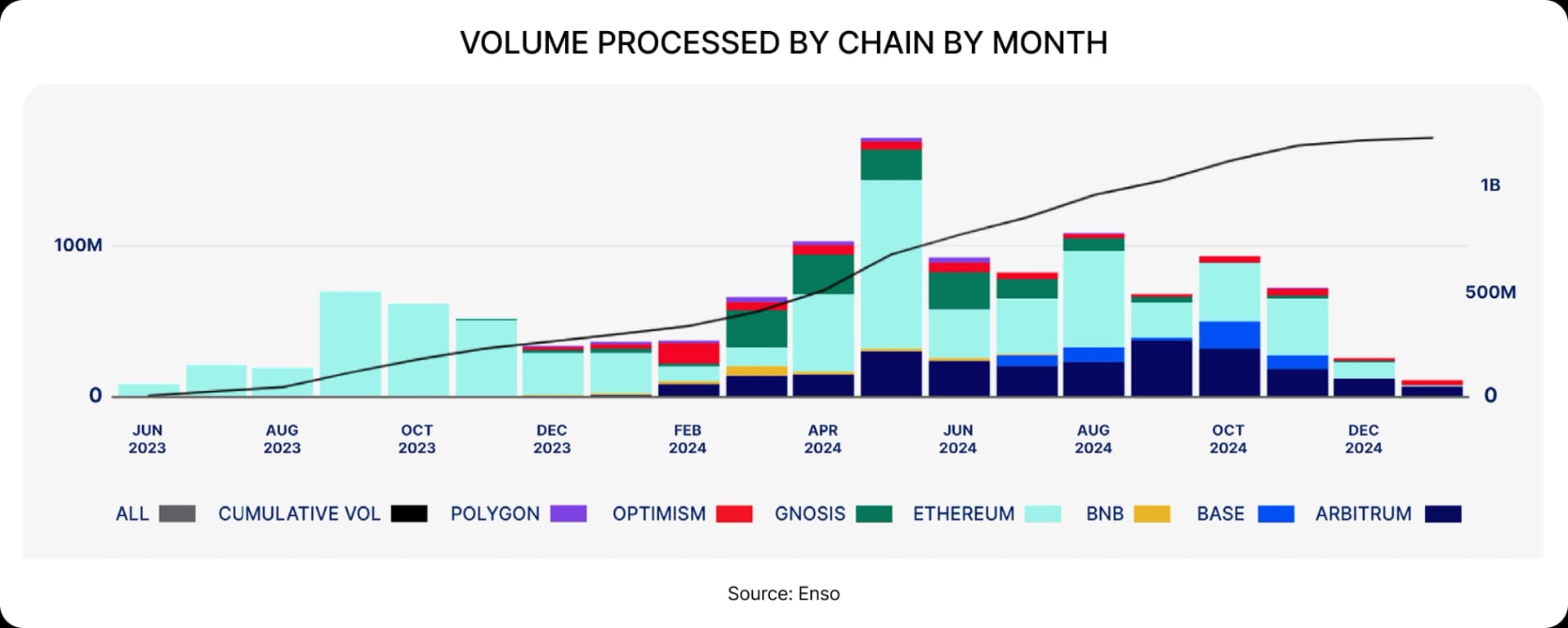
Enso’s API middle layer has demonstrated that it can meet fluctuating transactional peaks and scale consistently; direct volume settled by week has grown consistently since the API launched. By allowing developers to focus on end users’ needs rather than considering the feasibility of their desired functionality, Enso supports and encourages innovation. Developers can focus product strategies on the evolving needs of their users or opportunities that maximise their total addressable market rather than what they’re individually technically capable of delivering. Increased interoperability also makes it easier to leverage the cost efficiencies of rollups while maintaining compatibility with established ecosystems.

Enso’s API middle layer has demonstrated that it can meet fluctuating transactional peaks and scale consistently; direct volume settled by week has grown consistently since the API launched.
By allowing developers to focus on end users’ needs rather than considering the feasibility of their desired functionality, Enso supports and encourages innovation. Developers can focus product strategies on the evolving needs of their users or opportunities that maximise their total addressable market rather than what they’re individually technically capable of delivering. Increased interoperability also makes it easier to leverage the cost efficiencies of rollups while maintaining compatibility with established ecosystems.
These advantages have been embraced by the DeFi community at large, and the Enso network settles an increasing number of intents every week. Since Enso established itself as an API middle layer, it has validated and settled 1,037,283 direct intents. The value of intents validated and settled now sits at more than $11.4bn. The continued growth in intent volume and settlement signals the network’s effectiveness and developers’ reception of its intent-based solutions.
Use cases
Enso’s flexible, composable infrastructure can facilitate the adoption of a host of real-world applications. Its intent engine can create bespoke workflows that enhance functionality, while shortcuts deliver the flexibility to enable rapid prototyping and iteration, enabling product teams to respond quickly to market demands.
With over 60 projects now using Enso, there are many examples of its practical impact:
- Boyco integrates Enso to handle all DeFi execution for its Berachain launch, which has already reached an impressive $1.5b TVL.
- CoWSwap was a launch partner for Enso’s API debut and uses Enso as a solver for swaps and DeFi-based intents.
- LI.FI leverages Enso to obtain optimised calldata for swaps and defi actions within their aggregator.
- Velvet Capital integrated Enso’s intent engine to optimise portfolio management, routing trades through the most efficient channels while protecting against MEV (miner extractable value) front- running.
- SphereOne uses Enso to facilitate its autonomous agents, with the DeFi hub’s AI infrastructure executing various onchain tasks.
- BrianKnowsAI simplifies asset bridging and token swaps across L2s with Enso, which it uses to support intent recognition and execution.
Looking forward
Enso’s intent-based architecture abstracts away the complexities of blockchain technology, making development as easy as asking, “Can you just do this for me?” This allows developers to focus on what they want to build rather than how to technically execute. Instead of grappling with technical integrations, developers can create, iterate, and launch faster with fewer resources.
For those building and shipping Web3 applications, the benefits of Enso are obvious: simplified blockchain interactions, access to more functionality, and faster product development cycles. But the real potential of intent-based architecture lies in its ability to expand beyond the early adopters already driving billions of dollars in settled volume through Enso. By abstracting the technicalities of blockchain for developers and end users, Enso has the potential to increase Web3 access for both – opening up a host of new use cases in the process.
Bringing more users into DeFi
The recent explosion of generative artificial intelligence (AI) tools means users are becoming increasingly comfortable with chat interfaces. Asking a platform to perform a task is within the wheelhouse of even the most devoted technophobe, and we’re now far more likely to trust the output from these systems. Intent-based platforms can capitalise on this general acceptance of chat-based interfaces, bringing this familiarity to Web3 applications and enabling non-technical users to interact easily with blockchain solutions.
It also creates an opportunity for AI agents –– autonomous systems that deliver on predefined objectives. By integrating Enso’s intent-based architecture, developers can provide AI agents with the “tools” needed to perform specific actions, providing access to smart contract abstractions to facilitate complex, multi-chain workflows and deliver cross-chain functionality.
This capacity not only has the potential to increase DeFi’s total addressable market but also opens the door for AI-driven systems to further optimise user experience, empowering consumers to consider new financial tools and products, and giving them more choice and control over their finances.
Dynamic yield optimisations, for example. Identifying the best yield opportunities requires constantly monitoring changing rates, fees, and protocols. With Enso infrastructure, users can simply state, ‘Optimise yield,’ and its intent engine will handle the rest – automatically rebalancing portfolios, staking in high-yield protocols, and responding to market shifts.
Expanding beyond DeFi
But DeFi isn’t the only sector that stands to benefit from an intent engine. While DeFi might be one of the most advanced use cases for blockchain technology, the tech has far wider-reaching applications.
Intent-based architecture opens blockchain tools to developers in fields like retail and manufacturing who previously lacked the resources or expertise to tackle blockchain development. By enabling developers, who are specialists in their industries, to create tools that address sector-specific challenges, Enso has the potential to accelerate innovation. Extending the tools of blockchain to new audiences gives rise to solutions and use cases otherwise left unexplored. This creates a virtuous circle: as more people become familiar with blockchain technology, they use it more frequently and drive demand for new use cases, ultimately increasing adoption in both professional and personal settings.
Unlocking institutional access
Enso’s intent-based architecture offers similar advantages to traditional financial institutions as well. Blockchain’s fragmented ecosystems, the complexity of interactions, and a heightened requirement for security and compliance mean financial incumbents have generally steered clear of DeFi. Similar to industries like retail, intent-based systems remove barriers and address the lack of technical expertise. Enso allows these known institutions to build out proprietary solutions and potentially even introduce uniquely Web3 offerings (e.g., staking and liquidity management) to more mainstream audiences, enhancing trust in decentralised products and prompting more industries to consider them.
For crypto natives and those less enthused by institutional involvement, decentralised autonomous organisations (DAOs) also stand to benefit from Enso’s architecture. DAOs, which prioritise collective decision-making over centralised control, can use intent-based infrastructure to automate complex operations such as treasury management or liquidity distribution. With shortcuts, DAOs can streamline governance processes and operational requirements to act more efficiently.
The path to scalable blockchain adoption As the blockchain ecosystem expands, fragmentation will be an ongoing headache threatening both innovation and adoption. Enso’s intent-focused infrastructure is one of the most compelling solutions to collapse the silo effect. Acting as a connecting middle layer, Enso abstracts the complexities of blockchain development, removing barriers to innovation, speeding up development, and helping usher in a new wave of developers and users. With its ability to accelerate innovation and drive mass adoption, Enso is poised to unlock Web3’s promise of an open, accessible, and equitable future.
Download the full report here
Download the "Enso: Taking DeFi from fragmented to functional" report here (PDF)