



Mainstream adoption of blockchain technology hinges on two components—interoperability and user experience (UX). For blockchain to reach users beyond digital natives earnestly discussing use cases, regardless of whether they exist yet, it needs one connected ecosystem and a decidedly web2 front end.
Currently, web3 users have to navigate a fragmented landscape of siloed chains. Juggling multiple wallets and seed phrases and managing assets scattered across incompatible networks is a headache for tech-savvy enthusiasts. For everyone else, it’s completely off-putting.
Bridging the gap between Web2 and Web3
Abstraction offers a solution. The long-established principle simplifies complex operations and effectively hides–abstracts–them from the user. In a web2 world, it allows us to send emails, make calls, transfer money, trade, and shop without a technical understanding of the steps underpinning each request. Replicating this in a web3 environment masks the complexities from users and creates interfaces that are just as friendly as your favourite web2 website. Abstraction will increase blockchain accessibility and enable mainstream adoption.
Omnichain infrastructure takes this one step further, allowing dApps, decentralised apps, to operate across multiple blockchains and support the transfer of data and assets. Creating a collaborative ecosystem easier for developers to work with prioritises interoperability, user experience, and broader adoption.
Interoperability is a critical milestone in blockchain evolution. Omnichain infrastructure empowers individuals to interact with multiple networks from a single platform. It also provides one unified identity across all web3 platforms, enhancing data portability, streamlining authentication, and ensuring consistent security protocols.
A blueprint for omnichain infrastructure
Kontos is the first example of user-focused omnichain infrastructure. As such, it offers a well-rounded example of how the architecture can support mainstream adoption.
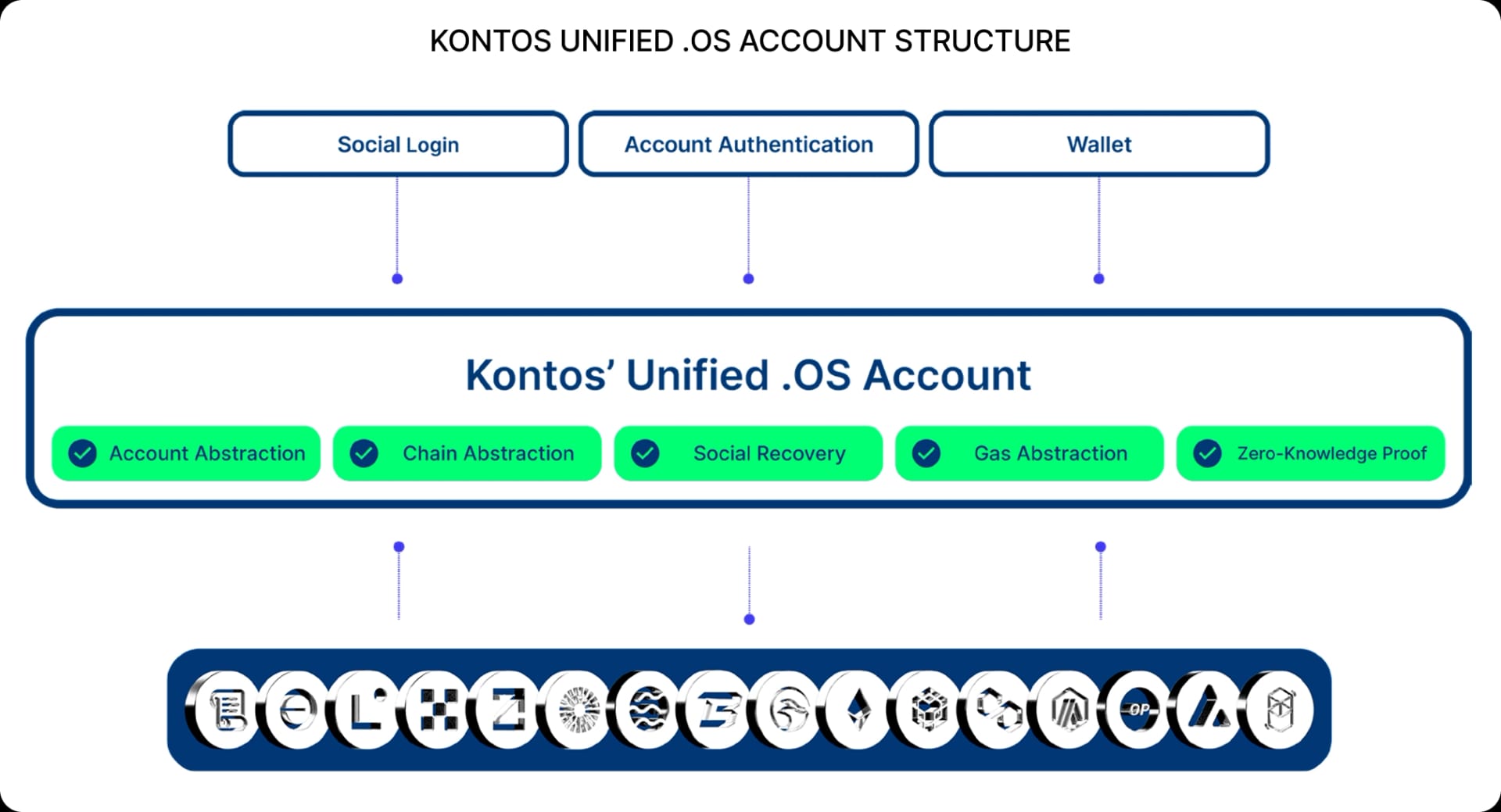
Powered by Zecrey Labs, which focuses on making blockchain accessible and user-friendly, Kontos places users at the forefront of the technology. It prioritises UX over technical architecture and removes the intricacies and jargon that prevent many people from engaging with blockchain technology. Its design combines chain, account, and gas abstractions with a built-in bridge layer– leading to a web2 feel with web3 benefits.
Chain abstraction
Chain abstraction abstracts the technicalities of navigating cross-chain transactions, creating a framework that allows users to engage with multiple networks from a single interface. It does this by simplifying the interaction between different blockchain networks, thus creating a smoother user experience across the chain. By removing the need to swap between networks and manage lots of wallets or accounts, it provides access to functionalities like smart contract execution, asset transfers, and data sharing across multiple chains. Ultimately, chain abstraction reduces the complexity of blockchain and increases its accessibility.
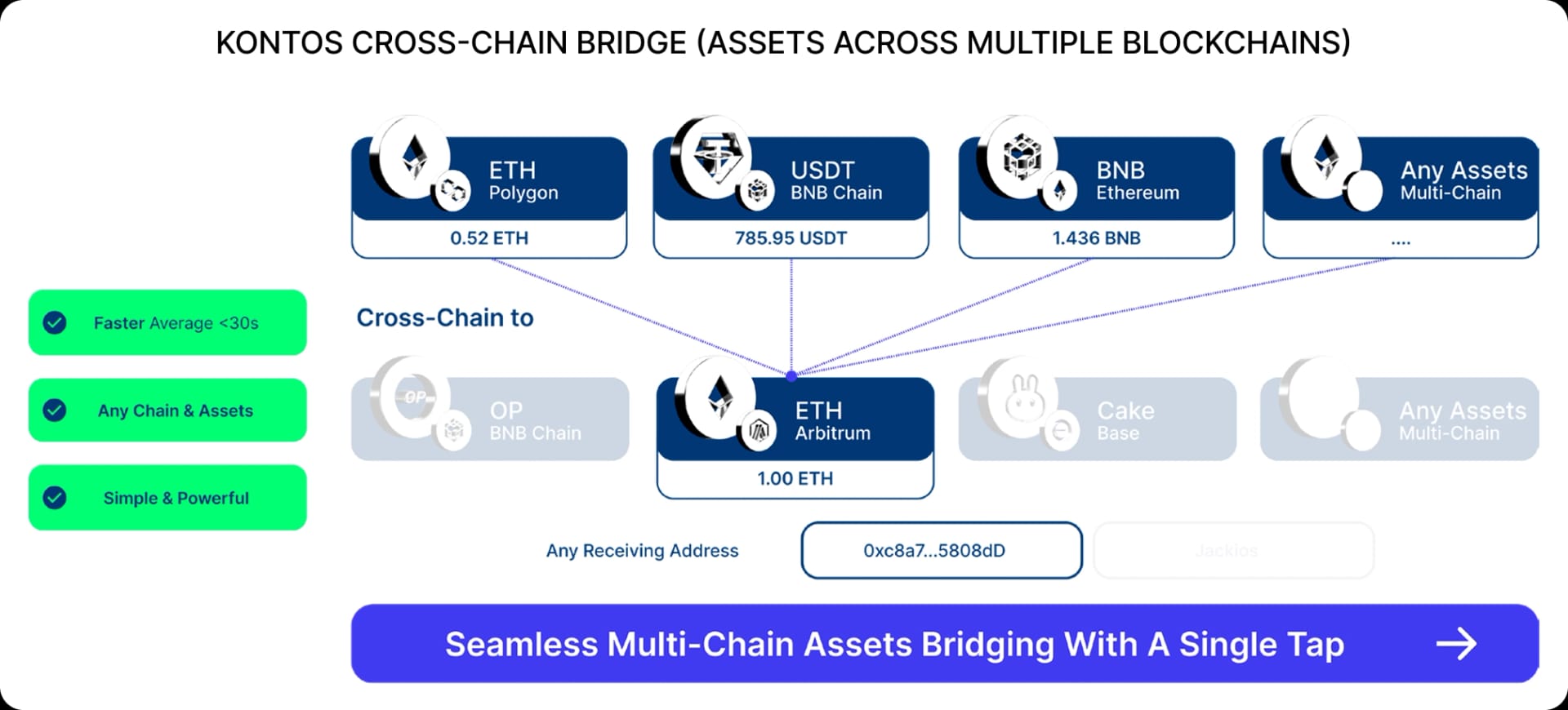
Simplifying interactions across multiple networks removes barriers to entry, reduces the chance of user error, and means individuals don’t need to learn the technicalities of each chain. In the example of Kontos, where trading is the primary use case, chain abstraction means users can focus on executing trades rather than navigating the technicalities of chain interoperability.
Those technicalities, though hidden from users, power an immense network. Kontos uses a sophisticated recursive zero-knowledge proof (zk-proofs) system to handle complex verification tasks and achieve chain abstraction. This system aggregates proofs through three layers to produce a final proof that collectively verifies off-chain and cross-chain operations. A light client sources proofs from external chains by returning block headers and states, which are then validated for accuracy and integrity on Kontos. This ensures the status of external chains is accurately reflected within its environment.
AI x Intent x Omnichain
This approach to chain abstraction reduces the complexities of managing multiple chains, and Kontos leverages artificial intelligence (AI) to streamline the user experience further. A ‘co-pilot’ type feature is available via its Telegram and Discord bots and its wallet interface, allowing users to complete complex tasks onchain with text prompts.
Kontos’ AI Module significantly impacts Omnichain Trading, delivering AI-Powered market insights alongside Intent-decoding by natural language interaction.
The Kontos AI Module enhances the platform in two key areas:
1. AI-Powered Crypto Insights: AI-Powered Crypto Insights: Kontos AI agent provides users with real-time, intelligent insights into the crypto space. Users can simply ask questions like ‘What should we buy today?’ or “Show me the top 10 Meme coins,” and receive comprehensive, AI-generated reports that include:
- Trading signals
- Trending token analysis
- Market insights and predictions
- Personalised recommendations based on user preferences and market conditions
2. Seamless AI-Guided Trading or Intent-decoding: Once users identify interesting investment opportunities, the Kontos AI Module streamlines the trading process. For example, if a user decides ‘I want to buy $100 of $PEPE on Ethereum,’ the AI will automatically populate the trading interface with the relevant parameters. Users can then execute the trade with a simple confirmation click, making the entire process quick and effortless.
By integrating AI-driven insights into a seamless omnichain trading platform, Kontos is setting a new standard for user-friendly, intelligent crypto trading.
Kontos is continuously upgrading its AI Module to ensure it remains one of the most powerful and user-friendly AI assistants in the crypto space.
Strategies for chain abstraction
Kontos is not the only protocol tackling blockchain’s interoperability challenges. Particle, NEAR, and Okto are just three others seeking to enhance cross-chain interactions with chain abstraction.
Particle is a modular Layer1 solution. Its Universal Accounts consolidate user addresses, balances, and interactions across all chains into a single interface. It leverages atomic cross-chain swaps, meaning interactions across all chains happen as one or not at all.
NEAR faces a similar problem if its focus on simplified onboarding and account aggregation can’t keep up with the complexities of multi-chain interactions. Okto’s asynchronous approach has the potential to introduce dependencies that negatively impact performance and scalability.
Okto is an intermediary designed for developers and end-users. Its Orchestration Layer delivers for both by simplifying liquidity, tech standards, and UX—which it sees as the three leading causes of fragmentation. Okto leverages decentralised transaction networks to manage cross-chain transactions asynchronously.
Kontos’ use of recursive zk-proofs sets it apart from the rest of this ecosystem. It’s an efficient approach to processing that maximises decentralisation and security. By comparison, Particle relies on a single Layer 1 solution that could limit its ability to scale. NEAR faces a similar problem if its focus on simplified onboarding and account aggregation can’t keep up with the complexities of multi-chain interactions. While Okto’s asynchronous approach has the potential to introduce dependencies that negatively impact performance and scalability.
Omnichain account abstraction
While distinct from chain abstraction, Omnichain account abstraction goes hand-in-hand with chain abstraction to improve the user experience. Account abstraction creates a single account to manage all cross-chain interactions, eliminating the need to remember multiple private keys or mnemonic phrases and store assets on different chains.
The Ethereum Virtual Machine’s (EVM) rigid rules govern how transactions are created, signed, and validated. This historically made account abstraction tricky for the protocol since it required changes to how accounts are executed. In March 2023, a workaround was proposed: Ethereum standard ERC- 4337. It moves transaction validation to a higher layer, allowing for the creation of smart contract wallets that merge the functionality of Externally Owned Accounts (EOAs) with smart contracts. While the standard doesn’t directly enable cross-chain interaction, it does provide a guide for EVM- compatible chains such as Solana, Polygon, and Avalanche to adopt similar abstraction mechanisms.
Kontos has based its dual-layer account model on a refinement of ERC-4337. Users create an account with a simple, memorable name like a handle rather than a thirty-character alphanumeric account number that then serves as a central control point for any associated smart contract accounts on underlying public chains.
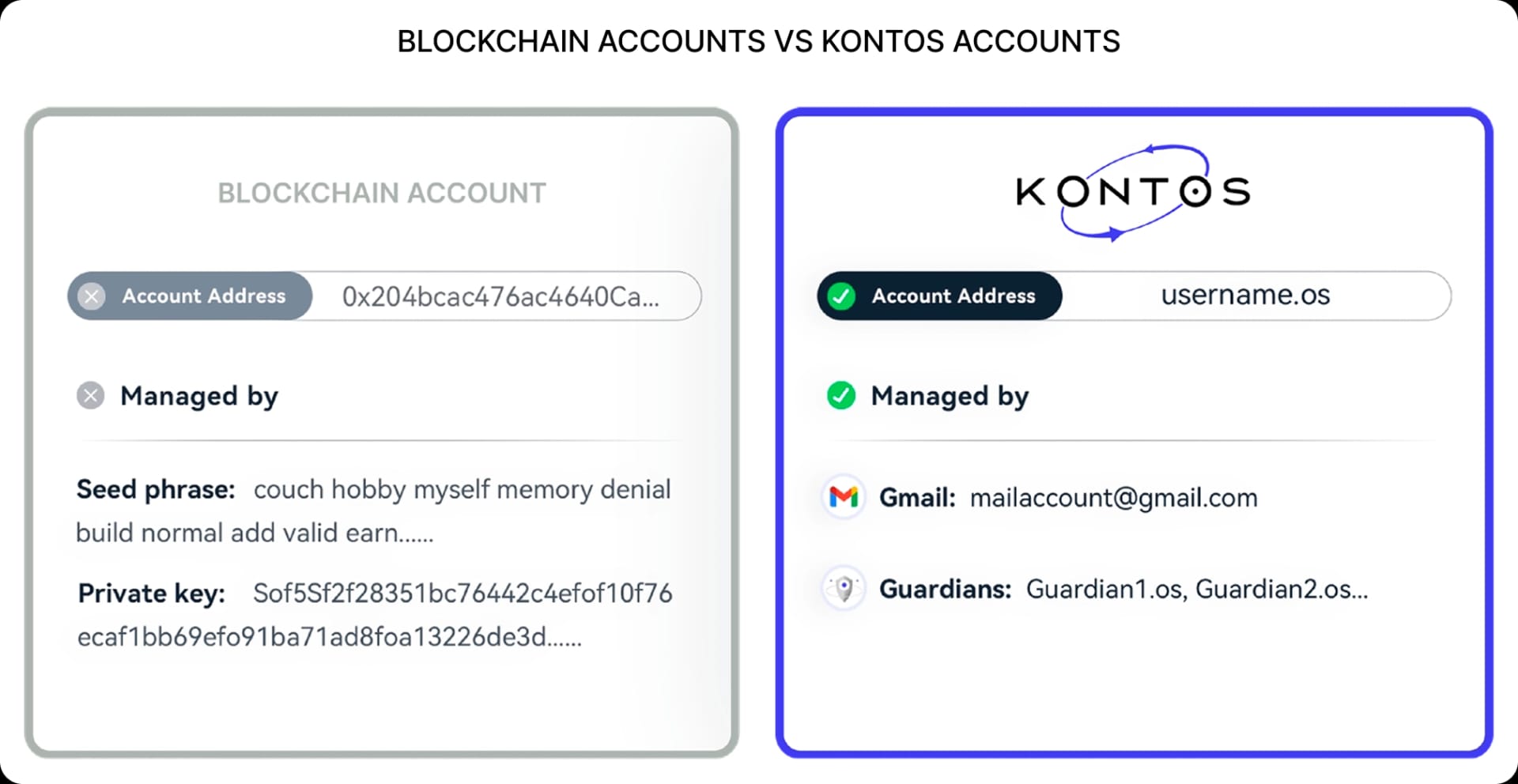
A suite of social recovery features integrated with Kontos accounts allows for forgotten login details to be easily recovered without compromising security. Users connect their Kontos account to Gmail or nominate Guardians—other Kontos accounts owned by themselves or friends and family. In the case of an account recovery request, at least two Guardians have to consent before an account can be successfully restored.
Kontos contract accounts include additional features that enhance the user experience, such as arbitrary verification logic that supports single and multi-sig verification. Capabilities like social recovery and time locks enhance security, while atomic multi-operations allow users to approve transactions and swap tokens in just one step.
Gas abstraction
Onchain operations incur a gas fee that is paid via network tokens to validators to execute a transaction or contract. The fee fluctuates depending on transaction complexity and network congestion (costs can become prohibitive for smaller transactions when network congestion is high).
The management of gas fees can generate additional costs for users over and above the fees themselves. Those transacting on multiple chains will either need to swap and convert tokens to pay gas fees, which can incur transactional charges, or hold balances for gas in native tokens, which increases their exposure to often volatile markets. Additionally, there is a time burden associated with gas fees adjusted for network congestion, possibly requiring users to monitor and manually calculate them. This is complicated, requires chain-specific knowledge, and is time-consuming for those it doesn’t deter completely.
Gas abstraction critically overcomes these barriers, simplifies gas fee management, and makes blockchain easier for non-technical users to navigate. Gas abstraction is not new. It was also introduced by ERC-4337 via Paymasters, smart contracts that sponsor gas fees and allow users to pay for gas in one token (ERC-20) across different chains.
Despite the precedent, Kontos’ Broker takes gas abstraction one step further. It’s an intermediary that pre-pays transaction fees and assets, reclaiming them once a trade has been executed. This simplifies the process for users and automates gas fee management.
Kontos effectively acts as a universal gas hub, allowing individuals to purchase assets on Ethereum without holding Ether. Providing they have a sufficient balance in their Kontos account, Broker will intervene, liaising with their associated smart contracts accounts on underlying blockchains to manage the transaction behind the scenes. Effectively, Broker facilitates the purchase without requiring the user to bridge for gas. This can dramatically increase cost efficiency, which is particularly important in a trading environment where gas fees and micropayments can eat into returns.
Built-in bridge layer
While abstraction hides the complexities of blockchain a built-in bridge layer provides the infrastructure to deliver direct interoperability. Unlike abstraction, which automates the process of cross-chain communication and transaction, a built-in bridge operates as a mediator, creating a network of connected chains by enabling the transfer of assets, data, and information from one chain to another.
As such, built-in bridge layers operate at a lower level than abstraction systems and facilitate a broad range of direct communications and transactions in real-time. Two-way asset bridges facilitate the flow of capital through asset transfer, while messaging bridges support data transfer. Bridging offers several advantages, such as delivering interoperability, increasing liquidity, and providing users with access to a broader range of services from one central account. However, traditional bridging methods can introduce unnecessary complexities that overly complicate UX. They are also typically the weakest point in a network and can be vulnerable to attacks.
Strategies for built-in bridge
The built-in bridge ecosystem is expansive. LayerZero and Wormhole’s Portal are among the heavy hitters in the space. However, innovations like Avalanche Bridge are fast on their heels.
Built for Wormhole, Portal is distinct from the protocol itself. The token bridge allows users to transfer tokens and NFTs cross-chain by locking original tokens in a smart contract and issuing a Portal- wrapped token for the target chain that can then be exchanged for native tokens. This bypasses KYC requirements and supports smart contract composability, making it easier for developers to build dApps on top of the bridge.
LayerZero acts as a foundational layer to connect multiple blockchains. It includes onchainsmart contracts with Communicator, Validator, Network, and Library modules– ‘endpoints’. These support the integration of new chains and enhance scalability. Third-party entities, Oracle and Relayer, ensure the validity and security of transactions by providing block headers and transaction proofs, respectively.
Avalanche Bridge facilitates asset transfer between Avalanche and Ethereum. Wardens Avascan, BwareLabs, Halborn, and Ava Labs monitor and verify cross-chain transactions. Avalanche Bridge is aimed at mass adoption, with a cost-effective, simplified transaction process and an easily navigable interface.
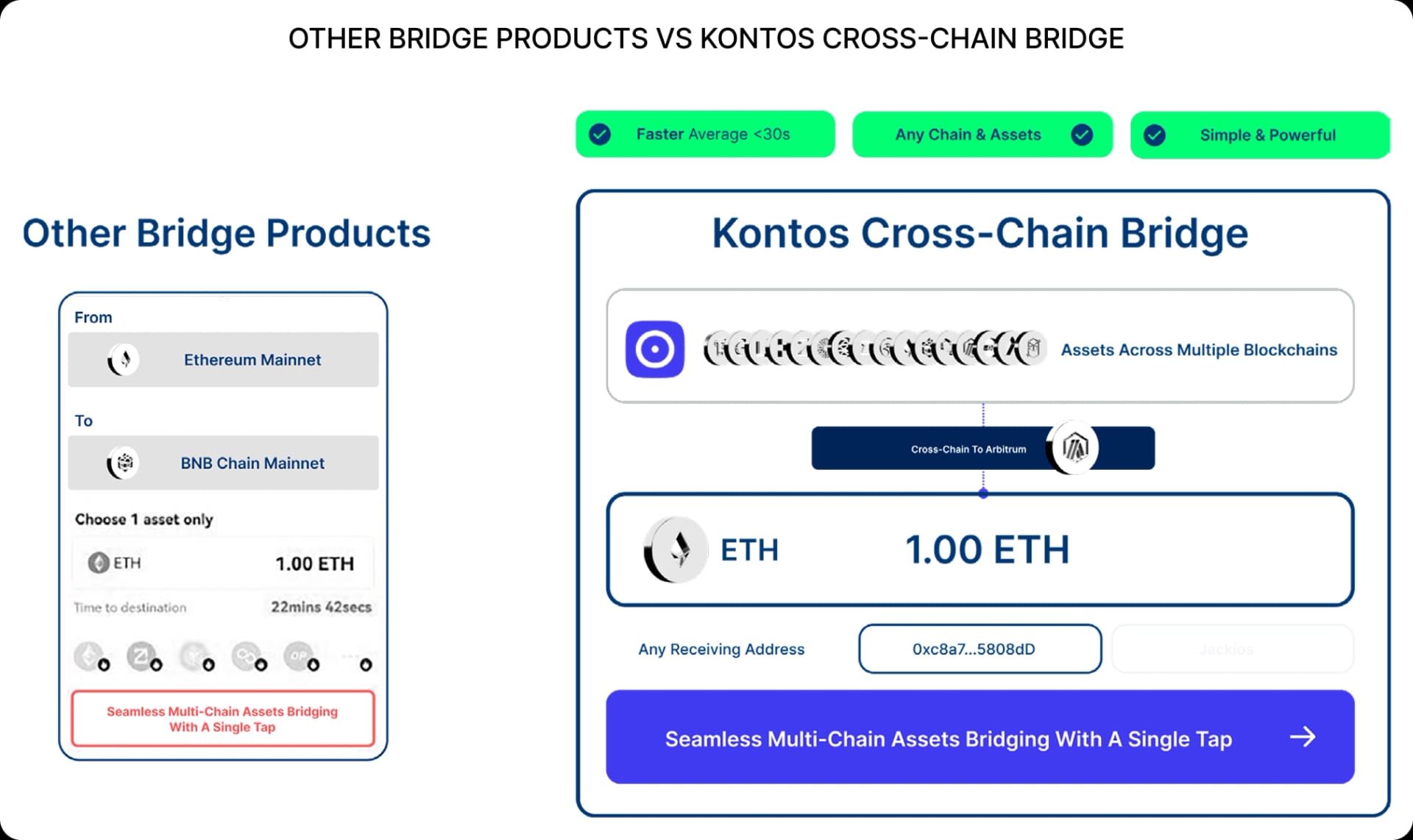
The Kontos Bridge Abstraction Layer (BAL) isn’t intended to simply move one asset between two chains. Designed specifically for the Kontos ecosystem, BAL can move assets from multiple supported chains in a single transaction, allowing users to place trades in any combination of supported assets. It employs zk-proofs to ensure security and privacy, protecting transactions from unauthorised access. The integration of light clients optimises both speed and efficiency, delivering faster transactions. The architecture reduces the dependence on centralised entities, such as Avalanche Bridge’s wardens. It also limits single points of failure and avoids overreliance on verifiers. integration with existing multi-chain infrastructure means BAL can scale reliably, adapting to support the blockchain ecosystem as it matures.
Omnichain infrastructure in the real world
Real world success is the only success. Omnichain infrastructure is merely a facilitator and successful if it results in real-world applications that make blockchain genuinely accessible to everyone. With over 1.91M million accounts created, Kontos provides a solid example of a complete multichain infrastructure. To date, it has facilitated more than 7.26 million tasks and supports multiple use cases.
Trading platform
Trading is the most developed real-world use case on Kontos. The platform includes features to analyse market trends, access token information, identify trending tokens, and support omnichain trading.
Account and gas abstraction are key components of the trading platform. They ensure users don’t need to understand the complexities of multiple chains or hold a range of native tokens to cover gas fees. For example, a user can trade USDT held on Ethereum for assets on Binance Smart Chain. Broker will receive the cross-chain request, pre-pay any gas fees, and then use balances held in other tokens to reclaim fees once the trade has been executed. This flexibility allows users to utilize a combination of assets from various chains to facilitate transactions on the target chain, making the trading process more efficient and accessible across multiple blockchain networks.
Multichain dApp interaction
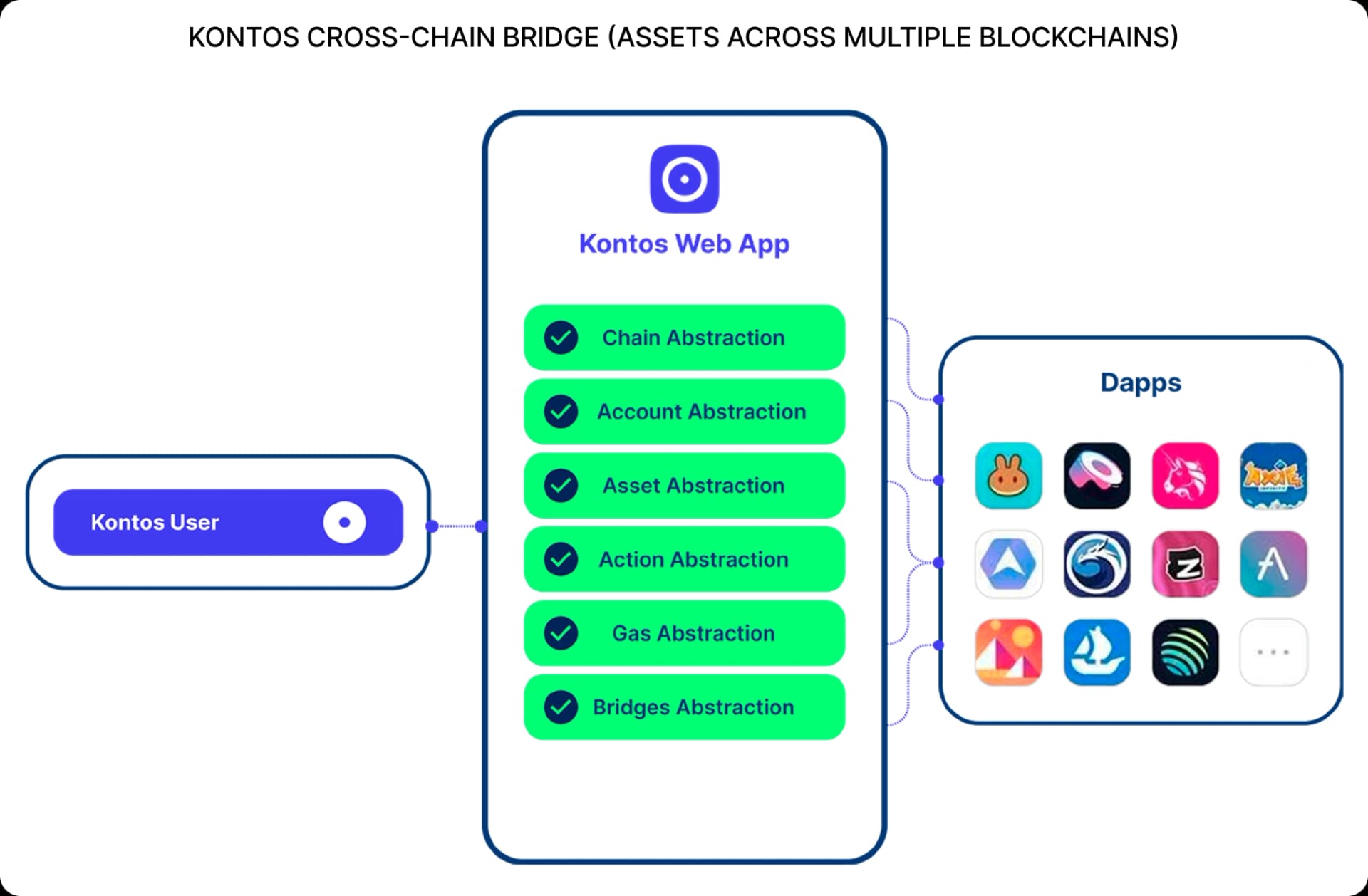
Kontos’ account and gas abstraction also allows users to interact with dApps across blockchains without juggling multiple wallets or holding various native tokens for gas fees. Individuals can use their single Kontos account to access a DeFi application on a supported chain and Broker will automate the payment of gas fees, using assets held on any chain to cover the cost. This flexibility allows users to utilize a combination of assets from various chains to facilitate transactions on the target chain, making the trading process more efficient and accessible across multiple blockchain networks.
Beyond abstraction and bridging
Kontos has demonstrated the effectiveness of combining core abstractions with its bridge abstraction layer. The end result has been to enhance interoperability and make blockchain transactions easier for users to execute.
Its roadmap is focused on improving user experience. Support for non-EVM chains is slated for Q3 of this year, and the protocol also plans to further integrate AI into its chain abstraction, a development aimed squarely at increasing usability for blockchain novices.
Conclusion
Omnichain infrastructure that combines abstraction and bridging presents an opportunity to take blockchain mainstream. It can connect an ecosystem of disparate chains. By hiding the complexities of navigating them, web3 applications will become easy to use and widely accessible.
Kontos’s focus on optimising UX and innovative use of technologies like zk-proofs and light clients presents a blueprint for omnichain infrastructure and the eventual mass adoption of blockchain.
It already successfully supports multiple use cases and nearly 2 million accounts. The recent introduction of AI capabilities is only the latest example of Kontos leading the evolution of the multichain landscape.