



Executive Summary
Why Liquidity Matters
Liquidity is the lifeblood of decentralised finance. Without reliable market depth, tokens cannot function as mediums of exchange, collateral, or governance assets. Shallow liquidity leads to volatility, weak adoption, and the risk of sudden breakdowns in user confidence. For protocols and DAOs, ensuring liquidity is therefore not just a technical challenge but a strategic priority: it determines whether a token remains viable within the broader DeFi ecosystem.
The options available to treasuries are limited but consequential. On one side, Protocol-Owned Liquidity (POL) guarantees depth by committing treasury assets directly into pools. On the other, incentive programmes attract external providers by subsidising yields. Both approaches are widely used, but each comes with trade-offs. POL ties up treasury resources and exposes them to impermanent loss or opportunity costs. Incentives mobilise external capital quickly, but at the price of permanent outflows and the risk of attracting mercenary actors who withdraw as soon as yields decline. Increasingly, some protocols have turned to blended approaches, combining POL with incentives to seed markets and then crowd in external participation.
This report examines four case studies that illustrate these dynamics in practice: EURe’s activity on Gnosis via the Aave V3 market, GHO’s deployment on Aave V3’s Arbitrum market, the bCSPX incentive programme on Gnosis, and the joint SAFE liquidity provision by SafeDAO and GnosisDAO. Together, they provide a window into how different strategies succeed or fail, and under what conditions liquidity support can transition from temporary subsidy to sustainable adoption.
Case Studies
EURe on Gnosis
Among the four case studies, EURe represents the clearest example of liquidity support evolving from subsidy to sustainability. The programme unfolded over more than a year, beginning with Protocol-Owned Liquidity that seeded an Aave pool and secured stable conditions for borrowing and trading. This foundation ensured that Gnosis Pay, an accompanying payment rail integrating EURe for debit transactions, could expand without the risk of sudden volatility or liquidity gaps undermining adoption.
Once stable liquidity was in place, incentives were layered on top. Cashback linked to card payments created a direct channel to retail usage, while liquidity mining rewards drew in external providers to deepen the pool. Because POL was already stabilising the market, these incentives could focus on driving traffic and growth rather than plugging structural gaps.
The decisive factor was utility. Gnosis Pay transforms EURe from a pool-based token into a settlement medium for everyday payments. As transaction volumes expanded, external capital increasingly supported the pool, enabling POL to be withdrawn gradually without destabilising the market. The steady presence of POL throughout this process proved essential, providing continuity while adoption took place.
In a nutshell, the EURe programme succeeded because three elements were present simultaneously: POL provided stability, incentives accelerated adoption, and utility converted activity into retention. Crucially, the duration of the programme gave this cycle time to mature, turning what began as a subsidy into a self-sustaining market.
GHO on Arbitrum
The case of GHO, pegged stablecoin on Arbitrum shows the risks of incentives without considering utility. Substantial rewards were deployed to attract borrowing, and headline metrics initially suggested success as liquidity deepened quickly. Yet much of this activity was driven by looping strategies, where users borrowed GHO only to recycle it back into farm rewards. This behaviour concentrated liquidity in a handful of wallets and inflated growth figures without building genuine adoption.
Governance interventions were largely reactive. Caps on supply and borrowing parameters were adjusted only once utilisation ceilings had already been hit. Without meaningful integration into payments, derivatives, or structured products, GHO lacked the utility that might have converted subsidised liquidity into real usage. When incentives began to decline and attention shifted elsewhere, capital exited, exposing the fragility of the model.
The GHO Case study demonstrates that incentives alone, even at scale, cannot guarantee sustainability. Without utility to anchor demand, liquidity may appear strong but can vanish as quickly as it arrived.

bCSPX on Gnosis
The case of bCSPX on Gnosis highlights both the potential of incentives and the limits of adoption without deeper utility. Substantial rewards bootstrapped liquidity, with TVL climbing to nearly $6 million and positioning bCSPX among the leading assets on the chain. At first glance this suggested success, yet most of the depth came from a few large LPs. When two of these participants withdrew, TVL collapsed from millions to under $1 million even before incentives fully ended.

Additionally, Backed Finance’s strategic shift toward the xStocks Alliance introduced further uncertainty, leading stakeholders and Gnosis to reconsider bCSPX’s role and the possibility of migrating it.
The bCSPX case shows that incentives can attract liquidity and generate early momentum, but without meaningful integration into a broader ecosystem, retention remains limited.
SAFE Liquidity Provisioning
SAFE offers a different angle by illustrating the costs and limits of relying solely on POL. Through the joint treasury, POL was deployed to secure depth and maintain continuous trading access. This guaranteed liquidity without the need for incentives, creating stability and functioning as a form of infrastructure.
However, the approach came at a price. As SAFE depreciated heavily against ETH, POL positions suffered significant impermanent loss. While alternative pool compositions or calibration strategies could have reduced exposure, the structural cost of liquidity provision fell directly on the treasury. Moreover, because the token still lacks utility from integrations beyond SafeDAO’s own governance, liquidity provision has not yet translated into sustained external demand.
The SAFE case study underlines that POL, when deployed in isolation, functions primarily as an operational cost. It guarantees liquidity, but without utility or incentives, it cannot be replaced.
Cross-Case Lessons
Taken together, the four case studies underline that liquidity provision is not just a mechanical act of adding capital, but a strategic decision that must be guided by vision, anchored in utility, and supported by effective governance.
Strategy and Vision
Liquidity must be deployed with purpose. Narrow, pool-level interventions may create short-term depth, but without a broader adoption strategy they struggle to generate lasting impact. EURe succeeded because its liquidity provisioning was embedded within a vision of supporting payments via Gnosis Pay. By contrast, GHO illustrated the limits of treating liquidity as an isolated metric: in both cases, incentives inflated participation but failed to translate into durable adoption and solid liquidity infrastructure.
Utility is Key
Liquidity becomes meaningful only when users have a reason to hold and use the token. EURe’s integration into everyday transactions gave the token a role beyond its pool, ensuring that liquidity served genuine demand. GHO lacked equivalent avenues, leaving it vulnerable to farming loops, while bCSPX suffered from the absence of a RWA ecosystem that could make the token more than just exposure to stocks. SAFE, as a governance token, highlighted the difficulty of generating external demand without functions that extend beyond governance rights.
Ecosystem Context
Liquidity strategies succeed when they are aligned with the surrounding ecosystem. EURe benefited from integration with Gnosis Pay and lending markets, which reinforced adoption. bCSPX lacked this support despite clear attempts to stimulate DeFi activity through Aave and PWN. In the case of SAFE, limited use cases and the DAO’s own approach to token utility constrained growth. Together, these cases underline that collaboration across actors and stakeholders is a critical element of sustainable liquidity.
Rather than simply bootstrapping a pool and waiting for other protocols to participate, coordinated action offers a stronger path. Joint initiatives create the conditions for liquidity to embed itself in broader usage, while isolated efforts are far less likely to prove resilient.
Design and Calibration
The structure of liquidity initiatives matters as much as the resources committed. In the case of EURe, farming strategies were limited because rewards were tied to real-world payments and capped. The treasury complemented this with a proactive POL approach designed to anticipate behaviours. GHO took a different path: looping strategies were possible, rewards accrued without caps, and governance intervened only after problems had surfaced. For bCSPX, the main risk lay in concentration, with a handful of large LPs effectively determining the pool’s fate. SAFE illustrated another dimension, where the calibration of pool composition and parameters directly shaped treasury outcomes.
The lesson is clear: design and calibration cannot be treated as afterthoughts. They determine whether liquidity initiatives foster adoption or leave systems fragile once incentives are withdrawn.
Active Management and Timing
Effective liquidity provision depends as much on governance and timing as on the resources committed. EURe on Gnosis demonstrated how proactive, rules-based adjustments (like adding or withdrawing POL in line with utilisation) can stabilise markets and build trust. GHO on Arbitrum, by contrast, highlighted the risks of reactive governance, where parameters were adjusted only after imbalances had emerged, leaving the pool vulnerable to mercenary capital.
The lesson is that liquidity strategies need a clear framework from the start. Whether through triggers, proactive adjustments, concentration limits, or other mechanisms, the aim is to align incentives or liquidity provisioning with resilience. Without such structures, treasuries risk wasting resources and ceding control to short-term actors.
Cost Trade-offs: POL vs Incentives
Liquidity provisioning and incentives always carry a cost, but the form differs across models. POL alone secures infrastructure, as SAFE showed, but exposes treasuries to impermanent loss and opportunity costs. Incentives alone mobilise external capital, yet GHO and bCSPX revealed their fragility: activity driven by loops or a handful of LPs vanished once rewards end. POL combined with incentives, as in EURe, created a more durable outcome: POL stabilised the pool, incentives drove growth, and utility converted adoption into retention.
There is no single superior model. What matters is how liquidity is understood: either as a cost borne by the protocol, or as an external activity driven by users. Factors such as overall strategy, ecosystem integration, and token utility determine which approach fits best.
Measurement and KPIs
In all case studies, standard KPIs such as TVL and number of holders showed growth. However, closer analysis revealed a more complex reality, with issues like wallet concentration, looping strategies, weak usage, or limited volume.
This points to an important lesson: classic metrics alone cannot capture the full picture. A broader KPI framework is needed to reflect the true state of liquidity and to guide the incentive and POL strategies with efficiency.
A Mix as a Model?
There is no single correct model for liquidity provision strategies. Each approach produces different costs and outcomes, and the right choice depends on how a protocol defines the role of liquidity and the purpose of the tokens involved. POL secures infrastructure but exposes treasuries, incentives can ignite growth but often attract mercenary capital. Combinations can succeed, but only when tied to real utility and sustained over time.
The central lesson is that liquidity must be deployed with a clear purpose and embedded in a broader strategy. Adoption requires more than TVL: it demands integration into ecosystems, calibrated growth designs, proactive decision-making processes, and above all, utility and features that give users a reason to stay.
The EURe case study provides the clearest benchmark to date. By combining POL, incentives, and genuine utility over an extended horizon, it turned temporary support into durable market adoption. It shows that liquidity strategies can evolve from subsidy to sustainability. Future initiatives would do well to measure themselves against this baseline.
Introduction
Liquidity is the foundation of any functional market in decentralised finance. Without sufficient depth, tokens cannot serve as mediums of exchange, collateral, or governance assets. Thin liquidity leads to volatility, weak user confidence, and barriers to adoption. For treasuries and DAOs, bootstrapping liquidity is one of the most critical and costly challenges they have to face to ensure growth.
Protocols typically turn to two main tools: Protocol-Owned Liquidity (POL), where the treasury commits assets directly into pools, and incentives, where external providers are rewarded for supplying capital. Both approaches can secure liquidity, but each comes with trade-offs such as impermanent loss, opportunity cost or mercenary capital.
This report analyses four case studies that illustrate different approaches: EURe’s activity on Gnosis via the Aave V3 market, GHO’s deployment on Aave V3’s Arbitrum market, the bCSPX incentive programme on Gnosis, and the joint SAFE liquidity provision by SafeDAO and GnosisDAO. Each adopted a distinct strategy, ranging from POL-heavy designs to incentive-driven programmes, and each produced different outcomes. Examining these cases in detail allows the report to identify the strengths and weaknesses of each model and extract the broader lessons they offer.
The objective is not to prescribe a single best solution, but to distil the key takeaways that can lead to best practices. Strategy, utility, ecosystem alignment, design, and cost management all emerge as decisive factors. Together, the findings provide a framework for treasuries and protocols seeking to move beyond temporary subsidies and toward liquidity strategies that can support durable, long-term adoption.
Stimulating EURe activity on Gnosis via the AAVE V3 market
Strategic Context
This case examines the deployment of Monerium’s EURe stablecoin on Aave V3’s Gnosis market. EURe is a central asset in the Gnosis ecosystem, not only as a DeFi instrument but also as the settlement layer for Gnosis Pay, which connects onchain balances to everyday debit card payments. Through this integration, users can spend EURe directly at merchants worldwide, giving the asset a real-world utility that most stablecoins still lack.
To sustain the growth of Gnosis Pay, deep liquidity and trade efficiency were crucial. Hence, kpk led a liquidity bootstrapping programme built on Protocol Owned Liquidity and targeted incentives. This design provided durable market depth while still attracting external participation.
The case is especially relevant because it shows how the combination of POL, incentives, and a live payment use case can move a euro stablecoin from fragile adoption toward a more sustainable growth path.
The section unfolds in three parts: first, a chronology of events and liquidity shifts, second, an in-depth analysis of utilisation, incentives, and the key role of Gnosis Pay, and third, key takeaways on how this mix of strategies shaped EURe’s trajectory on Gnosis.
Event Chronology
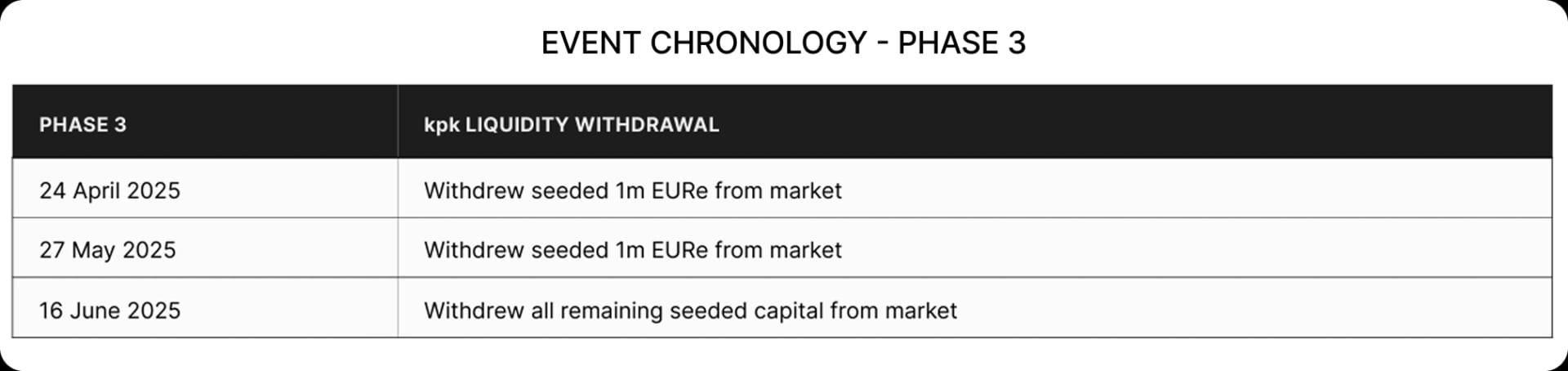
The development of EURe on Aave V3’s Gnosis market can be traced through a sequence of liquidity injections, incentive programmes, and targeted withdrawals that gradually reshaped the market’s dynamics.
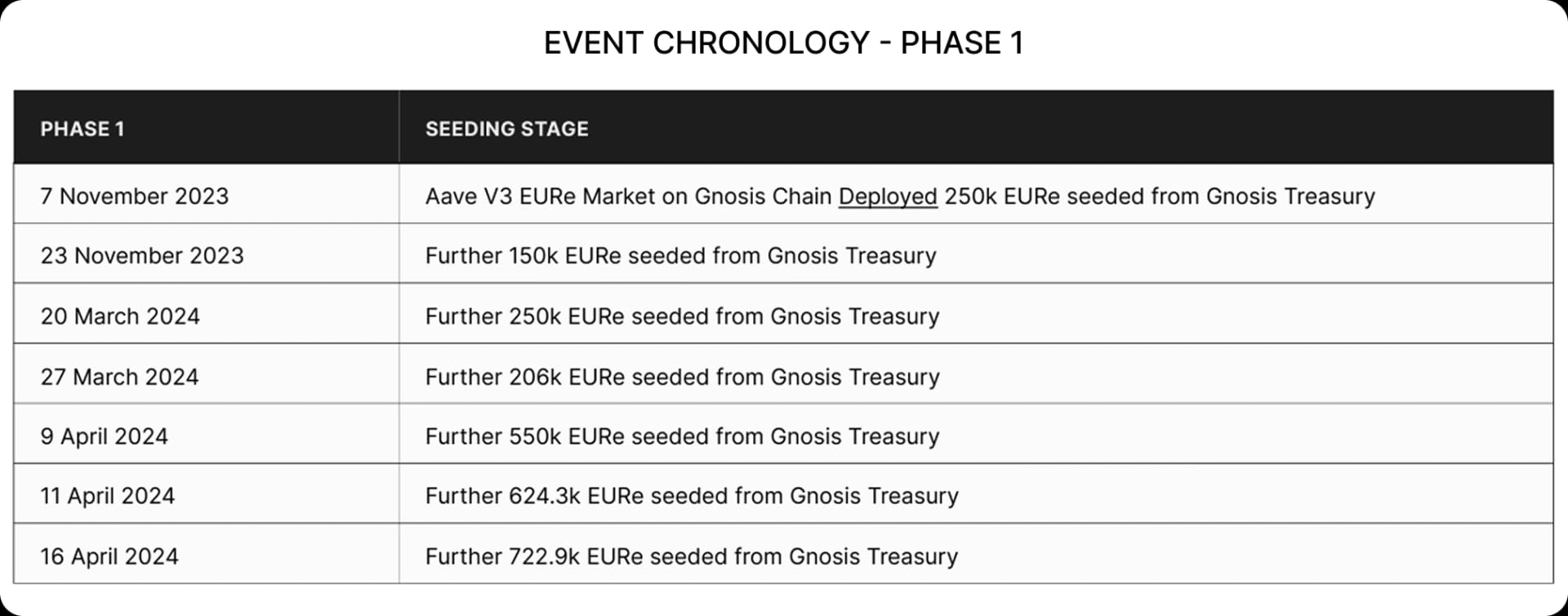
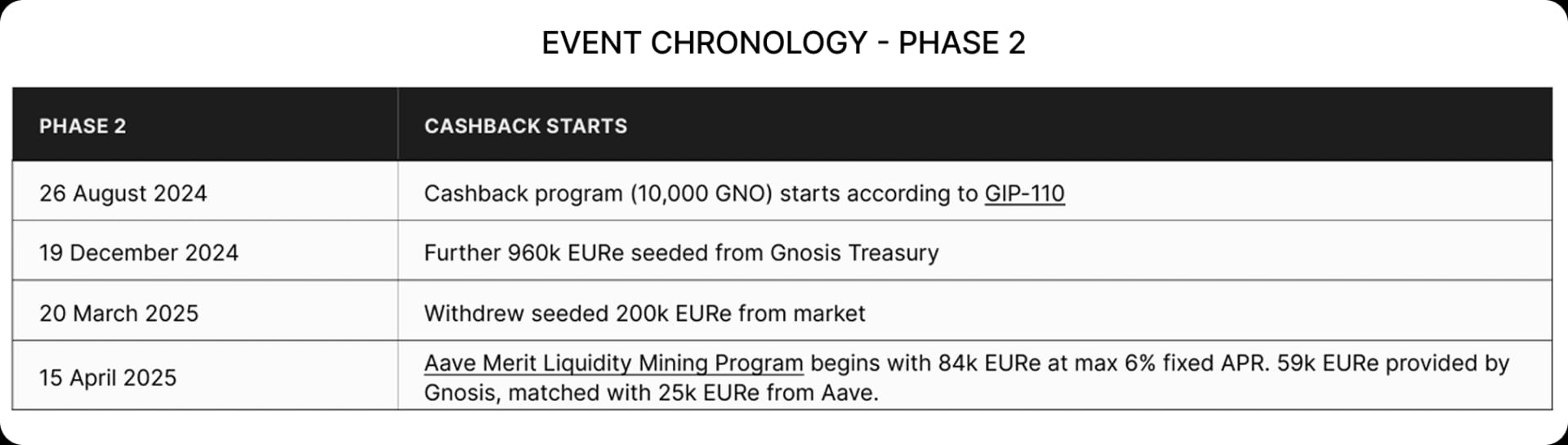
On 19 December 2024, 960,000 EURe were seeded into the market, raising total participation to 3.71 million EURe. This was followed in March 2025 by the first withdrawal of 200,000 EURe, signalling the start of a gradual reduction in protocol-owned capital as a test of whether external liquidity could sustain the market.
In April 2025, direct incentives were introduced into the Aave pool via the MERIT programme. With a budget of 84,000 EURe, 59,000 EURe funded by Gnosis and 25,000 EURe by the Aave DAO, the campaign aimed to maintain a 6% APR on EURe borrow positions for three months.
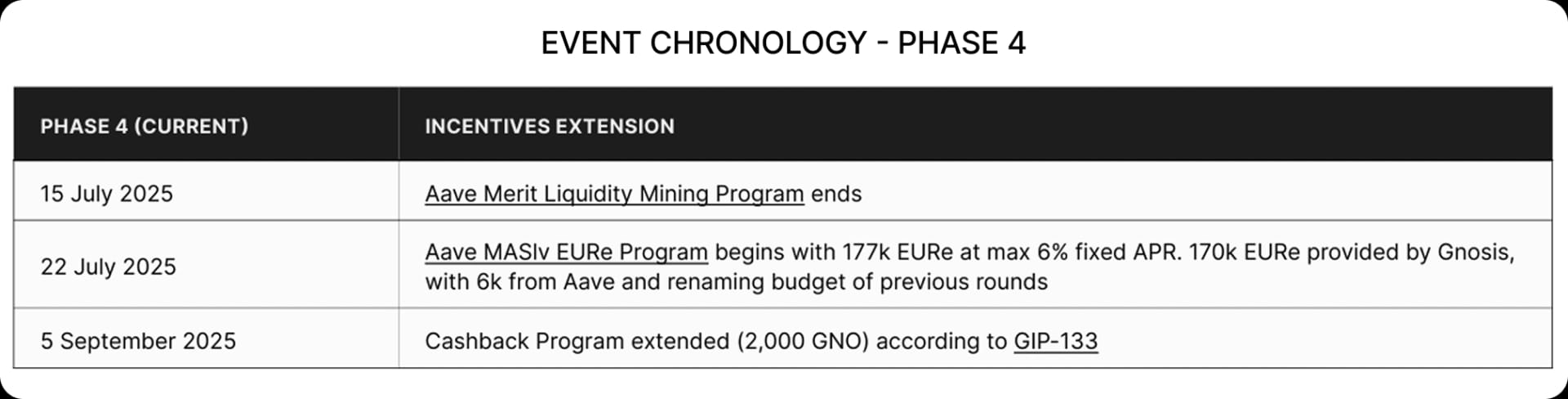
Finally, on 9 September 2025, the Gnosis Card cashback was renewed with a fresh budget of 2,000 GNO, further consolidating EURe’s role as the settlement layer for retail payments.
Each of the four milestones, initial seeding, incentive periods, liquidity withdrawal, and renewed incentives, shaped the liquidity profile and adoption path of EURe. In the following analysis, we will assess how these interventions influenced utilisation, the balance between organic and gamified activity, and long-term retention prospects anchored in Gnosis Pay.
Strategy and Market Dynamics: Analytical Review
This section provides an in-depth analysis of EURe’s trajectory on Aave V3’s Gnosis market. It examines the behaviour of the market, the influence of incentive programmes, and the broader strategy designed by kpk. The objective is to assess both the strengths and weaknesses of this approach, drawing out the key lessons that emerge from EURe’s deployment.
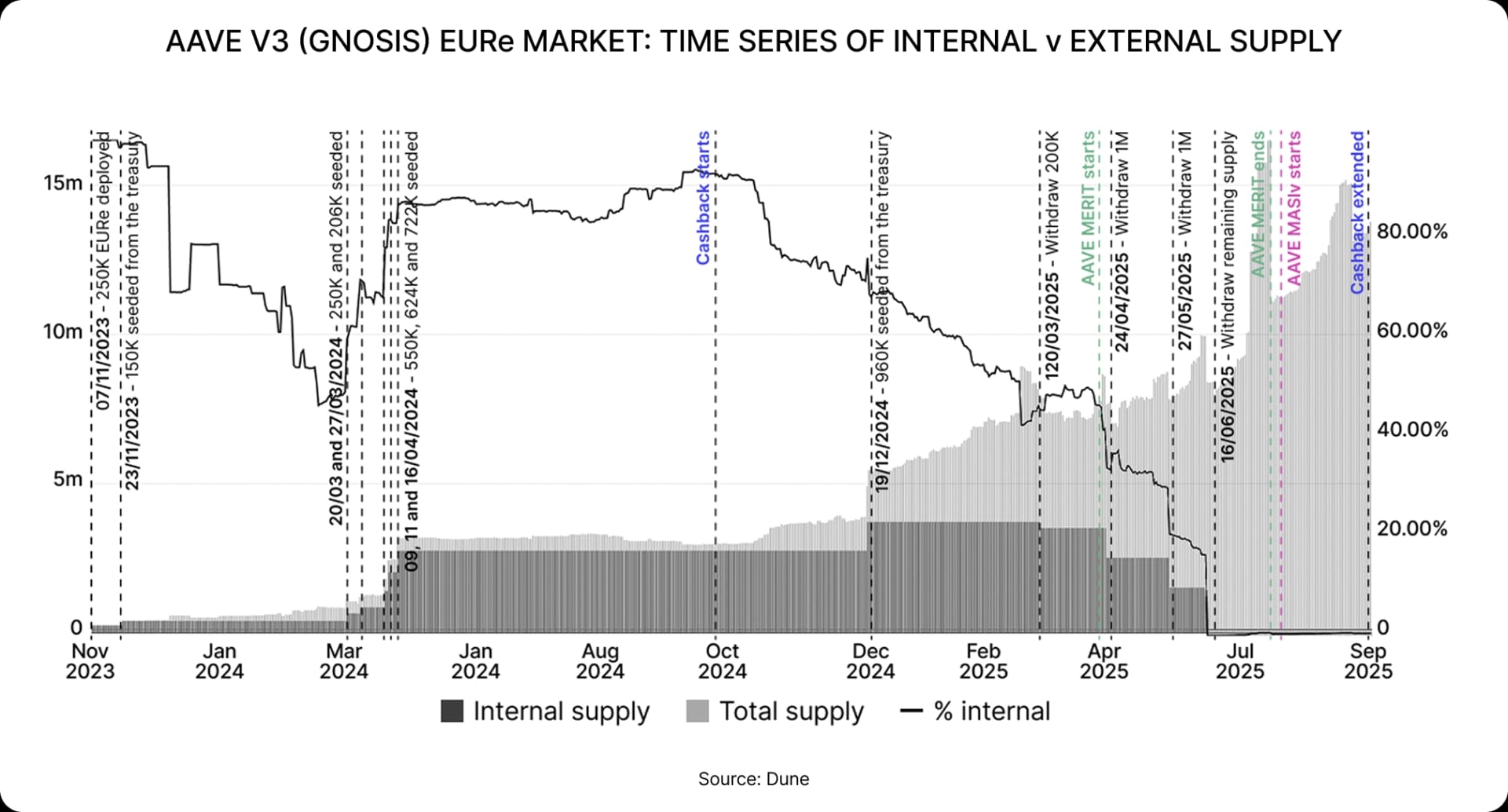
As a reference point, the chart below illustrates the evolution of supply on the Aave market, with annotations marking each of the critical events described in the chronology. This visual benchmark allows the subsequent analysis to be directly linked to the timing of interventions and their observed market effects.
Utilisation Rate and POL as a Signal
The timing of EURe’s liquidity injections and withdrawals was not arbitrary but guided by a set of quantitative and qualitative factors, in particular the utilisation rate. This metric provided a direct signal of market balance and became a central parameter in kpk’s strategy for managing Protocol-Owned Liquidity. In practice, kpk used a threshold of around 80/90% utilisation as a trigger for action.
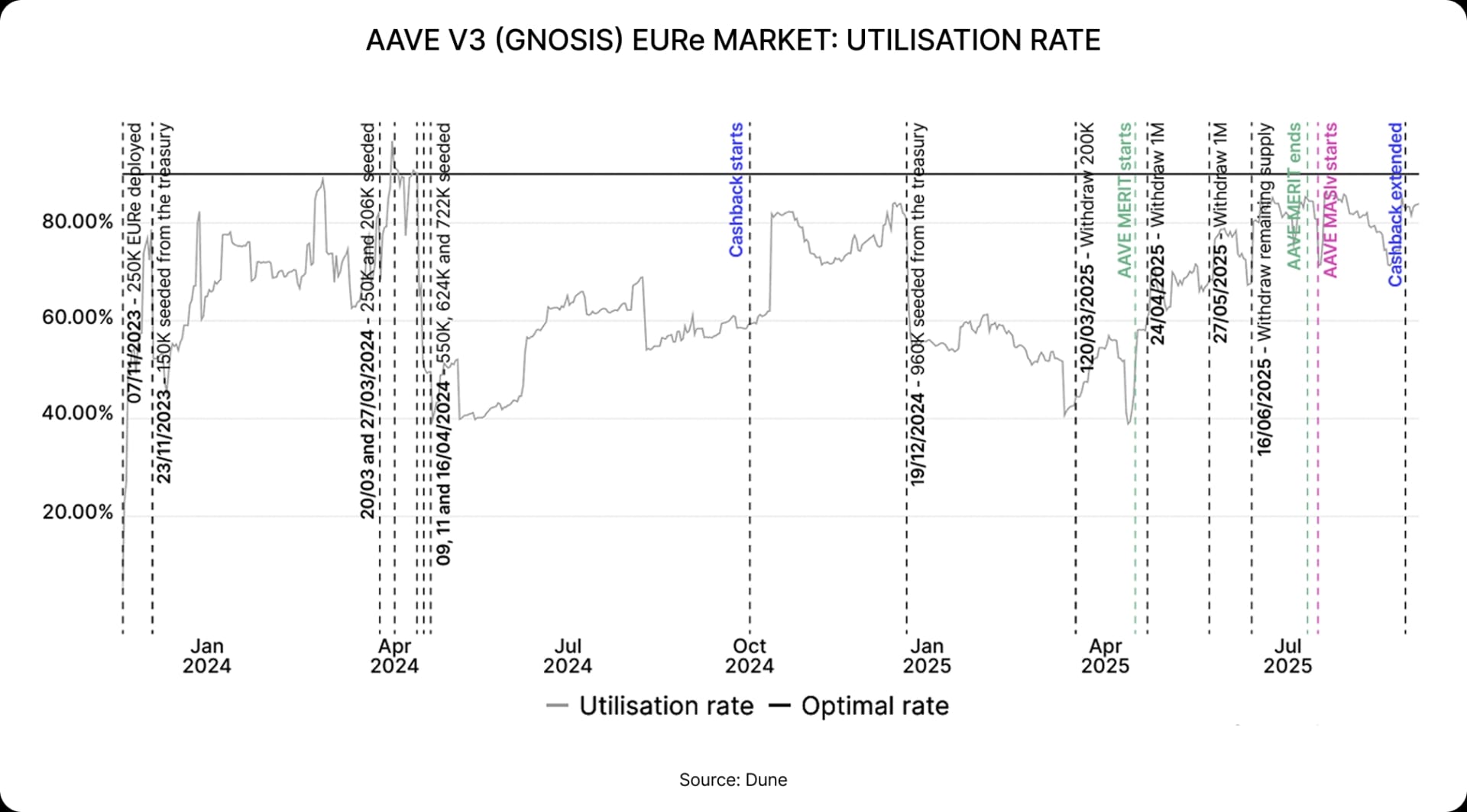
After the initial seeding phase in late November 2023, utilisation rates began to climb, a clear signal of early adoption. However, stability was lacking. Spikes and sharp swings revealed that the market remained shallow, where even modest changes in supply or borrowing produced outsized effects. This volatility made the market less predictable and therefore less reliable for participants.
When utilisation approached the 80% threshold in April 2024, kpk intervened by deploying additional capital. The aim was not only to follow growing demand but also to provide greater depth so the market could absorb volatility more effectively. By increasing supply at this stage, kpk sought to smooth out fluctuations and bring more predictability to borrowing conditions, laying the groundwork for a healthier and more stable environment.
Between April and December 2024, no further adjustments were made. Supply during this period was sufficient to absorb activity, while adding more liquidity would have lowered yields and discouraged the entry of exogenous capital. Equally, withdrawing liquidity was deemed premature, particularly in view of the upcoming cashback programme, which was expected to boost demand.
It was only once utilisation again approached the 80% mark in December 2024 that kpk added a final tranche of liquidity. This decision was also influenced by the share of POL in the market, which remained high at 70–75% of total supply. In practice, this meant the pool was still predominantly composed of kpk’s own liquidity, with external participation only beginning to take shape. With the market still in its bootstrapping stage, removing liquidity too early would have risked destabilisation.
The dynamic shifted after this last round of seeding. Utilisation began to decline, which at first glance might suggest a loss of interest. In reality, this movement reflected a more positive development: GnosisDAO’s share of supply was also falling, signalling that exogenous capital was stepping in to replace Protocol-Owned Liquidity. Over time, external deposits surpassed POL, a clear indication that the market was maturing and no longer dependent on treasury seeding for stability.
At this point, kpk initiated progressive withdrawals, steadily reducing its position to zero. Importantly, the utilisation rate continued to rise and eventually stabilised around the 80% level, widely regarded as healthy for lending markets.
This evolution demonstrates how POL, guided by utilisation signals, can serve as a temporary stabiliser during bootstrapping but gradually cede control to external capital once the market reaches maturity.
The Role of Incentives
In the pre-cashback era, attracting external supply beyond kpk’s capital base proved difficult. At the time, Gnosis Pay, first presented at ETHCC in July 2023, was still in its infancy, averaging only 5,000 transactions per week, with around 900 weekly active users and a total volume of just $300,000-350,000, far from the multi-million dollar weekly volumes seen today.
The introduction of the cashback programme around August 2024 marked a turning point. Much like the early growth strategies of other card providers such as Crypto.com, the cashback proved highly effective in boosting user conversion. From this moment onward, the amount of exogenous capital in the Aave EURe market began to grow rapidly. As shown in the utilisation rate chart, GnosisDAO’s share of supply fell steadily from around 90% to 50%, while utilisation rates continued to climb indicating that the activity was growing.
The second major phase of incentives began in April 2025 with the launch of the MERIT programme. The impact was immediate: activity in the Aave market surged, and, as we will see in a later section, this coincided with a sharp increase in Gnosis Pay usage.
When the MERIT incentives ended on 15 July 2025, supply contracted sharply which is a predictable outcome. Total supply dropped from 16.5 million EURe to 11.0 million EURe, a fall of around 33% (5.5 million). However, a closer look at the data suggests this was largely the effect of short-term, mercenary capital that had entered the market solely to capitalise on the incentives for a very short period of time. If this exceptional movement is removed, the underlying trend appears smoother and more consistent (refer to the trend line).
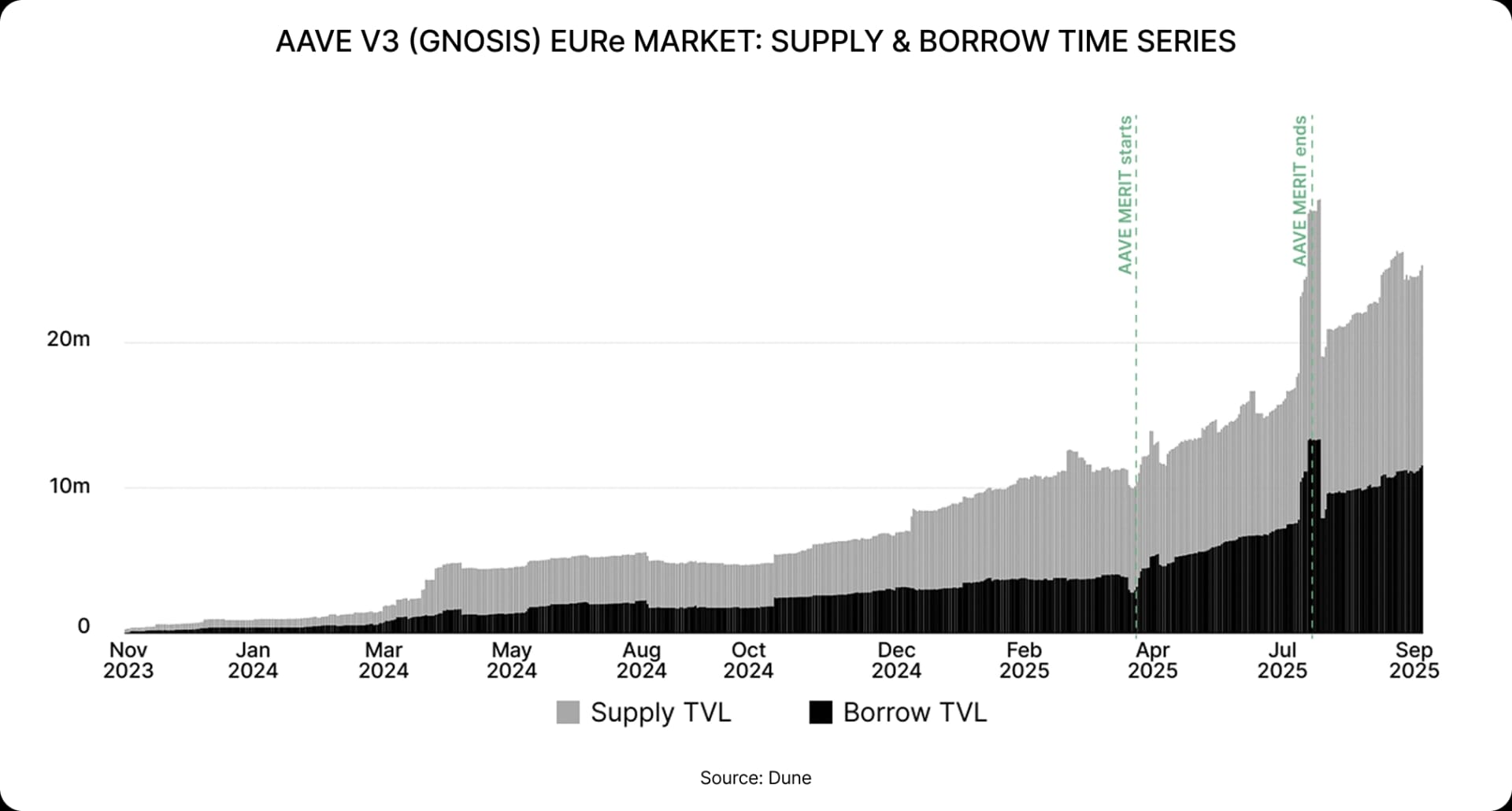
Taken together, the incentives played a key role in bootstrapping external liquidity and stimulating activity. While they did generate bursts of inorganic behaviour, their overall impact was to foster sustained activity and attract external liquidity to gradually replace the initial POL, which had provided the market’s foundational depth.