



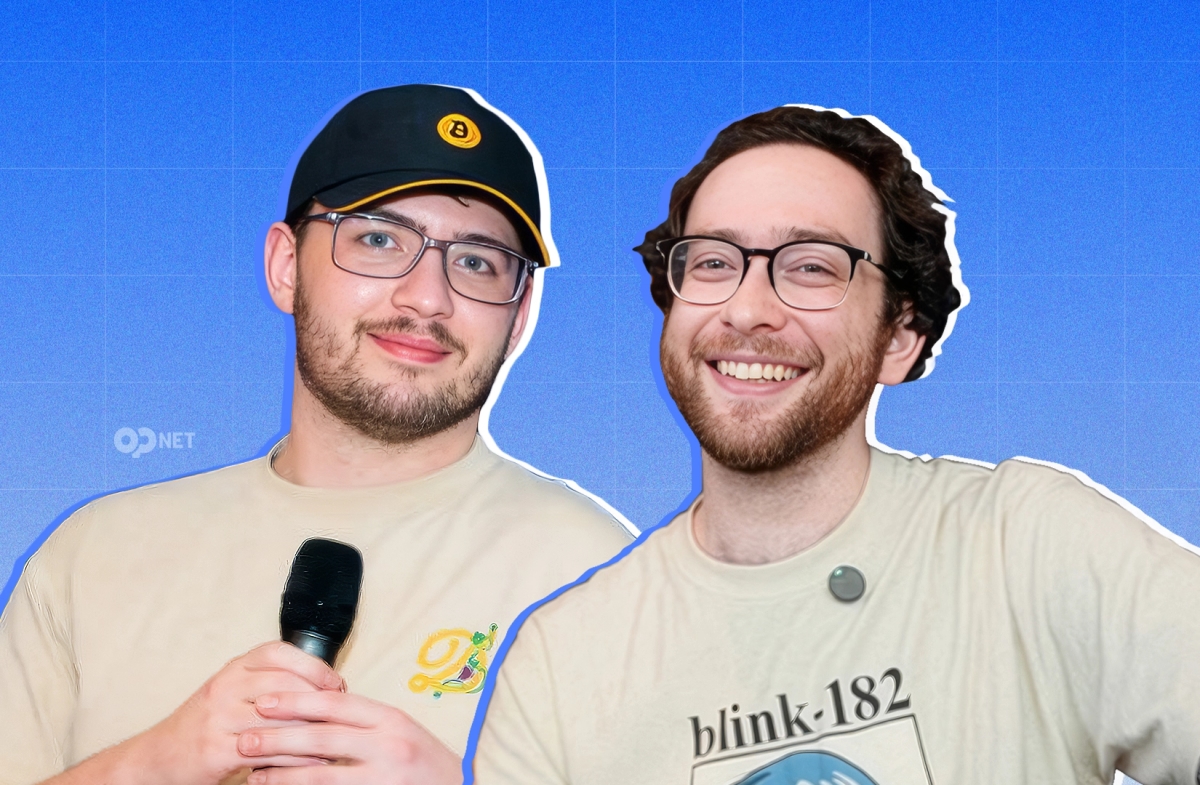
Frederic Fosco, involved in Bitcoin since 2013, and Samuel Patt, a long-standing enthusiast with a background in crypto trading, launched OP_NET to address a specific problem: the lack of native programmability on the world’s most secure blockchain.
OP_NET enables smart contracts directly on Bitcoin Layer 1, using BTC as gas while preserving self-custody. By unlocking native stablecoins, lending, and trading, the protocol aims to turn dormant BTC liquidity into productive capital without the custodial risks of wrapped assets or the centralisation of sidechains.
We caught up with the co-founders of OP_NET, Frederic Fosco (aka Danny Plainview) and Samuel Patt (aka Chad), at Consensus in Hong Kong last week to discuss why the “digital gold” narrative poses a long-term security threat to Bitcoin and how they are bringing DeFi primitives to Layer 1 without relying on bridges or sidechains.
Read more about their vision for a Bitcoin-centric DeFi ecosystem in the interview below.
Bitcoin builders often fall into two camps: ideological purists and pragmatic engineers. Where did each of you start, and how has your thinking evolved over time?
Frederic: I got into crypto when I was 13, purely through Bitcoin. Memes were the first thing that made sense to me. That was the week the Dogecoin client was released. I built a PC and started mining Bitcoin, Dogecoin, and Litecoin.
I liked the concept of having multiple digital currencies, but Bitcoin was restrictive. There was nothing to do except speculative gambling or dark markets. We come from a deeply ideological background, where we want to make these assets do something new and actually build something useful.
Samuel: We both started from the building perspective. On the pragmatic side, we were looking to invest in whoever was building Bitcoin DeFi. It became increasingly clear as we looked for opportunities that nobody was doing it.
We saw many Bitcoin Layer 2s being built, but we didn’t see anyone building Uniswap for Bitcoin or real on-chain DeFi apps. It became clear that you need a protocol that allows smart contracts on Bitcoin to realise the future we wanted. That is where the idea of OP_NET evolved.
After more than a decade of Bitcoin’s evolution, why do you believe now is the right time for a project like OP_NET to exist?
Frederic: Bitcoin miners require the price of Bitcoin to double every halving cycle to sustain the economics of mining. At the 2024 halving, the price was about $70,000. Two years later, it is roughly the same.
It needs to either reach $140,000 for miners to sustain profitability, or Layer 1 fees need to increase. Bitcoin, being digital gold, is great for institutions, but it cannot keep rising exponentially forever. There needs to be actual utility on Layer 1 for fees to rise.
Samuel: We are also in a unique position where DeFi on Ethereum has reached a stagnation point. We haven’t seen TVL really take off since its peaks, but we have seen killer applications and use cases proven there. Bitcoin has not been able to touch any of that.
You are in a unique position, with open-source, proven, product-market-fit applications on ETH and massive institutional demand for more BTC use to seek yield. The narrative is shifting towards “how do I use my Bitcoin?” The timing is right for Bitcoin-native assets, stablecoins, and RWAs.
Samuel, you come from a punk background and have long leaned into Bitcoin’s anti-establishment ethos. How do you reconcile that philosophy with building DeFi primitives that could eventually attract institutions?
Samuel: The punk movement began as an underground counterculture and gradually evolved towards the mainstream. Once a movement reaches a mainstream audience while still representing counterculture, it shifts the culture it was trying to counter in the first place.
DeFi is the democratisation of traditional financial tools. It allows anyone to access over-collateralised loans and permissionless financial activity typically reserved for the ultra-wealthy.
When you combine Bitcoin, a counterculture movement, with DeFi, you open the door to opportunities for sovereign individuals to have more agency. This inevitably leads to greater adoption of Bitcoin as an asset and fulfils the vision of a peer-to-peer currency.
You’ve described OP_NET as a way to turn Bitcoin from a passive store of value into programmable financial infrastructure. What convinced you that Bitcoin’s Layer 1 was the right place to build?
Samuel: Every Layer 1 blockchain and every asset combined is worth less than Bitcoin’s market cap. Bitcoin lacks the functionality of Ethereum or Solana, yet maintains significant market dominance. This proves Bitcoin wants to stay on Bitcoin.
Its strength lies in its network and decentralisation principles. Most attempts to capitalise on this have been sidechains or ETH forks with bridges. The best Layer 2 for Bitcoin is still Ethereum with Wrapped Bitcoin, and that represents only a tiny percentage of the supply.
If we want to tap into Bitcoin’s liquidity, the only place to start is Layer 1. You must build natively, without compromising Bitcoin’s values, without requiring bridging, and without demanding extra trust assumptions.
Frederic, OP_NET makes a bold claim: no BIPs, no forks, no sidechains, no bridges, no wrapped BTC. How are you achieving expressiveness on Bitcoin L1 using only Taproot, Tapscript, and the UTXO model?
Frederic: Most people building on Bitcoin view its limitations as negatives because they are used to EVM environments. Their solution is always to bypass Bitcoin with a wrapper or sidechain.
Our approach is the opposite. We stay within Bitcoin’s box and view its limitations as superpowers. The UTXO set is at odds with traditional smart-contract layouts, but it enables powerful capabilities such as universal tracking. We focus on benefiting from these features rather than fighting against them.
You describe OP_NET as a metaprotocol and a “consensus layer interpretation” over Bitcoin. Where does execution actually occur, and how does the network agree on state transitions without modifying Bitcoin itself?
Frederic: We realised that OP_NET is not a traditional metaprotocol because our nodes have consensus. Protocols such as Ordinals or BRC-20 function as centralised indexing services. There is no peer-to-peer network to verify whether nodes see the same state.
OP_NET achieves consensus because our nodes have no disagreement about the state. We use Bitcoin as a ledger, following all transaction schemas without UTXO bloating or illegal operations. Every node sees the exact same data and interprets it the exact same way.
Execution happens between the nodes, but we verify the state of this execution through consensus. We achieve smart contract-based assets on Bitcoin Layer 1 without changing Bitcoin, custodiansing funds, or worrying about conflicting states. The maths are correct between our nodes.
By using native BTC as gas, how do you meter computation, prevent spam, and price execution when you’re constrained by Bitcoin block space and fee markets?
Frederic: Speed is often cited as a drawback of Bitcoin Layer 1. Miners have the final say on transaction ordering. We addressed this by implementing a priority fee system. Gas is paid in native, unwrapped Layer 1 Bitcoin.
When users make a transaction, they attach a priority fee. The OP_NET nodes examine the Bitcoin block and execute order transactions based on the priority fee, not their position in the Bitcoin block. This means Bitcoin miners do not have the final say in MEV.
Our nodes are the first protocol to incentivise node runners on the Bitcoin network. The gas and priority fees are structured so that OP_NET node runners can mine the fees paid for transactions in a trustless, decentralised way using a SHA-1 puzzle system.
Samuel: This is also how consensus is reached. All gas fees are paid in Bitcoin per block and aggregated into a new address, which is encrypted with SHA-1. The system releases funds to the node runner who submits the closest SHA-1 collision, along with a checksum of the network state.
If everything ultimately settles on Bitcoin, what new trust or security assumptions does OP_NET introduce, if any? Where should sceptics focus their scrutiny?
Frederic: Our ethos is “verify, don’t trust.” We do not custody Bitcoin for any user. Our native DEX, MotoSwap, operates like Uniswap V3. The liquidity pool does not custody Bitcoin; it acts as an Oracle pricing router.
When you buy tokens, Bitcoin is routed directly from you to the seller. The contract never holds it. However, for things like lending, where you need a programmable version of Bitcoin, you would need wrapped Bitcoin on the Bitcoin network.
This requires a custodian or a decentralised provider. We do not want to be that custodian. That is the only area under scrutiny, but it is an optional feature for specific DeFi use cases.
Samuel: We are not turning Bitcoin into a natively programmable asset. We are turning the chain into a natively programmable device. You can swap Bitcoin trustlessly for programmable assets on BTC, like stablecoins.
OP_20 tokens, bonding curves, launchpads; these resemble ecosystems we’ve seen on other chains. What makes token issuance on Bitcoin fundamentally different?
Frederic: Bitcoin is fertile land where nobody has planted crops. Everything done on Ethereum or Solana is new to Bitcoin. Coupled with AI coding tools, the barrier to entry has disappeared.
Samuel: Bitcoin is the most secure, decentralised blockchain and ledger. For asset issuance and value transfer that doesn’t require high-frequency trading, it makes sense for assets to live on BTC.
We know what works on other chains. The question is whether you can adapt it for Bitcoin. Being able to issue assets in a place where it has never been done before provides immense value to holders.
Proof-of-Hodl is positioned as a self-custodial staking model. How does it work mechanically, and how is it different from typical staking or yield farming structures on other chains?
Frederic: We ported the MasterChef contract from SushiSwap to OP_NET and added a feature native to Bitcoin. If I have 10 Bitcoin and stake one, the transaction creates two new UTXOs: one sent to me (change) and another sent to me (stake).
The contract logs that specific UTXO. When I claim rewards, the contract checks whether that UTXO is still in my wallet. If so, I claim the rewards. I never send Bitcoin to a third party.
This contrasts with models like Babylon, where Bitcoin sits in a shared custodial multisig, doing nothing. We believe you should be able to farm an unlimited number of tokens without your Bitcoin leaving your wallet.
If OP_NET activity scales significantly, how does that impact Bitcoin’s base layer? Is there a ceiling to how much programmability Bitcoin L1 can realistically handle?
Frederic: When thousands of people want to trade tokens every 10 minutes on a chain with limited transaction capacity, you get fee wars. We have seen this with Ordinals and Runes.
Bitcoin miners will be happy because fees offset the halving. This will look like sustained periods of high fees on Layer 1. I believe there are three main pillars for Layer 1: DEX, stablecoins, and lending.
For the first few months, activity will be intense. Fees will be high. That is positive for the network’s security budget.
Samuel: There is no limit to the programmability you can add to Bitcoin. High demand for block space will eventually level off, leaving only the most high-value transactions. The fee market is a free market.
It will stabilise where it is sustainable for miners and users. The question is: how can you best serve Bitcoin holders? The best applications will emerge and survive the initial rush.
There are multiple approaches attempting to expand Bitcoin programmability (BitVM, Arch, various rollup models). Where do you see OP_NET fitting in that landscape?
Frederic: OP_NET does not have a native gas token. It is a non-extractive upgrade to Layer 1. BitVM, Arch, and rollups often have their own tokens or handle everything off-chain, posting only proofs to Bitcoin.
If you claim to be on Bitcoin but transaction speeds match Solana, you are not on Bitcoin; you are custodying Bitcoin and using a wrapped version. OP_NET will be refreshing for Bitcoiners because it actually happens on Layer 1.
Samuel: The value proposition is simple. With other solutions, the first step is to bridge off Bitcoin. With OP_NET, you never leave. You only make Layer 1 transactions. To the user, OP_NET doesn’t exist. Instead, you just have smart contracts on Bitcoin.
Is Bitcoin still “digital gold,” or has crypto moved on past that like-comparison at this point?
Frederic: In every cycle, Bitcoin is redefined. The digital gold narrative is great for not scaring off institutions.
Samuel: Bitcoin won’t destroy fiat currency; it is now much friendlier to the wider financial system. But the digital gold narrative, with its hoarding of assets in a Fort Knox-style manner, undermines Bitcoin’s security incentive model.
Frederic: If no one conducts Layer 1 transactions and the price doesn’t double every four years, the security model breaks. If Bitcoin isn’t at $140,000 in 2028, or if fees don’t offset the halving, the mining rate will collapse.
Samuel: You have to incentivise transactions to subsidise miners. The only way is to offer full programmability and financial opportunity on Layer 1.
If OP_NET succeeds fully, what disappears from crypto? Wrapped BTC? L2 dominance? Cross-chain bridges? Or something we haven’t yet anticipated?
Frederic: Unless Bitcoin changes to enable smart contracts, you still need programmable Bitcoin. I don’t think wrapped Bitcoin or L2s will disappear overnight.
But a lot of the crap will go away. We saw 90+ Bitcoin L2s launch recently. That won’t happen. Bitcoin will look more like Ethereum, with a handful of useful L2s.
Samuel: If we achieve massive adoption, we enter a Bitcoin-centric world. The value proposition for programmable Bitcoin on Bitcoin is greater than wrapping it for Ethereum.
What might disappear is the need for non-Bitcoin chains. If you have the most secure chain with full programmability, the value proposition of other L1s diminishes. Innovations developed outside Bitcoin will migrate towards it, creating a Bitcoin-denominated crypto universe.