

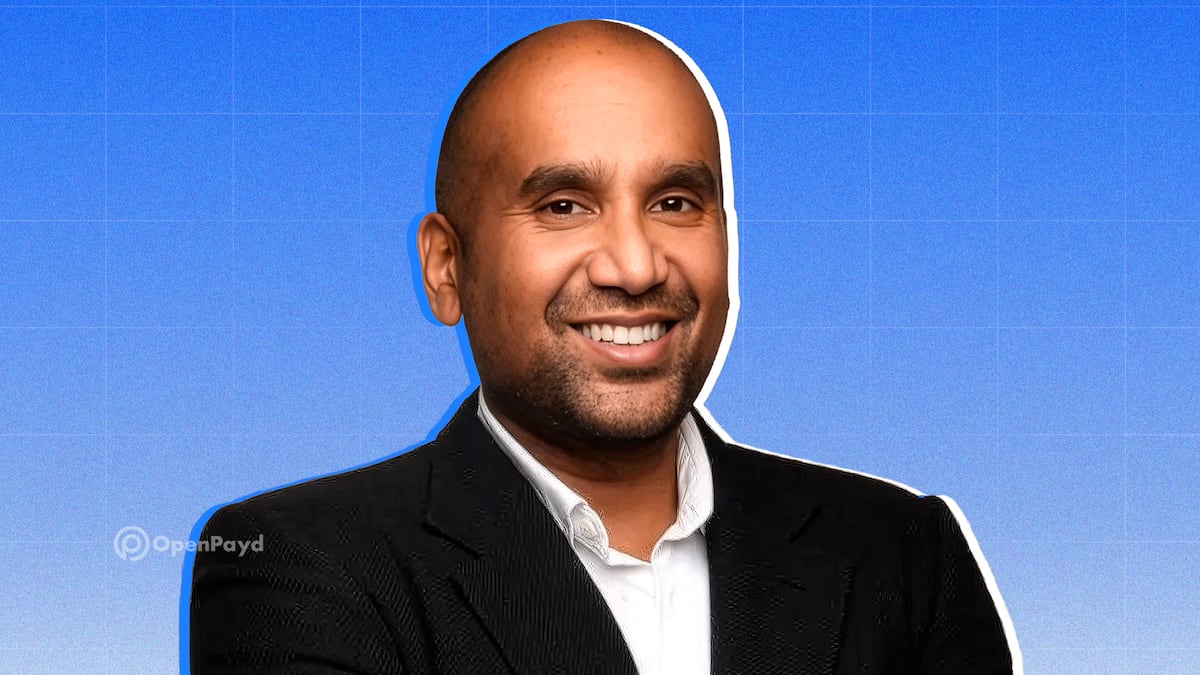
Lux Thiagarajah has over 17 years of experience working for some of the largest and most innovative organisations in finance, including J.P. Morgan, HSBC, BCB, and FalconX. He began his career as an FX trader at J.P. Morgan before transitioning to the buy side to lead a macro trading desk. He then moved into senior roles in payments, becoming the CRO of BCB and, more recently, the Chief Commercial Officer at OpenPayd.
At OpenPayd, Lux draws on his track record of helping businesses reach the next stage of their development. He is responsible for driving revenue and growth from both new and existing clients, as well as for identifying strategic partnerships that advance the company’s ambition to become the default financial layer for businesses operating globally.
We recently spoke with Lux Thiagarajah, CCO of OpenPayd, about the critical role of universal financial infrastructure in today’s global economy and how stablecoins are reshaping corporate treasury operations.
Read more about OpenPayd’s vision for a unified fiat and digital asset ecosystem in the interview below.
You moved from FX trading at JP Morgan to macro trading and then into senior roles at BCB, FalconX and now OpenPayd. Which parts of that path most shaped how you build revenue in fast-moving markets?
My time at JP Morgan was instrumental in teaching me how to make money. Being part of the G10 trading desk taught me when to make quick decisions, as being slow meant lost opportunities, but also how to know when to step back and be more strategic. I also learnt the importance of personal relationships. Whilst the product you are selling is important, clients are also investing in you as a person. I have carried those lessons in every role since.
As CCO of OpenPayd, I keep one eye on immediate revenue to ensure we hit targets and deliver annual growth, while keeping the other on our strategic partnerships. They may take longer to develop, but they are instrumental in ensuring long-term revenue growth.
OpenPayd positions itself as a universal financial infrastructure. What does ‘universal’ mean for your enterprise clients?
Universal means optionality without complexity. For our enterprise clients, it is the ability to enter new markets, launch new products, and adopt new payment rails without renegotiating banking relationships or rebuilding their operating model each time.
Too many global businesses are constrained by the limitations of their original banking setup. Universal infrastructure removes that constraint by bridging traditional and blockchain rails.
In practice, our clients get a single, regulated access point to local and international payments, FX, and stablecoins. They can choose the most efficient rail for a given transaction today and switch tomorrow if economics, regulation, or customer behaviour changes. That optionality is what matters. Universal is not about using every rail at once; it is about never being stuck with the wrong one.
You process more than €130bn in annualised volume for 800-plus clients. Which sectors are scaling fastest on the platform, and why?
Financial institutions are among the fastest-growing verticals on our platform. The key driver is the rapid adoption of stablecoins, which has moved decisively beyond trading and into payments, treasury, and settlement. What has changed is the regulation.
With frameworks such as the GENIUS Act in the US and MiCA in Europe now in place, institutions finally have the legal certainty to move from experimentation to production.
We are seeing banks and regulated financial firms integrate stablecoins into core workflows, using them to fund accounts, manage liquidity, and settle cross-border flows more efficiently. Stablecoins offer real-time settlement, cost transparency, and 24/7 availability, directly addressing many long-standing inefficiencies. As a result, financial institutions are not just testing these rails; they are scaling them.
Your platform handles API orchestration across traditional rails and blockchains. What is the main operational lift this removes for large enterprises?
The biggest lift we remove is fragmentation. Large enterprises already know how to integrate APIs. What breaks at scale is governance, reconciliation, and control across multiple payment providers, banks, and now blockchains.
By centralising orchestration, we consolidate multiple workflows into one. Compliance checks, settlement logic, reporting, and treasury visibility are handled consistently, regardless of whether value moves via SEPA, SWIFT, or blockchain. This reduces failure points, audit exposure, and the need for manual intervention. The result is not just faster payments but a payments operation that can scale without adding cost, manual effort, or risk.
OpenPayd enables unlimited virtual IBANs, automated reconciliation and multi-asset wallets. Which feature creates the biggest turning point for clients?
Unlimited virtual IBANs, combined with automated reconciliation, are often the initial turning point. They give clients immediate visibility and control over cash flows. As their volumes and use cases scale, access to own-named virtual IBANs becomes critical. Having accounts in the client’s own name significantly improves payment success, beneficiary recognition, and counterparty trust, reducing rejected or delayed payments.
That structure also delivers immediate visibility and control over cash flows. Each customer, transaction, or geography can have its own account, with funds automatically matched and reported in real time. For many businesses, this transforms payments from an operational burden into a scalable function.
The longer-term step change occurs when this is paired with multi-asset wallets. At that point, clients move beyond efficient fiat operations and begin optimising liquidity across fiat and stablecoins within a single treasury view.
For large enterprises, what is the biggest bottleneck today: technology, compliance or internal operations?
Internal operations are a major bottleneck. The technology works, and in the US and Europe, regulation is no longer the blocker it once was. MiCA and the GENIUS Act have given enterprises greater clarity in the world’s two largest currency zones.
What slows progress is internal inertia. Legacy processes, siloed teams, and risk frameworks built for batch-based banking struggle to adapt to real-time, global money movement. The companies racing ahead are not waiting for perfect certainty. They are modernising decision-making and treating payments and treasury as strategic infrastructure rather than back-office functions.
OpenPayd has written about building global crypto treasuries. What do enterprises still misunderstand about running digital asset operations at scale?
The biggest misunderstanding is treating digital assets as a bolt-on rather than core treasury infrastructure. At scale, that approach creates more risk, not less. Separate tools, isolated teams, and manual controls do not stand up to regulatory scrutiny or operational reality.
Running a digital asset treasury properly looks very similar to running a fiat one. It requires clear governance, real-time liquidity management, auditability, and integration with existing finance systems. The difference is speed and programmability. Enterprises that unify fiat and stablecoin operations under one framework gain efficiency and control. Those that bolt crypto on the side will eventually be forced to unwind and rebuild.
You are known for guiding companies into their next stage of growth. What is that next stage for OpenPayd?
The next stage is distribution at scale. We are building the universal financial infrastructure and have already invested in best-in-class regulatory and technical foundations.
Now the focus is on embedding OpenPayd more deeply into the global financial ecosystem. That means powering more banks, PSPs, and platforms behind the scenes, expanding our licensing footprint, and continuing to lead in stablecoin and multi-asset infrastructure. For us, growth is not about adding features for the sake of it. It is about becoming the default financial layer for businesses operating globally.
Looking ahead two to three years, which area becomes the main battleground: global payouts, stablecoin settlement, embedded finance or multi-asset treasury?
Multi-asset treasury is becoming the strategic battleground. Global payouts and embedded finance are already competitive and increasingly commoditised. Stablecoin settlement is a critical rail, but on its own, it is not the endgame. The real value lies in providing enterprises with a unified way to manage liquidity across fiat and digital assets in real time, globally. That is where cost, speed, and resilience converge, and where long-term competitive advantage will be built.