



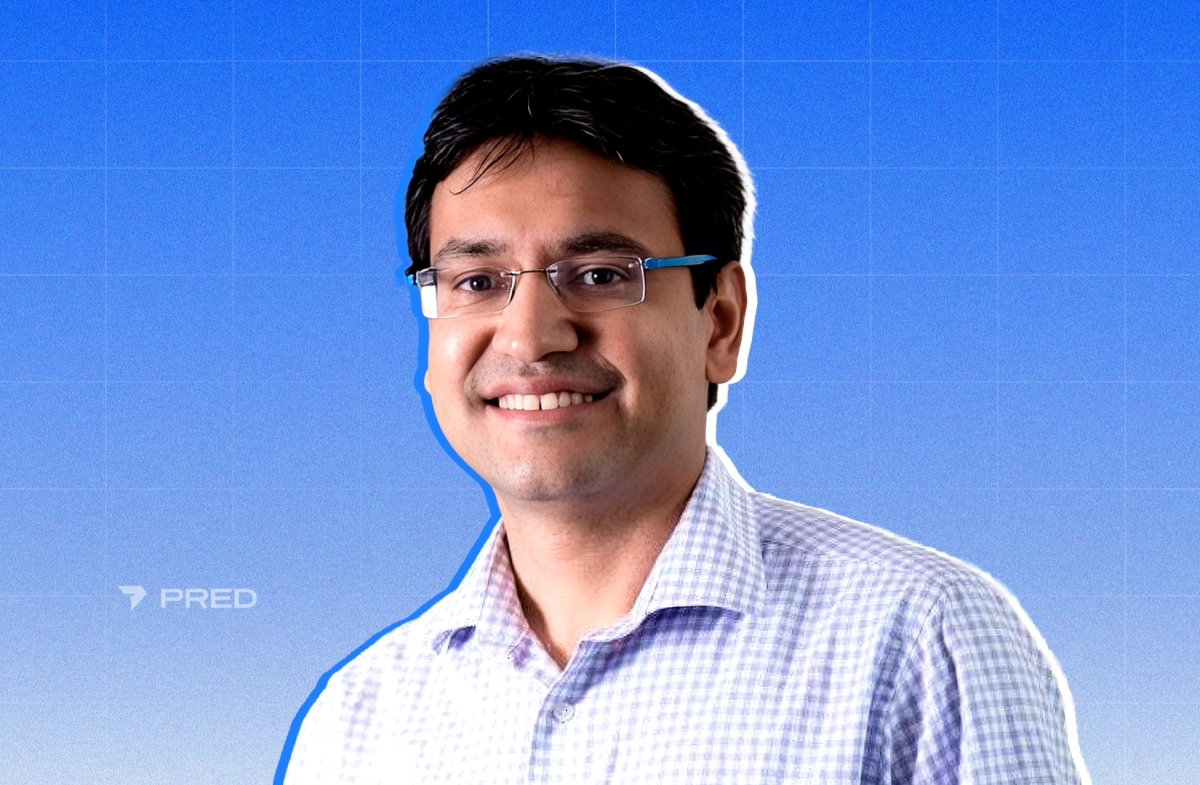
Amit Mahensaria is a founder, operator, and edtech pioneer who has spent the last two decades building and scaling ventures that bridge technology with learning outcomes. An alumnus of IIT Delhi and IIM Lucknow, he began his career in investment banking and private equity before co-founding Impartus Innovations in 2013. Impartus became a backbone for digital instruction in India, eventually leading to its acquisition by upGrad in 2021.
After steering upGrad Campus through its post-acquisition growth, Amit turned his focus to the intersection of decentralised tech and engagement. With PRED, he is applying his experience in aligning platform incentives with user success to the world of sports prediction markets, aiming to replace adversarial bookmaker models with transparent, peer-to-peer trading infrastructure.
We recently spoke with Amit Mahensaria, Founder of PRED, about his transition from scaling edtech giants to building a decentralised sports trading exchange, and why he believes the traditional sportsbook model is broken.
Read more about PRED’s strategy to professionalise sports trading and the move towards a “Bloomberg terminal for sports” in the interview below.
Amit, you spent the last decade improving digital education in Asia with Impartus and upGrad, building for institutions and millions of students. What was the specific ‘lightbulb moment’ that made you change from the structured sector of EdTech to the decentralised, permissionless industry of sports prediction markets?
I have been involved in sports trading for the past 22 years. This industry is dominated by middlemen, the sportsbooks or bookies, who are your counterparties for every trade and charge around 20% commission, or “vig”, if you cash out. Frustrated by this, I started a sports prediction community eight years ago, which became quite popular. The idea for PRED stems from there: replacing the middleman in sports trading.
The acquisition of my previous startup, Impartus, by upGrad and its scaling to two million users taught me how to build and scale products globally. Around the same time, in mid-2024, I witnessed Polymarket’s breakout during the US election. Here was a prediction market outperforming traditional polls, being cited by mainstream media, and proving that markets aggregate information better than experts.
I realised we are witnessing a fundamental shift. This was my “lightbulb” moment to build the next global consumer product that uses technology to fundamentally change and solve my personal pain point in sports trading.
I have been a crypto investor since 2020, and my co-founder is a Web3 veteran. Both of us felt that blockchain infrastructure and stablecoin adoption had finally arrived in 2024 to support this build.
There is $3 trillion in global sports betting and trading volume every year, yet the infrastructure is stuck in the 1990s. Traditional sportsbooks are adversarial by design. They profit when you lose, limit or ban winners, and set prices that guarantee their edge. It is a broken system that punishes skill. My EdTech experience taught me that the best platforms align incentives with users.
At upGrad, we succeeded because students who engaged achieved better outcomes, which drove our growth. Sports trading should work the same way. The platform should benefit when traders succeed, not when they fail. That is what PRED is building: a peer-to-peer exchange where the house does not bet against you, winners are not penalised, and the best price wins.
You are building products at the intersection of ‘decentralised tech and engagement.’ Do you see a parallel between your learnings at Upgrad and the product you are now building for sports fans on PRED?
There is definitely a through-line, but I would frame it differently. In education, there is a quote: “Teach me the way I can learn.” Courses are designed by teachers, not students. This was my biggest challenge: how to build the learning experience from a student’s perspective and make it engaging.
Similarly, in sports, platforms are designed by bookies who benefit when bettors lose. Today, people place bets and then pray they win. We want to unlock sports trading. Taking a position and then flipping it should be as seamless as trading stocks on Robinhood or Hyperliquid. PRED is built for sports, built for trading, and designed by sports traders. I am a trader myself, and I am building something I will love to use: high-speed access to the deepest liquidity.
PRED shares this philosophy. We are not building a casino with flashing lights designed to extract money from casual users. We are building trading infrastructure for people serious about sports analysis. The “engagement” comes from giving skilled analysts a venue where their edge actually translates into returns, something traditional sportsbooks actively prevent.
Sports is high action, and accordingly, the core philosophy at PRED is speed in everything we do: market creation, trading experience, settlements, and access to winnings. Once people win, they want to celebrate and then trade immediately on the next match. It is critical that the product is built for this. We will have resolutions and winnings in minutes, not hours or days. People have short attention spans, and this speedy trading creates an experience they will love.
At Upgrad, success relied on gaining the trust of millions of students and massive institutions like universities. In Web3, trust is often placed in code and smart contracts. How has your approach to building ‘trust’ with your users changed?
Trust in Web3 is actually more demanding, not less. You cannot hide behind institutional relationships or brand reputation. Everything is on-chain and verifiable. Users can audit your smart contracts, see exactly where funds flow, and verify that the system works as promised.
The biggest problem in sports trading is that users feel cheated, believe they are not getting the best prices, or think the house is always winning. Building a decentralised order book where every transaction is transparent and verifiable on-chain goes a long way towards gaining this trust. When users know they are getting the best prices for their trades, they can focus on trading without worrying about being shafted.
At PRED, we embrace this radical transparency. Our contracts are auditable and open. Settlement is provably fair. We use oracle networks that anyone can verify. When a market resolves, you can trace exactly how the outcome was determined. Compare that to a traditional sportsbook, where you have to trust that they will pay you and won’t change the rules.
But code alone is not enough. We are also building trust through performance: tight spreads, fast execution, and a track record of reliable settlements. The crypto-native audience is sophisticated. They have seen too many projects over-promise and under-deliver. We would rather earn trust slowly through consistent execution than hype our way to short-term attention.
The core promise of PRED is that you don’t bet against the house; you just run the market. For the average sports bettor used to traditional books, can you explain in simple terms how this ‘peer-to-peer’ model benefits them mathematically?
Let me make this concrete. When you bet on a coin flip at DraftKings, you are paying -110 on both sides. That means you risk $110 to win $100. The house takes roughly 10% of every dollar wagered. That is the “vig” or “juice.” Over time, that is an enormous headwind for any bettor. In many markets, this vig can be as high as 20%.
On PRED, there is no house setting prices. Users trade directly with each other, and the platform only takes a small fee on winning trades. Our target spread is around 1%. So instead of paying 5% on that coin flip, you pay under 1%, and that goes to other users, not to PRED. Over 100 trades, a skilled trader retains a significantly greater edge.
But here is what really matters: in traditional bookmaking, if you are really good, they will limit or ban you. Your skill becomes worthless. On PRED, winners are welcome. We make money on volume, not on users losing. So a sharp bettor with a 3% edge can actually realise that edge, rather than being shut out after a few winning weeks.
Our core premise is that PRED’s performant trading interface and its lowest spreads will change the core behaviour from betting to trading. When you can flip or change your predictions without any loss or vig, you start trading instead of betting and praying.
Which blockchain did you choose to build PRED and why?
We built on Base. Three reasons: speed, cost, and ecosystem.
Sports markets move fast. Odds can shift dramatically in seconds. You need a chain that can handle rapid order matching without users waiting minutes for confirmation or paying high gas fees. Base offers us 200-millisecond finality and fees measured in fractions of a cent.
Cost matters for trading use cases. If gas fees erode your edge, the platform does not work. Base’s architecture lets us offer the transaction throughput of a centralised exchange with the transparency of on-chain settlement. The Base ecosystem is where the action is right now for consumer crypto applications. There is a vibrant community of builders and users who understand DeFi primitives. These are exactly the early adopters who can appreciate what we are building and help bootstrap liquidity for the rest of the market.
The biggest challenge for any prediction exchange is liquidity. If I want to bet $1,000 on an underdog, I need someone else to take that bet. How is PRED solving the ‘chicken and egg’ problem of liquidity in these early stages?
Liquidity bootstrapping is the hardest problem in building an exchange. We are tackling it from multiple angles. First, we are onboarding professional market makers who commit to providing two-sided liquidity across major markets. They are incentivised through onboarding infrastructure, maker fee rebates, and early access to our most liquid markets. This ensures that from day one, users can get meaningful size filled at competitive prices.
Second, we are starting focused. Rather than launching across every sport and every market, we are concentrating liquidity on high-demand events, particularly major league games with natural trading interest. It is better to have deep liquidity in 50 markets than shallow liquidity in 5,000.
Third, we are building for traders who bring liquidity. Crypto-native traders understand how to provide liquidity. Sports sharps have capital they want to deploy but cannot on traditional books. By creating the right infrastructure and incentives, we are attracting participants who contribute to liquidity rather than just consume it. The goal is not to be everything to everyone on day one. It is to nail the core experience for serious traders, prove the model works, and expand from there.
Unlike sportsbooks that profit when users lose, PRED earns revenue from trading fees. Does this better align your incentives with winning players?
Incentive alignment is fundamental. Traditional sportsbooks are in an adversarial relationship with their best customers. If you win consistently, you become a problem they need to solve, usually by limiting your bets or closing your account. Their business model depends on losers funding winners, with the house taking a cut.
Our model flips this on its head. We do not make a single penny when our users lose. We only make money when they trade. A winning trader who stays active is valuable to us. They attract other traders, provide liquidity, and make our markets more efficient. We want our best users to succeed because their success grows the platform.
In terms of sustainability, volume-based businesses need scale but also have strong operating leverage. Our marginal costs are low once the infrastructure is in place. And sports trading has natural liquidity cycles. There is always another game, another season, another tournament. The key is building a platform that serious traders want to keep coming back to. If we do that well, volume follows.
What is the core USP of PRED and its strategy in a contested prediction market space?
Our core USP is simple: it is where “winners are welcome”, and you can “trade the game with speed.” In the broader prediction market space, we stand out for our focus. Polymarket proved the model for events like elections. We are building specialised sports infrastructure that requires different speeds, market coverage, and trading patterns. Sports is a $3 trillion annual market that deserves purpose-built tools.
We are designed for sports and for frequent traders. Sports present many hard problems that require custom solutions, problems that general-purpose prediction markets like Polymarket will find tough to design or solve.
While those platforms focus on market discovery for long-tail events, they simply won’t build the infrastructure sports traders need. In contrast, we offer the simple Long/Short structure that our users prefer. We back this up with the high-speed execution they demand and the lowest pricing on major markets they trust.
We are seeing a trend in which sports fandom is becoming increasingly financialised. Fans aren’t just watching, but they are trading outcomes. Do you see PRED transitioning into a ‘Bloomberg terminal for Sports,’ or would you prefer to keep it accessible to casual fans?
I love the framing, “Bloomberg terminal for sports,” because it captures our ambition without being hyperbolic. We are building a professional trading infrastructure: real-time market data, sophisticated order types, and analytical tools that let you test strategies. These are capabilities that stock traders take for granted that sports analysts have never had access to.
But here is the thing: Bloomberg didn’t become Bloomberg by simplifying for casual users. They built the definitive tool for frequent users, and the market came to them. We are taking the same approach. Start with the most demanding users: quantitative sports analysts, crypto traders, and frequent bettors who care about the best prices and a smooth trading experience. Build something they love.
Casual fans have plenty of options, including DraftKings, FanDuel, and Polymarket. They are optimised for entertainment. We are optimised for edge. Over time, we will make the platform more accessible, but we will not compromise the core experience that serves frequent traders. That is our moat.
You have successfully exited a company to a major giant like upGrad. When you look at PRED five years from now, does it look like a niche crypto tool, or do you see it replacing traditional sports betting apps on everyone’s phone?
Five years is a long time in this space, but I will tell you what I believe: the exchange model will become the default in sports markets, just as it did in equities.
Stock trading used to work like sportsbooks do today. You called a broker who set the price and then traded against you. Then electronic exchanges emerged, spreads collapsed, and the old model became obsolete. The same shift is coming to sports. Transparent markets with fair pricing will outcompete opaque books with adversarial structures.
Whether PRED specifically captures that opportunity depends on execution. But I do not see us staying “niche crypto.” The technology is maturing fast: account abstraction, gasless transactions, and fiat on-ramps. The blockchain becomes invisible infrastructure, like TCP/IP for the internet. Users won’t know or care if they are using crypto. They will just know they are getting better prices and not getting banned for winning. That is the endgame: becoming the venue where serious sports analysis turns into real returns. Not replacing casual betting apps, but serving the market they can’t.
One major criticism of Web3 apps is that the user experience is clunky. Wallets, gas fees, and seed phrases scare off normal users. How is PRED abstracting away this complexity?
This is something we think about constantly. Coming from a background of building consumer products in Web2, I feel the pain of the Web3 UX problem. It has killed a lot of otherwise promising products.
Our approach is layered abstraction. For the crypto-native launch cohort, we support full wallet connectivity. They want that control and transparency. But we are building toward an experience where new users can sign up with an email address, deposit via card, and trade without ever seeing a wallet address or gas fees. The blockchain becomes backend infrastructure rather than a user-facing feature.
Technically, we are leveraging account abstraction and smart accounts on Base. Gas fees are sponsored by the platform for normal operations. Deposits and withdrawals can go through familiar payment rails. The on-chain settlement happens invisibly. Users just see their positions and balances update in real time.
But I will be honest: we are launching first for crypto-native users. They are more tolerant of friction, and they understand the value proposition immediately. Mainstream UX is a progressive roadmap item, not a launch requirement. Better to nail the core trading experience for users who get it, then expand accessibility over time.