




Report by DL Research based on content provided by RedStone
Key Takeways
➤ Oracles are DeFi's foundational backbone, powering the entire $205+ billion ecosystem by transforming static blockchains into programmable financial systems, but today's complex multi-chain environment demands next-generation oracles that deliver modular, customizable, and context-aware data pipelines beyond traditional market price feeds.
➤ RedStone is the first modular blockchain oracle offering both push and pull models with sub-2.4ms delivery capabilities. Over 170 teams across 110+ chains chose RedStone as their oracle provider for its highest reliability standards and pioneering innovations in LRT feeds, yield-bearing stablecoins feeds, Bitcoin PoR oracles, and RWA tokenization feeds, becoming the fastest-growing oracle service by scaling from its first DeFi integration in early 2023 to $9 billion Total Value Secured by September 2025.
➤ RedStone is securing dominance across emerging blockchain ecosystems for both Push and Pull oracles, demonstrating that new perspective chains developing the frontier of onchain finance increasingly choose RedStone over competitors when selecting oracle infrastructure.
➤ RedStone's acquisition of Credora's DeFi ratings platform creates a vertically integrated blockchain data ecosystem, expanding beyond oracle services into comprehensive DeFi market intelligence. This integrated approach is exemplified by RedStone's role as official oracle provider for major tokenized assets including BlackRock BUIDL, Apollo ACRED, VanEck VBILL and Hamilton Lane SCOPE, positioning the company to deliver RWA data feeds, intelligence and ratings for the RWA and onchain finance convergence.
Summary Of RedStone Products
- RedStone Oracles: The DeFi Standard
- RedStone RWA Oracle: Unlocking DeFi and TradFi Convergence
- RedStone x Credora: DeFi strategies and assets Ratings
- RedStone Bolt: The Fastest Blockchain Oracle
- RedStone Atom: The First Liquidation Aware Oracle
- HypeStone: RedStone x Hyperliquid
- RedStone AVS: Blockchain Oracle with EigenCloud Security
- RED Token: The RedStone Flywheel
Why Are Blockchain Oracles The Backbone of DeFi?
DeFi started as a niche experiment in 2020. Throughout the past 5 years, it has become one of the fastest-growing sectors in global finance. Imagine a small city transforming into a global metropolis in just a few years. With such growth, the means of transportation must evolve. The rails and networks beneath the surface decide whether the city thrives or falters. Oracles are that infrastructure — the power that will decide how far and how fast DeFi can go.
According to DeFiLlama, DeFi accounts for over $205 billion in total value locked (TVL) as of September 2025, spread across thousands of protocols and assets spanning lending markets, stablecoins, derivatives, and tokenized real-world assets. Each year, hundreds of new projects and financial instruments emerge, accelerating the shift of capital formation, trading, and settlement into onchain systems. The direction of travel is unmistakable: finance is expanding onchain. As this evolution deepens, the importance of resilient infrastructure compounds, because without reliable rails for data and execution, the entire system becomes fragile.
Blockchains were designed as closed systems, deterministic machines that guarantee consensus but know nothing of the world beyond their current state. This isolation ensures security but comes at a cost: without external inputs, a blockchain cannot support any of the mechanics that define functioning markets. The bridge between deterministic code and dynamic reality is the oracle.
Oracles have been the invisible infrastructure behind every breakthrough in decentralized finance. By feeding blockchains with prices, rates, and proofs from the outside world, oracles transformed static ledgers into programmable financial systems. They powered the transition from speculative ICO capital formation into sustainable, revenue-generating DeFi protocols. Today, this massive ecosystem relies on oracle infrastructure, throughout Ethereum and its Layer 2s, alternative EVM networks like Avalanche and BNB Chain, as well as high-performance non-EVM ecosystems such as Solana, Sui, Aptos, and TON. And growth is not stopping here: as new primitives emerge with, i.e., MegaETH, Monad, Plasma, and traditional finance deepens its onchain exposure with, i.e., Arc, Tempo, and Converge, the demands on oracles will only intensify.
The increasing complexity in DeFi, coupled with a surge in participants, has created a pressing demand for a new generation of oracles. As chains become as ubiquitous as servers in Web2, oracles must evolve into modular systems that can scale, adapt, and innovate as quickly as the protocols they support. Next-generation oracle networks must deliver not just price feeds, but reliable, customizable, and context-aware data pipelines capable of powering a diverse array of protocols and assets, from yield-bearing stablecoins to RWA tokenization.
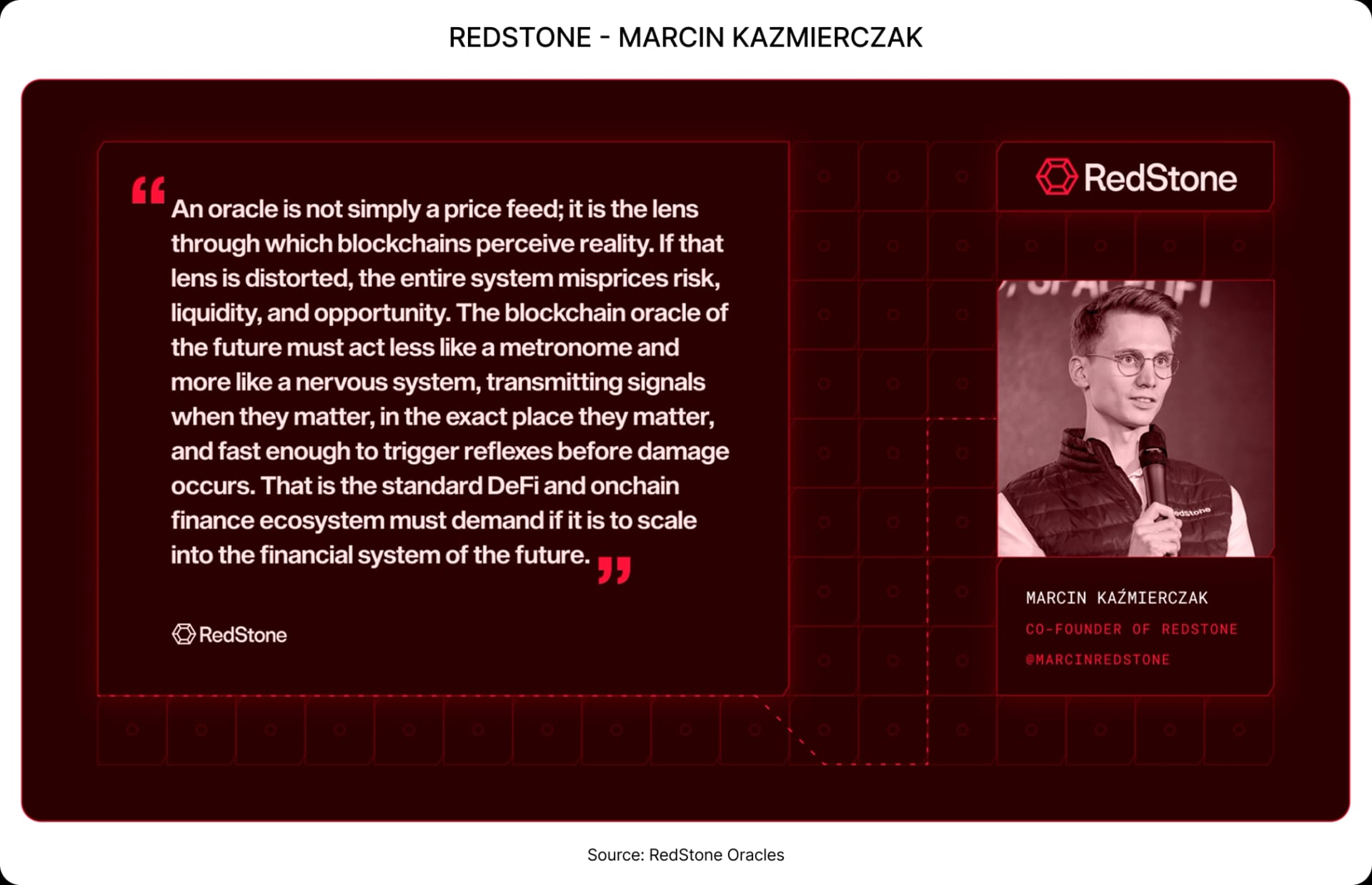
How RedStone Became the Fastest-Growing Oracle
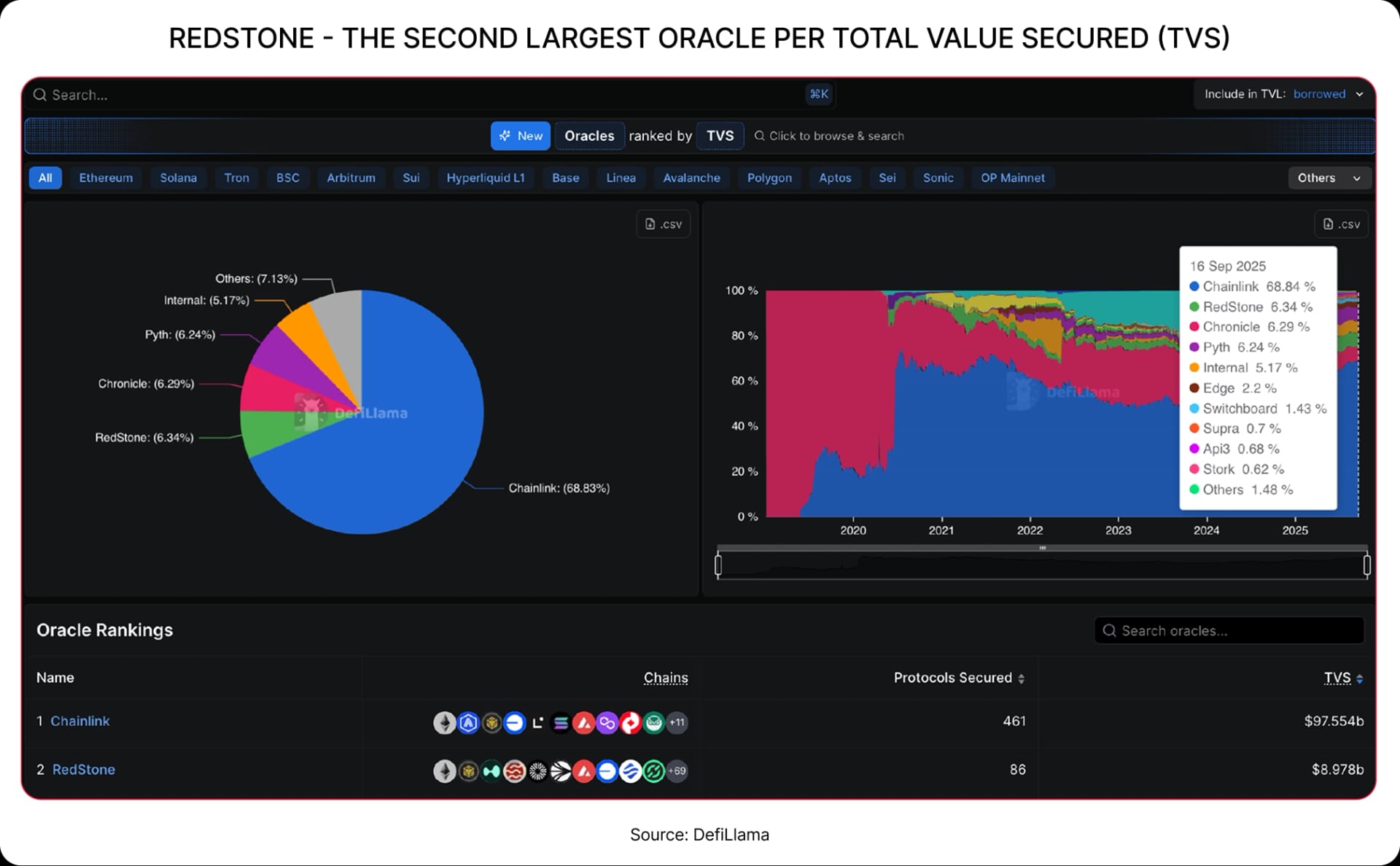
What specific aspects of RedStone's design enabled this rapid conquest of the DeFi ecosystem?
The systematic, professional and hard-working team co-founded by Jakub Wojciechowski and Marcin Kaźmierczak, along with their well-executed product growth strategy built on flexibility, market adaptability, and rapid execution, represents one of the defining factors behind RedStone's success. However, technical excellence stands as RedStone's defining advantage. Its price feed service delivers market-leading security, proven by protecting major DeFi protocols including Compound, Morpho, Ethena, Spark, Venus, Securitize, Drift and Kamino. Beyond traditional price feeds, RedStone pioneered innovative feed types: fundamental price feeds sourced directly from smart contracts, RWA oracles, and RedStone Bolt - the fastest push oracle at sub-2.4 milliseconds. RedStone emerged from the pressing need for oracle solutions during a period when infrastructure limitations severely constrained DeFi builders. This necessity drove RedStone's modular design, which directly addresses the blockchain industry's evolving demands for scalability and diverse price feed offerings.
RedStone’s motto is simple, yet very adequate: By builders, for builders.
But how does RedStone’s modular framework compare to other industry leaders, Chainlink and Pyth?
Chainlink: Push Oracle Grandfather
Chainlink pioneered the oracle space and fundamentally ignited the DeFi ecosystem, delivering the technology that powered "DeFi Summer" in 2020. Its AggregatorV3 push model interface became the industry standard, with the majority of DeFi developers building on its widely-adopted framework.
However, Chainlink's monolithic architecture has become increasingly constraining. The platform requires expensive full network redeployments for each new ecosystem, limiting it to just 26 chains with zero non-EVM support after five years of operations. This capital-intensive, non-scalable infrastructure creates economic sustainability challenges and prohibitively high costs for supporting innovation cycles. As a result, Chainlink has shifted from oracle innovator to legacy maintainer, predominantly managing existing clients rather than pioneering new DeFi primitives alongside emerging teams.
Pyth: Pull Oracle Advocate
Pyth Network pioneered the pull oracle model, bringing a fundamentally different approach to the oracle space that challenged Chainlink's push-based dominance. The platform achieved significant success by introducing cost- efficient, on-demand price updates that only occur when users request them, helping foster greater innovation and fresh perspectives in the oracle ecosystem.
However, Pyth's architecture creates several constraints. Its cross-chain delivery depends entirely on Wormhole's messaging system, creating a single point of failure that has caused feed disruptions during consensus issues. The platform lacks push model support, making it incompatible with existing DeFi infrastructure predominantly built on Chainlink's AggregatorV3 interface—forcing protocols to undergo costly migrations. Additionally, Pyth's reliance on third-party data providers severely limits custom use cases and innovation, as new asset support depends entirely on external providers meeting arbitrary thresholds such as trading volume rather than protocol-specific needs.
RedStone: Push & Pull Blockchain Oracle. By Builders, For Builders
As highlighted, there are currently two main approaches to oracles: push and pull models. However, providers often strongly defend their chosen methodology, claiming it to be the only viable solution for creating an optimal oracle framework.
That said, it is increasingly evident that a flexible and customizable approach is essential for success, as every team follows its unique path from designing a framework to implementing it and fostering protocol growth.

RedStone treats innovation as operational reality, not marketing speak. It is rapidly expanding its data product line across multiple dimensions, aiming to become the definitive blockchain oracle and data layer that serves builders with unique solutions tailored to specialized sub-sector needs. In the next section, we'll explore the publicly visible dimensions of RedStone's expansion strategy.
RedStone: The Most Secure, Scalable, and Innovative Oracle Network?
Blockchain oracles are not "one-size-fits-all" solutions. RedStone recognizes this fundamental truth and operates at the frontier of oracle design, accommodating every builder's unique requirements. While oracles remain the core of RedStone's offering, its ecosystem and offering has strategically expanded into complementary data services, including acquiring Credora’s DeFi ratings platform, to build a vertically integrated blockchain data ecosystem that transforms how DeFi protocols access and consume critical market intelligence.
Let's explore the full spectrum of RedStone's product suite.
RedStone Oracle: The DeFi Standard
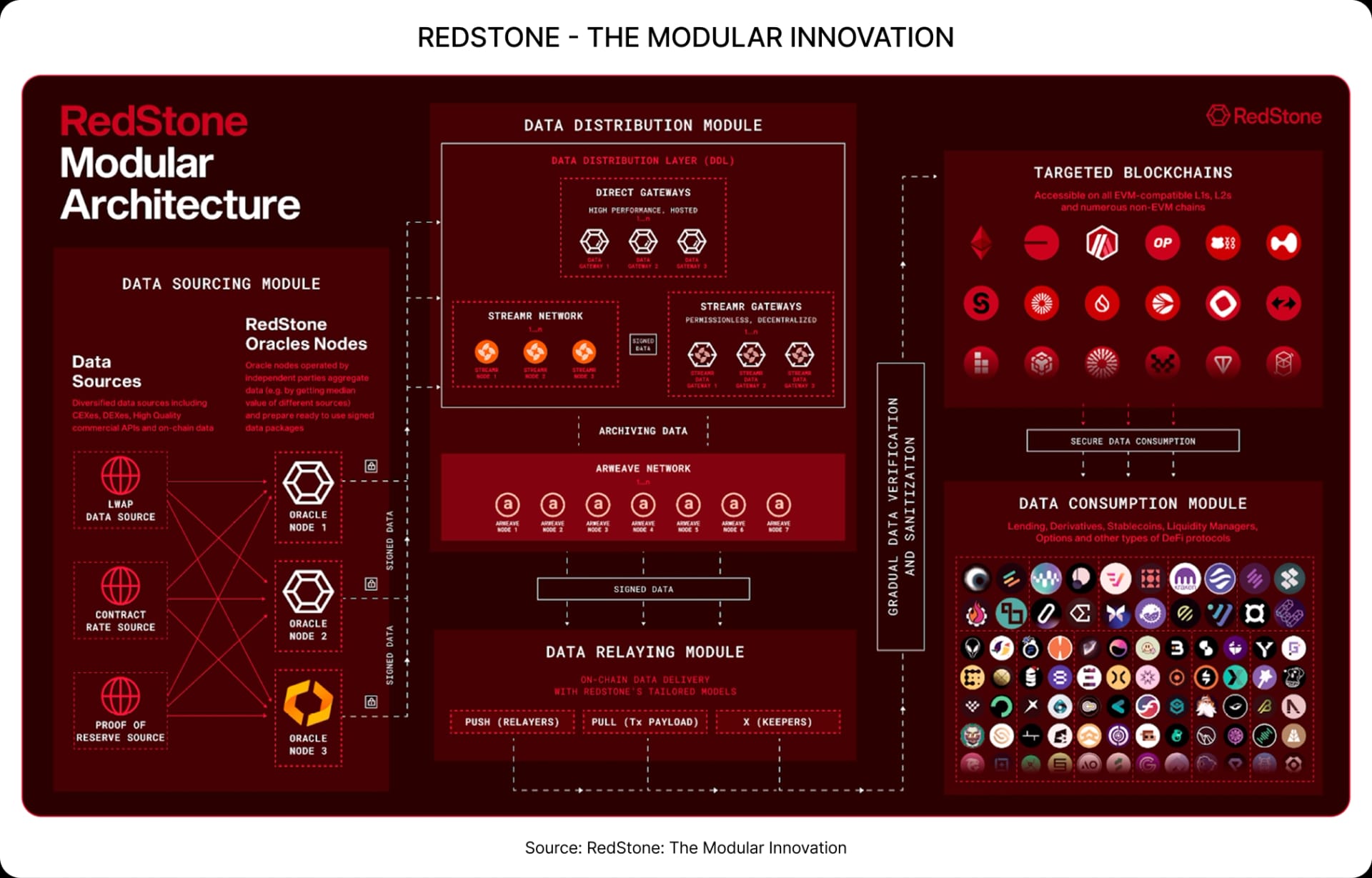
RedStone's blockchain oracle represents the flagship offering, delivering any asset to any blockchain through customized methodologies while maintaining the highest security standards with optimized resource expenditure. This capability has propelled RedStone to become the fastest-growing oracle service and the industry leader in quality and innovation.
What sets RedStone apart is its comprehensive data sourcing approach. The platform collects information directly from onchain sources, offchain APIs, and bespoke data providers including DEXes, CEXes, data aggregators, trading firms and TradFi/crypto custodians. This highly customizable data sourcing engine enables tailored solutions such as the LBTC/BTC feed for Lombard (the first Proof of Reserves Bitcoin LST oracle), the Proof of Reserves oracle for Ethena’s USDtb, with a bespoke monitoring dashboard, and dedicated validator tickets implementation for Puffer.
The RWA Oracle: Unlocking DeFi and TradFi Convergence
The global securities market, worth nearly $400 trillion, is extending onchain. Institutions like BlackRock and Apollo are already distributing tokenized private credit, treasuries, and private equity. According to RedStone’s Real World Assets report, DeFi has embraced this shift, with tokenized RWAs reaching $29 billion as of September 2025, and tokenized treasuries alone growing 85% in the first six months of 2025.
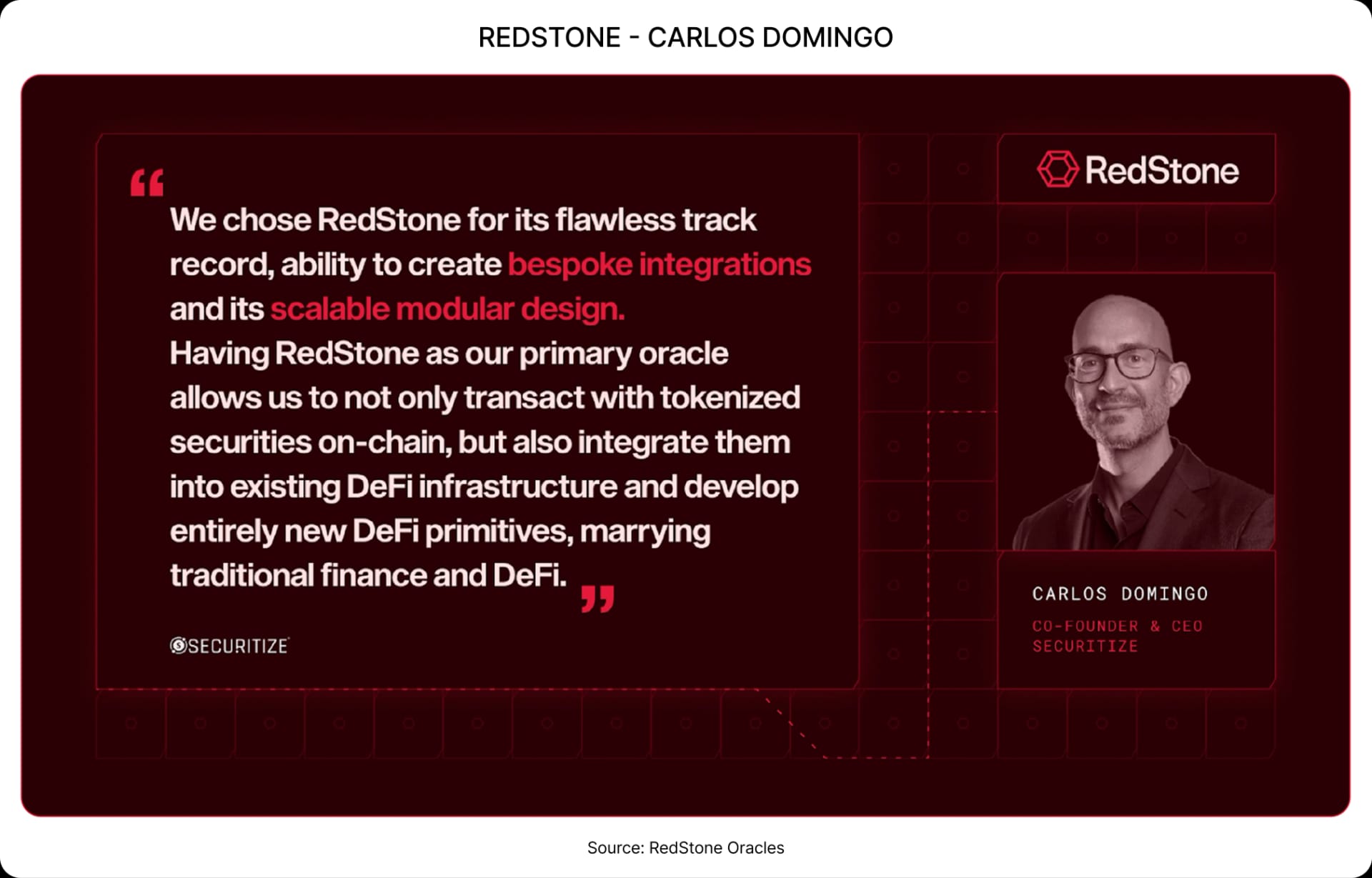
RWA oracles are building the foundation for tokenized assets to scale into the trillions, and for the next chapter of DeFi to be written on trusted, institutional-grade data. RedStone delivers innovative and tailored solutions, propelling that revolution.
RedStone x Credora: DeFi strategies and assets Ratings
For years, DeFi and TradFi operated on different principles: one open and fast, the other regulated and structured with risk frameworks at the heart of it. Now those two worlds are converging. RedStone has acquired Credora, the leading DeFi-native ratings platform. This creates the first oracle that delivers both real-time prices and DeFi strategies risk ratings. Protocols and users gain the tools to build safer and more transparent markets. The results are already visible - markets on Morpho that have Credora by RedStone rating grow faster than the ones lacking the rating.
Download the full report here
Download the "RedStone: The Fastest-Growing Blockchain Oracle Report" here (PDF)