




This spotlight is part of a series of deep-dive previews produced ahead of the upcoming State of RWAfi report, developed in collaboration with DefiLlama. The full report delivers a comprehensive, data-led assessment of the real-world asset landscape across DeFi, covering tokenised equities, real estate, commodities, and the broader structural forces shaping the next phase of onchain capital markets. The State of RWAfi Q1 2025 report will be published in the first week of April 2026.
RWAfi is often framed as the next big unlock for crypto. In theory, the idea is simple: put real-world assets onchain and make them programmable. In practice, the story is messier. Tokenising an asset is the easy part. Making that token legally enforceable, transferable, and usable across financial rails is much harder.
This helps explain why the RWAfi sector is developing unevenly. The asset classes that have scaled fastest are not necessarily the most ambitious. They are the ones where the legal wrapper is easiest to standardise and the operating model is easiest to defend.
That is also why regulation cannot be treated as a secondary issue in this sector. It sits at the centre of whether tokenised assets can move beyond issuance and function at scale. With that in mind, this article examines each major asset class and how the regulatory landscape around it is developing across its most important regions.
Why regulations matter more for RWAfi
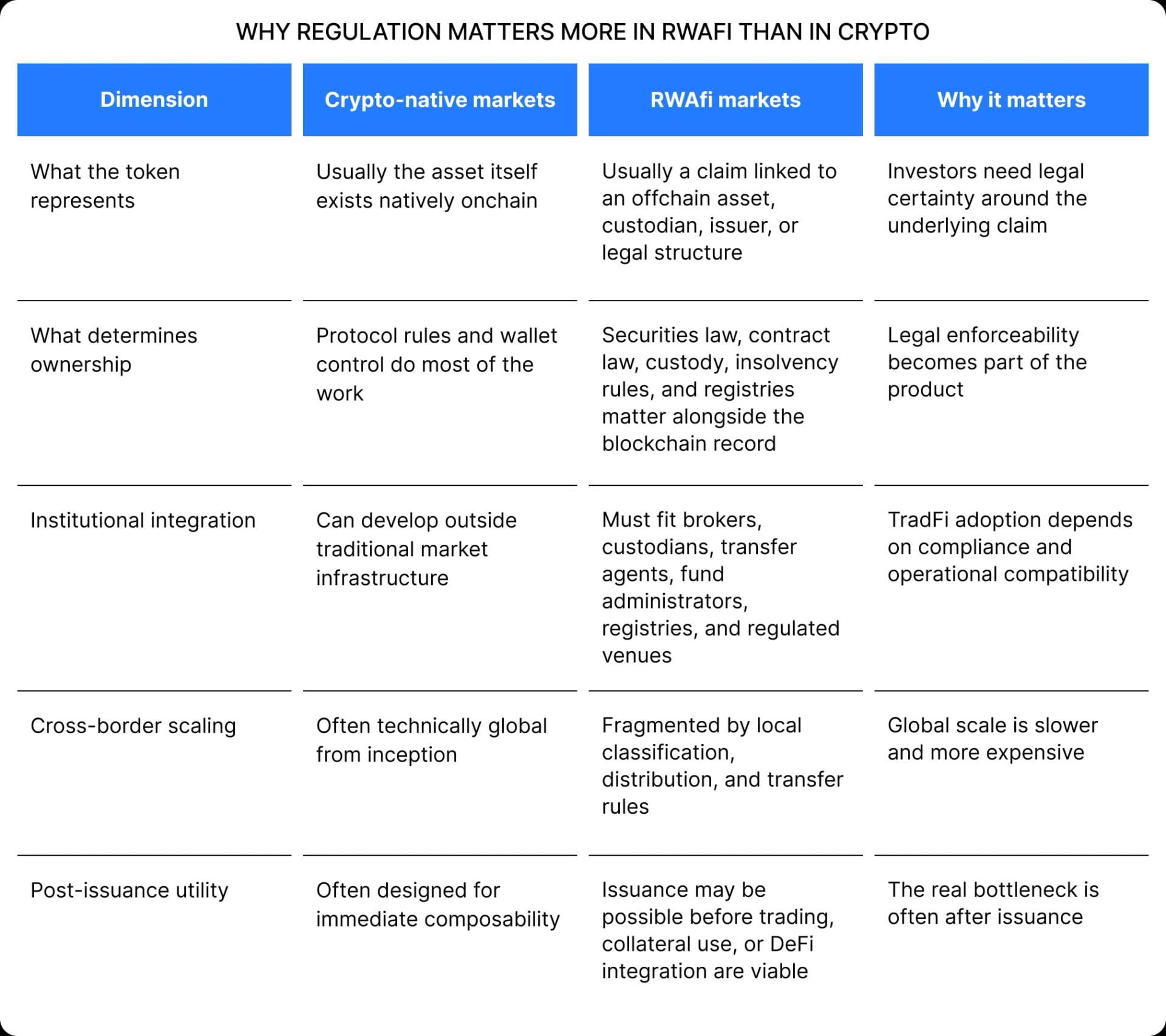
Compared to regular crypto assets, regulations matter far more for RWAfi adoption. The core difference is that crypto-native markets exist entirely onchain, so whether regulations exist or not, the asset's usage and ownership are governed by smart contracts.
With RWAfi, the token typically represents a legal claim on something offchain. That offchain layer can take many forms: a vaulted commodity, a broker-custodian chain holding shares, a fund or SPV owning property, or a private-market structure issuing debt or equity. As a result, transferability, enforceability, and insolvency treatment depend on external law and institutions just as much as they depend on smart contracts.
This is why institutions care more about regulation in RWAfi than in most of crypto. A bank, broker, custodian, fund administrator, or transfer agent can only support tokenised assets at scale if the rights attached to the token are unambiguous. That means clarity on who can buy the asset, whether the token qualifies as a security or another regulated instrument, how settlement and safekeeping work, and whether the token can move across venues without violating distribution rules or client-asset protections.
In practice, RWAfi adoption is rarely blocked by the ability to mint a token. It is blocked by the difficulty of aligning tokenisation with the rules that already govern the underlying asset. Comparing real-world assets (RWAs) to crypto assets on this dimension reveals clear differences across five areas.
Commodities: Easier to classify
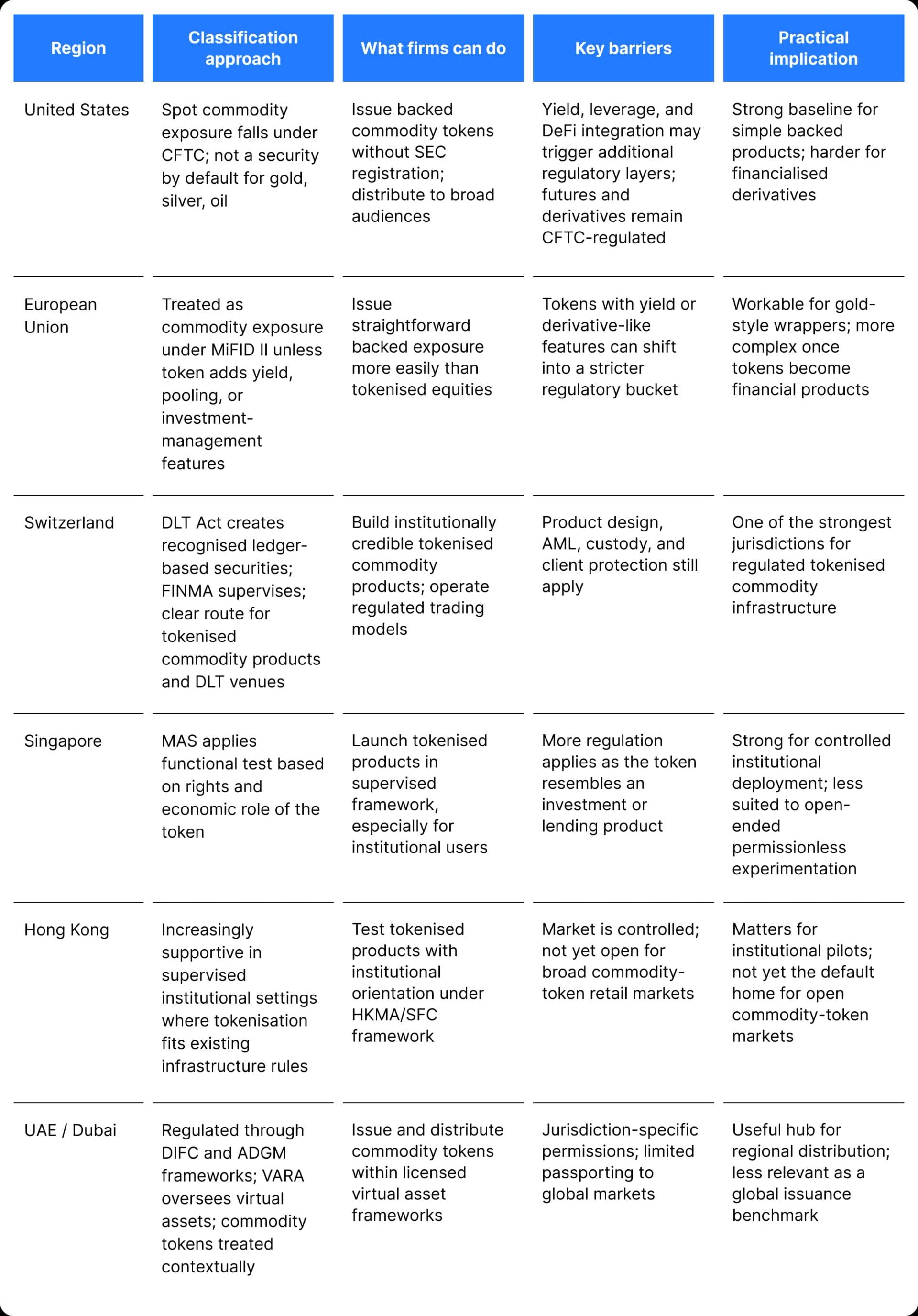
Commodities represent the most regulation-friendly entry point into RWAfi. In most major jurisdictions they are clearly distinguished from securities, which removes one of the central sources of uncertainty that has slowed tokenisation in other asset classes. That baseline clarity is the primary reason gold-backed tokens have scaled faster and more broadly than any other RWA category.
The regulatory environment is nonetheless layered. Simple backed exposure is generally workable. The complexity begins once commodity tokens enter DeFi, carry yield, or are used as collateral across protocols. At that point regulatory questions shift from classification to behaviour, and the answers are still being written.
Global Regulatory Landscape
The key dividing line in commodity regulation is not between jurisdictions but between what the token does. A token that simply represents a claim on a vaulted physical asset occupies a relatively clear regulatory space in most markets.
In the United States, spot commodity exposure falls primarily under CFTC jurisdiction rather than the SEC, meaning most backed gold or silver tokens are not securities by default. They can therefore be more easily traded and face less compliance.
In the European Union, MiFID II which is the main legal framework governing securities and commodities distinguishes between commodity instruments and securities based on the features of the product, and simple backed tokens generally fall outside the securities perimeter but once it becomes a yield bearing product the regulatory picture becomes more blurry.
Singapore's MAS applies a substance-over-form test, meaning the regulatory treatment depends on what rights the token gives the holder and what economic role it plays in practice. Commodity-linked products therefore remain workable where the token is limited to simple exposure, but the regulatory burden rises as the token begins to resemble a capital markets or lending product.
For commodities, the broad pattern is that tokenisation works best when the token just remains a claim on ownership of a commodity sitting in a warehouse while things become a lot more complicated when the product becomes more financialised and involves ways for investors to generate yield. The first model can often be accommodated within existing law. The second invites the full set of questions that also apply to investment products.
Tokenised stocks: Hard to integrate
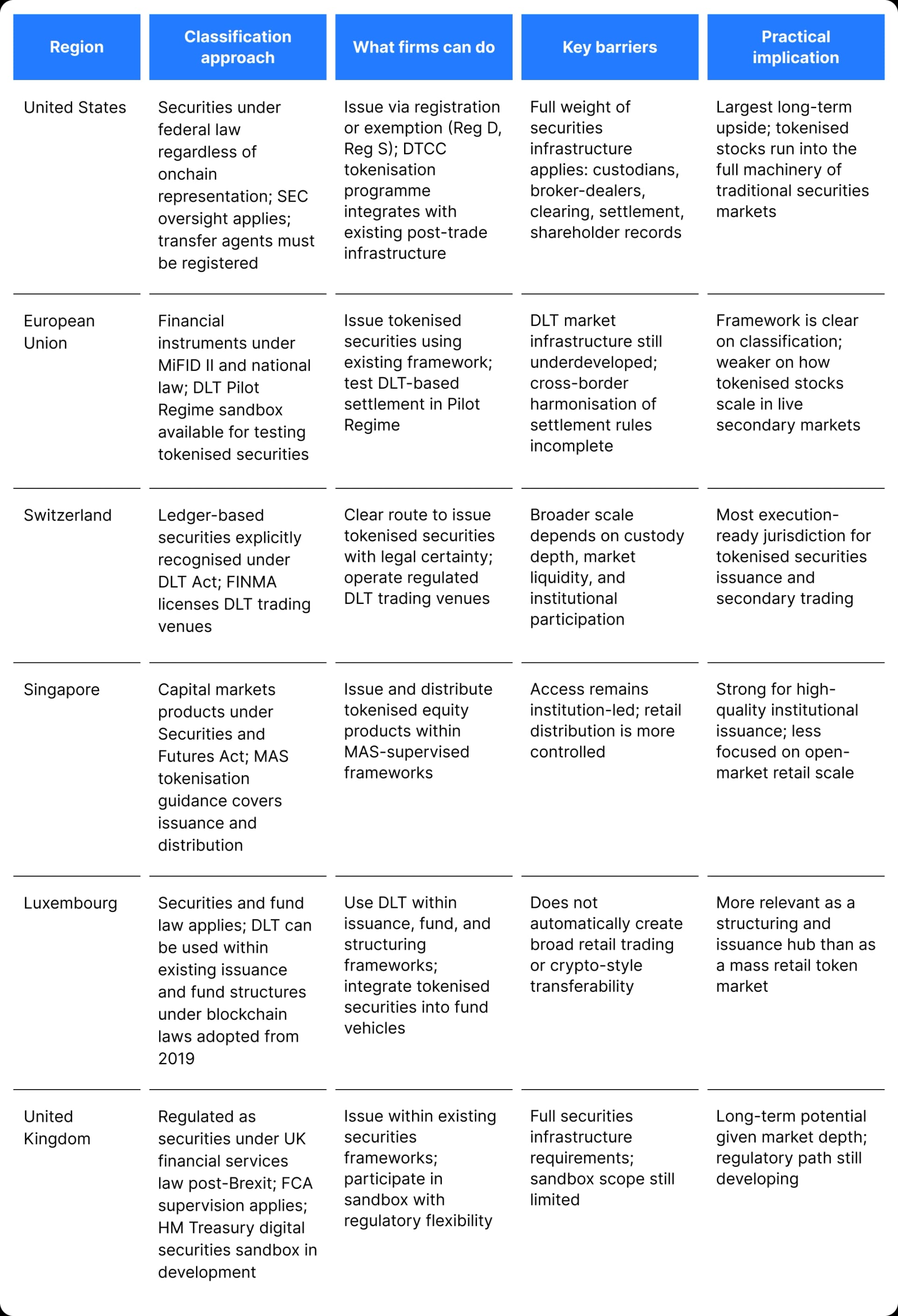
Tokenised equities occupy the most legally complex position in the RWA landscape. The underlying assets, public company shares, are among the most thoroughly regulated instruments in the world. Tokenisation does not remove that regulatory architecture. It places a new technical layer inside it, and whether that layer fits cleanly depends on how the token is structured and which jurisdiction it operates in.
The central question is not whether tokenised stocks are regulated. They almost always are. The question is whether the token can function within the existing plumbing of securities markets, including custodians, transfer agents, clearinghouses, and registered venues, or whether it requires those systems to be rebuilt around a new infrastructure.
Global Regulatory Landscape
In virtually every major jurisdiction, a token that gives holder rights equivalent to those of a share is treated as a security. That classification is not in dispute. The more complex question is how the token interacts with the broader machinery of equity markets once it has been classified.
In the United States, tokenised stocks remain securities under federal law regardless of whether they are recorded onchain. Issuers must comply with registration requirements or available exemptions. The SEC's position, reinforced through 2025 and into 2026, is that the technology used to represent the security does not affect the legal treatment of the underlying instrument. The infrastructure around the token, including transfer agents, custodians, shareholder records, and broker access, must also align with existing securities rules.
In the European Union, tokenised stocks that qualify as financial instruments do not fall under MiCA. They remain subject to MiFID II and related securities rules, with the DLT Pilot Regime providing a framework for testing DLT-based trading and settlement infrastructure from 23 March 2023. However due to the lack of clear regulations on tokenised securities it is not as straightforward to issue them in Europe and companies would have to comply with the existing regulations.
Switzerland stands out as the most execution-ready jurisdiction. Its DLT Act explicitly recognises tokenised securities, and FINMA has licensed DLT trading venues, giving issuers a clear route to launch tokenised securities with legal certainty and regulated market access.
Real estate: Bound by property law
Real estate is the most intuitive tokenisation narrative and the hardest sector to transform legally. Property ownership is anchored in local land law, registry systems, notarial processes, tax regimes, and jurisdiction-specific transfer rules that have existed for centuries.
As a result, most tokenised real estate today does not involve direct title tokenisation. It involves tokenising something around the asset: an SPV, a fund interest, a debt instrument, a trust structure, or another claim linked to property.
Global Regulatory Landscape
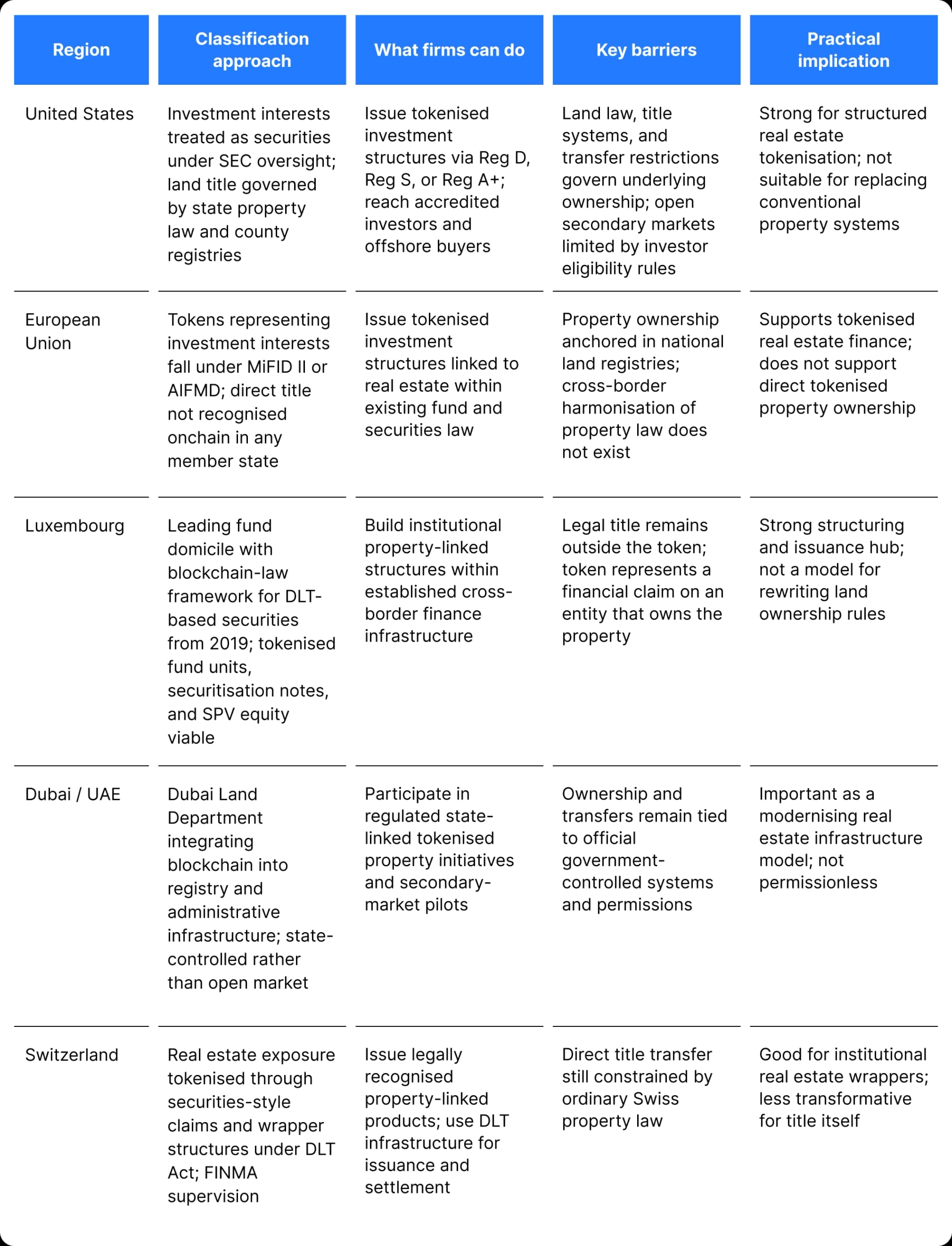
Real estate remains the asset class where the distinction between economic exposure and legal title matters most. In most jurisdictions, tokenisation does not replace the legal machinery that determines ownership of land.
Title continues to depend on local registry systems, notarial procedures, tax rules, and property-law formalities. As a result, most tokenised real-estate products represent an interest in a vehicle, fund, debt claim, or trust linked to the property rather than direct onchain title to the property itself
In the United States, tokenised real estate is therefore usually structured as a securities offering rather than as a new form of property registration. The token commonly represents an interest in an SPV, a fund, or a debt instrument, while the land title itself remains governed by state property law and county-level registry systems.
The same principle holds across the European Union. Where the token represents an investment interest, the relevant analysis usually runs through MiFID II, fund rules, or AIFMD depending on the structure. Direct transfer of title remains governed by national land registries and domestic property law, which has not been redesigned around blockchain-based ownership records in the major member states.
The UAE, and Dubai is an interesting example because it is one of the few markets trying to connect tokenisation more closely to the real-estate registration layer. The Dubai Land Department launched a dedicated real-estate tokenisation initiative in 2025 and moved it into a second phase in February 2026 that enabled resale activity in the secondary market for participating projects.
Alternative finance: Restricted by design
Alternative finance is the hardest RWA category to summarise from a regulatory perspective because it does not correspond to a single asset class. Private credit, private equity, venture capital, and carbon credits each sit in different legal buckets, are governed by different regulatory bodies, and carry different compliance requirements depending on how they are structured and where they are distributed. The only thing they share is that they are all private, operationally complex, and not yet well-served by traditional market infrastructure.
Tokenisation does not change those regulatory realities. What it changes is the cost and friction of operating within them.
Global Regulatory Landscape
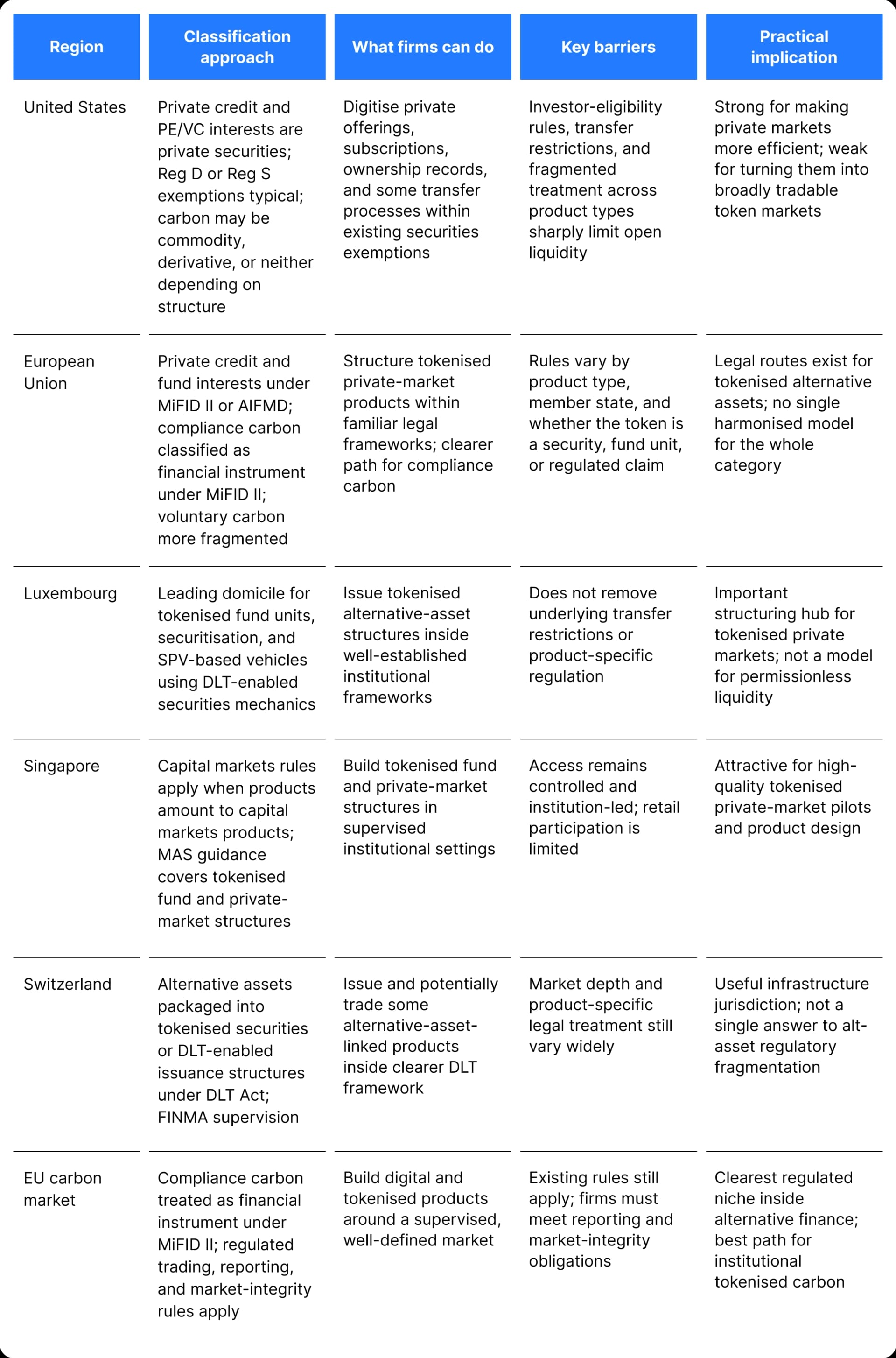
Private credit tokens are almost universally treated as securities or fund interests, depending on their structure.
Private credit and private-market fund interests remain governed primarily by securities and fund law. In the United States, those products are commonly issued through private-offering exemptions. In the European Union, the analysis usually turns on MiFID II, AIFMD which is the same regulations that applies to traditional investment funds.. Investor-eligibility checks, transfer restrictions, disclosure obligations, and distribution limits therefore remain in place after tokenisation.
Private equity and venture capital exposure follows the same logic. Tokenisation can improve how ownership records are maintained and how transfers are processed within permissioned channels, but it does not remove the constraints of securities law that make private markets hard to access than public equities which is why so many of these products are still permissioned and do not integrate well with DeFi.
Where things are more interesting is issuance. Luxembourg has become particularly relevant in this part of the market because tokenisation here is often about fund administration and structuring rather than the secondary market. Its fourth blockchain law introduced the control-agent regime for tokenised funds, and the first control-agent licence was granted in 2025. That strengthens Luxembourg’s role as a domicile for institutionally oriented tokenised funds, securitisation vehicles, and other private-market structures that want to issue tokenised private equity, private credit or establish a tokenised fund.
Carbon credits occupy a distinct position. Compliance carbon, in the form of emissions allowances under cap-and-trade systems, is classified as a financial instrument under MiFID II in Europe, giving it a clearer regulatory perimeter. In the US carbon credits are often treated as commodities.
Regulatory fragmentation is the biggest challenge
Regulatory fragmentation is widely acknowledged as a challenge for cross-border financial markets, but in RWAfi it takes on a more central role. It becomes a core risk for the sector, particularly for assets expected to operate in permissionless, globally accessible systems such as DeFi.
In traditional finance, fragmentation is burdensome but manageable because products are distributed through licensed intermediaries that apply jurisdiction-specific compliance controls at the point of sale. The asset itself does not need to be universally transferable, as it moves through controlled channels that screen for investor eligibility, apply distribution restrictions, and enforce reporting obligations throughout the transaction chain. Legal complexity is therefore contained within the intermediated structure of the market.
RWAfi operates under a different set of assumptions. DeFi does not rely on jurisdiction-specific distribution channels or intermediary oversight, and transactions are executed through smart contracts that cannot determine whether a wallet belongs to an accredited investor under US securities law, a professional client under MiFID II, or a retail user in a jurisdiction where the product cannot be legally offered.
Regulatory fragmentation therefore creates more than additional cost or complexity in RWAfi. It introduces a direct tension between the global transferability of crypto assets and the jurisdiction-specific rules that determine whether an asset can be lawfully held or traded. As RWAfi becomes more liquid and portable onchain, preserving the compliance framework that underpins the asset becomes increasingly difficult.
Market participants have responded by embedding compliance controls directly into tokens, typically through whitelists, transfer restrictions, or KYC requirements at the smart contract level. These mechanisms allow issuers to maintain legal compliance across jurisdictions, but they also limit the composability that makes tokenisation attractive. A tokenised stock that can only move between approved addresses, for example, cannot be freely used as collateral within DeFi protocols.
As long as legal regimes remain fragmented, most RWA tokens are likely to remain permissioned, and deeper integration into onchain finance will be limited to assets with relatively clear and consistent treatment across jurisdictions.
Addressing fragmentation in RWAfi will ultimately require either greater international coordination around shared principles for tokenised assets or the development of more advanced compliance infrastructure capable of enforcing jurisdiction-specific rules at the protocol level without undermining composability.