



Executive Summary
Key Insights
- Stablecoins are now the dominant form of onchain money, but usage remains fragmented across chains and infrastructures.
- General-purpose blockchains treat stablecoins as secondary assets, while issuer-led chains prioritise control, leaving a gap for a neutral, settlement-focused layer.
- Plasma is purpose-built for stablecoin settlement, embedding native modules such as gasless transfers, stablecoin-based gas, and confidential payments directly into the blockchain.
- DeFi functionality and deep liquidity are available from day one through partnerships with Aave, Curve, Fluid, Wildcat, Pendle, Ethena, and Binance Earn.
- Plasma’s differentiation rests on three pillars: accessibility with sustainability (free USDT transfers funded by programmable activity), integrated yield and liquidity (stablecoin balances made productive at scale), and neutrality with a decentralisation roadmap (avoiding reliance on any single issuer or sponsor).
- A phased roadmap, from launch and liquidity seeding to decentralisation, the pBTC bridge, and multi-stable integrations, positions Plasma to unify stablecoin activity across retail, institutional.
Summary
Stablecoins have moved from the periphery of digital assets to their centre of gravity. They now account for the majority of transactional volume in decentralised finance and are increasingly used in payments, remittances, financial instruments and as a dollar-denominated store of value. Their appeal is rooted in four attributes: they are permissionless, programmable, cheap, and fast. For millions of users globally, stablecoins represent access to reliable digital dollars outside the constraints of traditional banking infrastructure.
Regulation is gradually catching up. While frameworks remain uneven across jurisdictions, the direction is toward recognition and adoption. The combination of user demand, institutional interest, and regulatory clarity positions stablecoins as one of the most durable segments of the digital asset ecosystem.
The Challenge of Fragmentation
Despite this growth, the market is highly fragmented. Stablecoin activity is spread across multiple blockchains, none of which offer the combination of scale, usability, and neutrality required to consolidate flows at global level.
General-purpose chains such as Ethereum, Solana, and Layer 2s have supported early adoption, but stablecoins remain secondary to their core design. This creates friction: users face high fees, fragmented liquidity, and inconsistent integration across scaling layers. Tron, while dominant in remittances, serves a narrow use case and lacks the depth of DeFi activity or broader functionality beyond simple transfers. On the other side of the spectrum, issuer-led and corporate-backed chains such as Arc, Stable, and Tempo offer compliance and distribution advantages, yet they remain centralised or tied to single issuers, raising questions about neutrality and long-term resilience.
The result is an infrastructure gap. Stablecoins are growing rapidly, but the rails supporting them are either broad and inefficient or narrow and controlled. What is missing is a settlement layer that combines efficiency, neutrality, and scalability built specifically for them.
Plasma’s Proposition
Plasma was designed to solve this fragmentation. It is a settlement layer purpose-built for stablecoins, embedding them as first-class primitives at the architectural level. Features such as gasless USDT transfers, stablecoin-based fees, and confidential payments are combined with PlasmaBFT consensus to deliver sub- second finality, predictable economics, and high throughput.
Plasma’s ecosystem strategy ensures it launches not as a bare network, but as a financial stack. Partners such as Curve and Fluid, Aave, Euler, Wildcat, Binance Earn, Ethena, and Pendle provide a complete DeFi ecosystem from day one. Merchant rails are established through Yellow Card, BiLira, and other payment partners, linking stablecoin settlement directly into real-world corridors.
The design extends beyond stablecoins into Bitcoin through pBTC, a canonical omnichain asset secured via MPC-based bridging. Together, multi-stable support and pBTC integration position Plasma as a neutral settlement hub, not a single-issuer chain.
The competitive landscape is heating up. Tron dominates retail remittances, Ethereum anchors institutional flows, and new entrants such as Arc, Stable, and Stripe’s Tempo are targeting niches. Plasma differentiates itself through three pillars:
- Accessibility with sustainability: free USDT transfers as an onboarding funnel, funded by revenue from programmable activity and institutional services.
- Integrated yield and liquidity: partnerships that make stablecoin balances productive at scale.
- A focus on emerging markets to offer tangible and resilient solutions to countries where access to stable financial infrastructure is limited and inflation erodes purchasing power.
This positioning sets Plasma apart. It is neither a general-purpose blockchain nor an issuer-led environment, but a neutral settlement layer designed to consolidate fragmented stablecoin activity across the ecosystem.
Roadmap & Catalysts
Plasma’s roadmap compounds adoption in sequenced waves. The immediate focus is on mainnet launch and the token generation event, establishing the technical and economic foundations of the network. Strong partnerships will bootstrap liquidity and deliver a strong start, which will require continued attention and reinforcement to sustain growth.
The next stage emphasises decentralisation and asset expansion. Plasma follows a progressive decentralisation model, beginning with a trusted validator set and broadening participation as the protocol hardens. The launch of the canonical pBTC bridge extends the network beyond stablecoins to Bitcoin, anchoring liquidity from the world’s largest digital asset. Additional stablecoins and regional issuers will be integrated progressively, reducing reliance on any single issuer and widening adoption.
In the longer term, Plasma aims to become a venue for institutional settlement and programmables. Compliant privacy, treasury-grade infrastructure, and programmable yield extend functionality into FX settlement, corporate treasuries, and structured DeFi applications. At full maturity, Plasma positions itself as the neutral settlement layer for digital dollars.
Risks and Resilience
Plasma acknowledges that risks remain. Regulatory developments are uneven across jurisdictions, while technical challenges such as bridge security, validator concentration, and gasless economics are industry- wide concerns. Competitive pressure is intensifying as new chains emerge. Plasma mitigates these risks through progressive decentralisation, MPC-secured bridging, slashing mechanisms, and anchored liquidity partnerships.
Outlook
In a market defined by both innovation and fragmentation, Plasma offers a differentiated model: a chain purpose-built for stablecoins, architected for efficiency, designed for neutrality, and sequenced for sustainable growth.
If executed effectively, Plasma has the potential to unify stablecoin settlement across retail, institutional, and DeFi markets, and to serve as the infrastructure where digital dollars achieve global scale.
Introduction
Stablecoins have rapidly evolved into the dominant form of onchain money, now accounting for the largest share of transactional volume across decentralised finance, remittances, and digital payments. Their appeal rests on four attributes: permissionless access, programmability, low cost, and speed. For users in both developed and emerging markets, stablecoins function as digital dollars, serving as a store of value, a medium of exchange, and a vehicle for cross-border settlement. Regulatory frameworks, while uneven, are gradually converging toward recognition of stablecoins as legitimate components of the financial system, creating a supportive environment for continued adoption.
Yet the market remains fragmented. Activity is spread across multiple blockchains, none of which combine scale, usability, and neutrality in a single design. General-purpose chains such as Ethereum, Solana, and Layer 2s have supported adoption but treat stablecoins as secondary tokens rather than core infrastructure. This leads to high costs, fragmented liquidity, and inconsistent user experiences.
The result is a market at an inflection point: demand for stablecoins continues to grow, but the infrastructure to support that growth at scale has yet to emerge. What is needed is a settlement layer designed specifically for stablecoins, one that unifies fragmented activity, supports multiple issuers, and provides both efficiency and openness.
Plasma was created with this vision. It is a network designed around stablecoins as its foundation, aiming for inclusivity across all use cases, from everyday payments and remittances to DeFi and institutional settlement. To achieve this, Plasma introduces features such as gasless transfers, stablecoin-based fees, and confidential payments, alongside near-instant settlement, ultra-low costs, and integrations that anchor liquidity across the ecosystem.
This report evaluates Plasma’s design and positioning within the stablecoin market. It opens with an overview of market dynamics and adoption drivers, highlighting why a stablecoin-centric chain is strategically relevant. It then reviews Plasma’s architecture and performance model, followed by an analysis of its liquidity strategy and key partnerships. A review of the competitive landscape and key risks comes next. The report concludes with Plasma’s roadmap and catalysts, and an assessment of its long-term potential as a neutral settlement.
Stablecoin, a Market at Blockchain Scale
Stablecoins are no longer a side product of crypto. They are a market of their own, rivaling entire blockchains in scale and driving adoption across DeFi, payments, and remittances. Institutions are entering, governments are regulating, and issuers like USDT and USDC now act as global financial entities.
This section maps that landscape, from supply growth and usage patterns to institutional demand, regulation, and case studies like Tron, to show how Plasma can position itself as the dedicated chain for stablecoin settlement, unifying a market that is expanding faster than any other in crypto.
The Scale of the Stablecoin Market
Supply and Transactions Show Explosive Growth
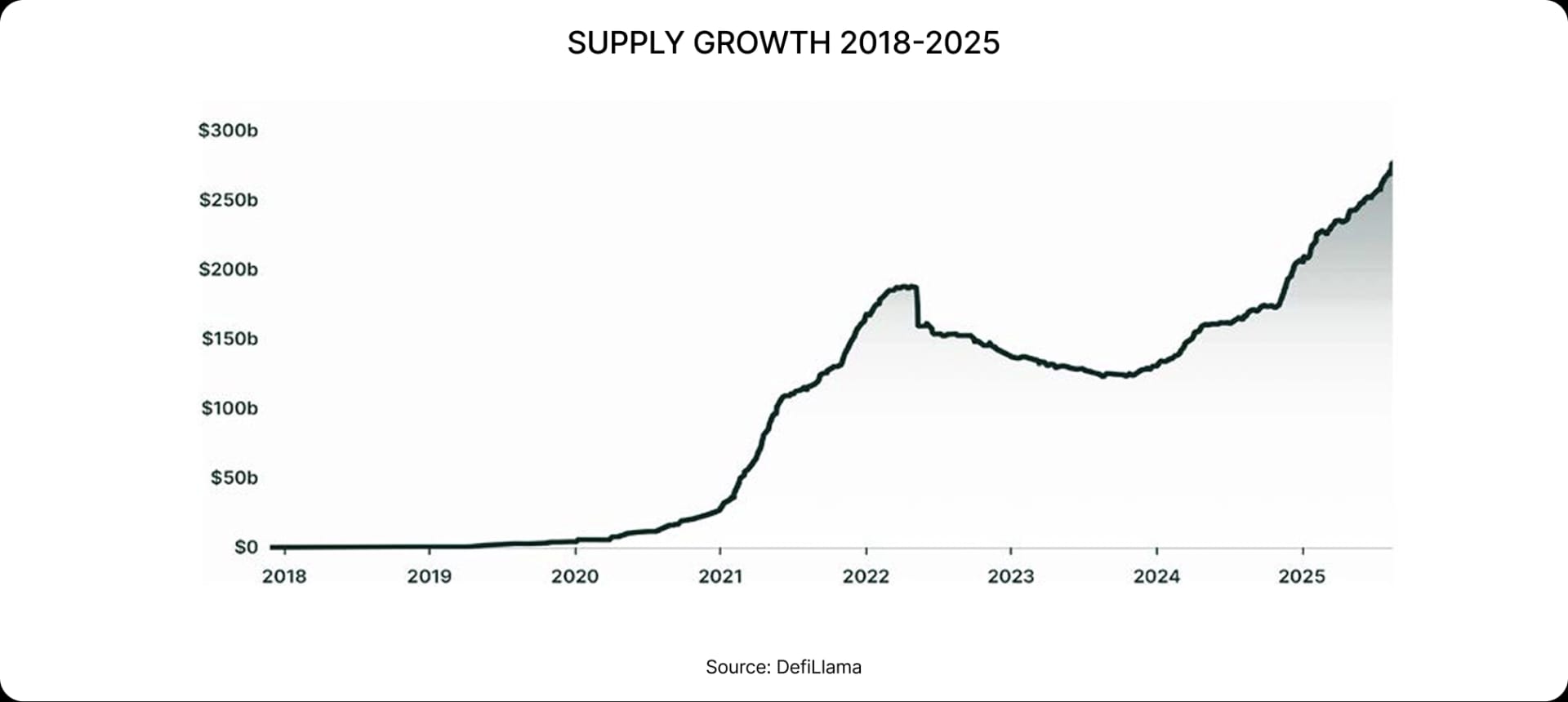
Supply growth has been extraordinary. At the beginning of 2024, the aggregate stablecoin supply stood at around $130 billion. By January 2025 this had climbed to $207 billion, representing a 59% increase over the year.
Growth accelerated further into 2025: by August, supply had reached $280 billion, up 40% year-to-date and 75% compared with the same point the previous year.
Stablecoins now account for roughly 1% of the entire U.S. dollar supply, up from 0.63% at the start of 2024, a significant increase given that regulation is not yet fully established.
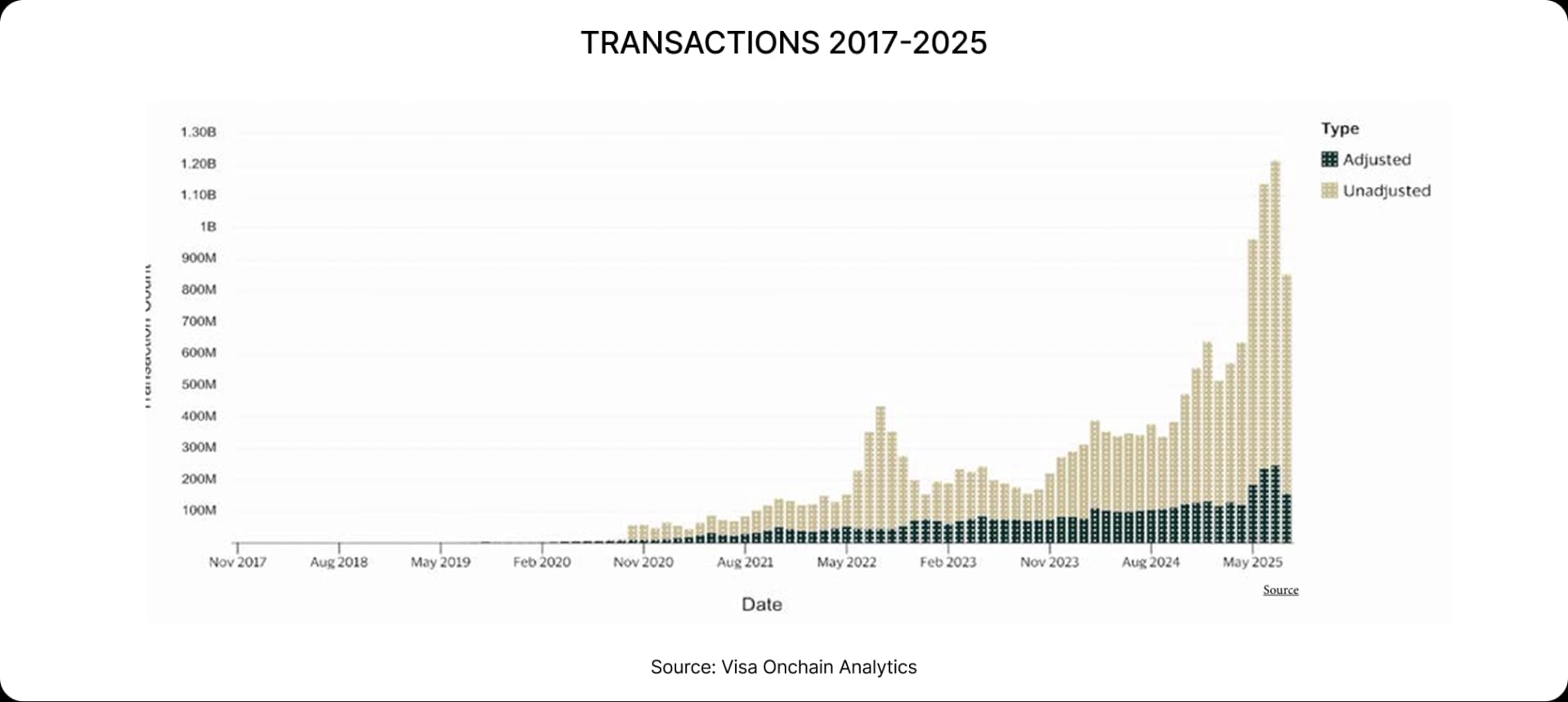
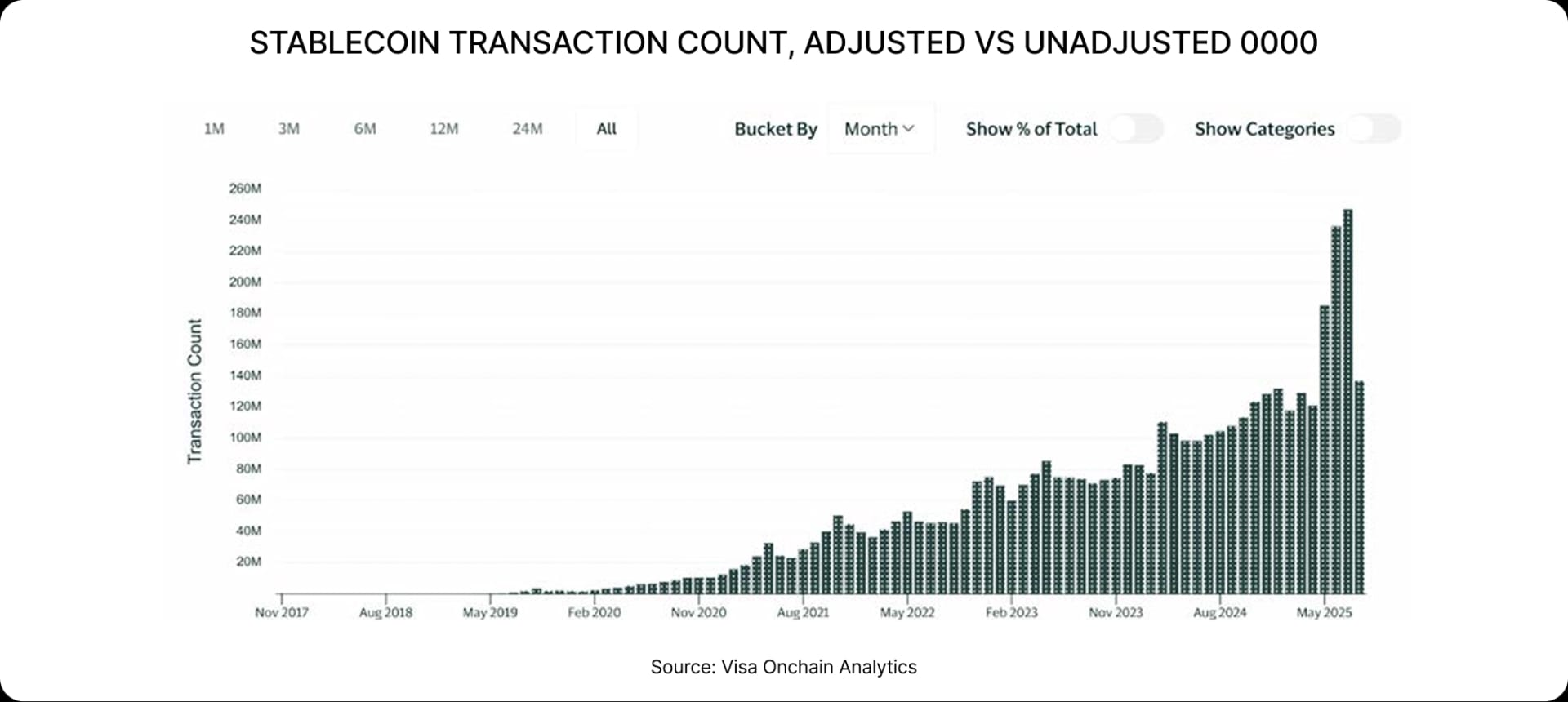
Once adjusted to remove inorganic flows, transaction counts average around 120 million per month, with recent peaks between 180 and 240 million, more than double the 100 million recorded in August 2024, underscoring clear adoption growth.
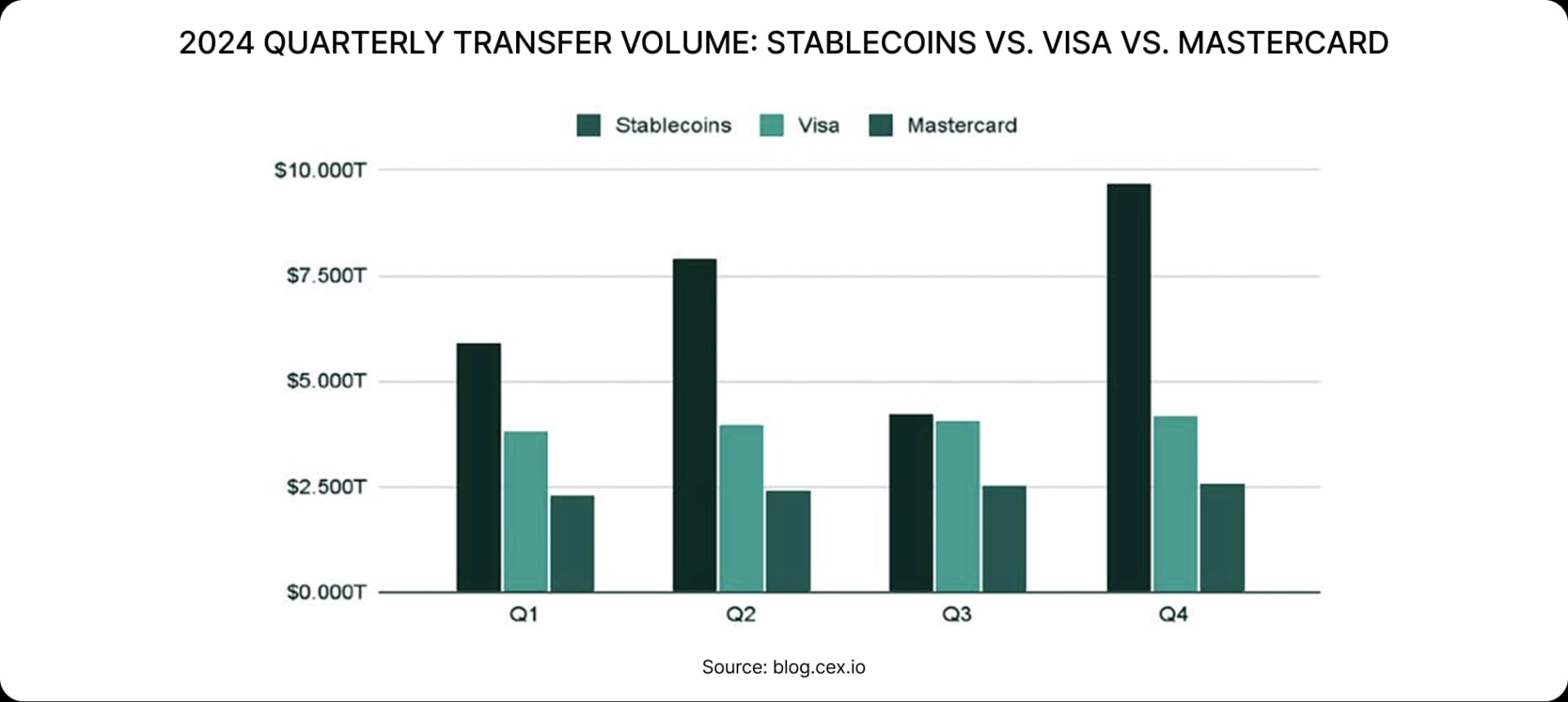
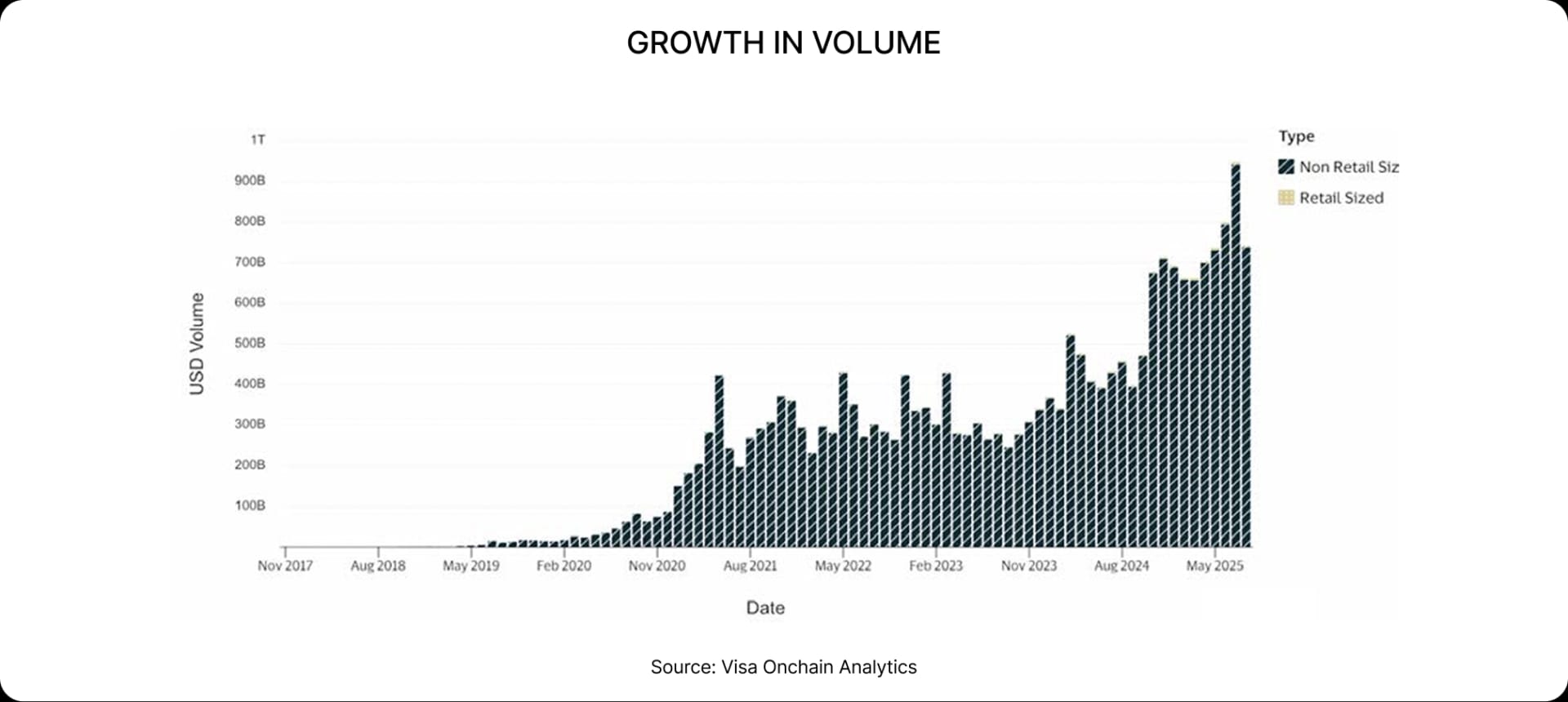
Stablecoin Activity Is Now Comparable in Size to Leading Blockchains
At first glance, hundreds of millions of stablecoin transactions per month may appear large, but the true scale only becomes clear when measured against networks that define the industry’s throughput benchmarks.
Checking the network activity, Ethereum processes roughly 1-1.5 million transactions per day. This translates to around 30-45 million per month unadjusted. Still on a non-adjusted basis, Base currently handles around 9 million daily transactions, or about 270 million per month. BNB Smart Chain averages 12 million per day, equivalent to 360 million per month. Arbitrum processes around 90 million monthly transactions, while Tron records close to 280 million transactions monthly. Solana stands apart with scale unmatched by most networks, consistently recording over 2 billion non-vote (that is, organic) transactions per month, reflecting both high user activity and applications optimised for rapid throughput.
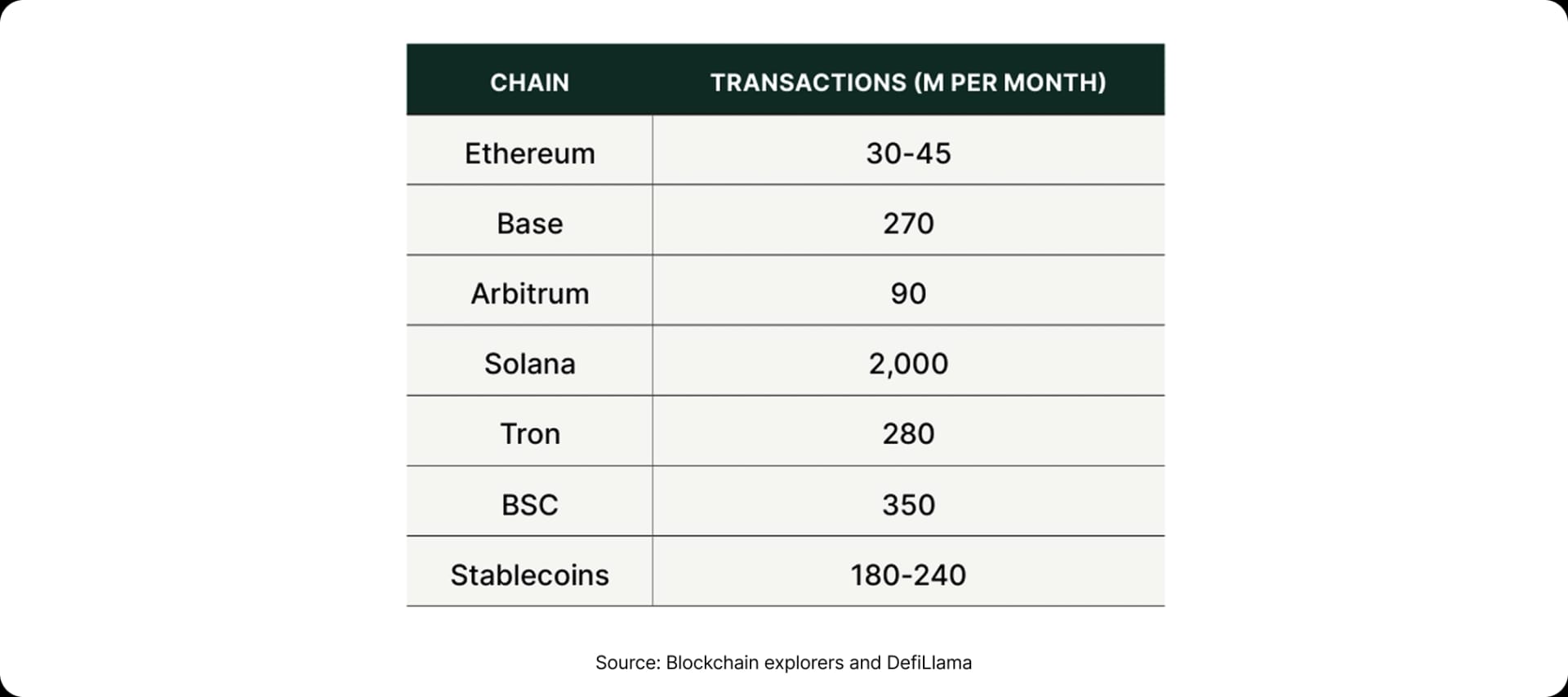
The implication is clear: stablecoins, though not a blockchain themselves, have reached a point where their transactional footprint rivals the largest networks in the industry.
A Surge in Issuers
Another important dimension of the market is the breadth of stablecoins being issued and the speed at which new entrants have appeared. In January 2023, only three stablecoins, DAI, USDT, and USDC, had market capitalisations above $1 billion. Today, that figure has grown to ten, a sign of both investor demand and issuer confidence in the asset class.
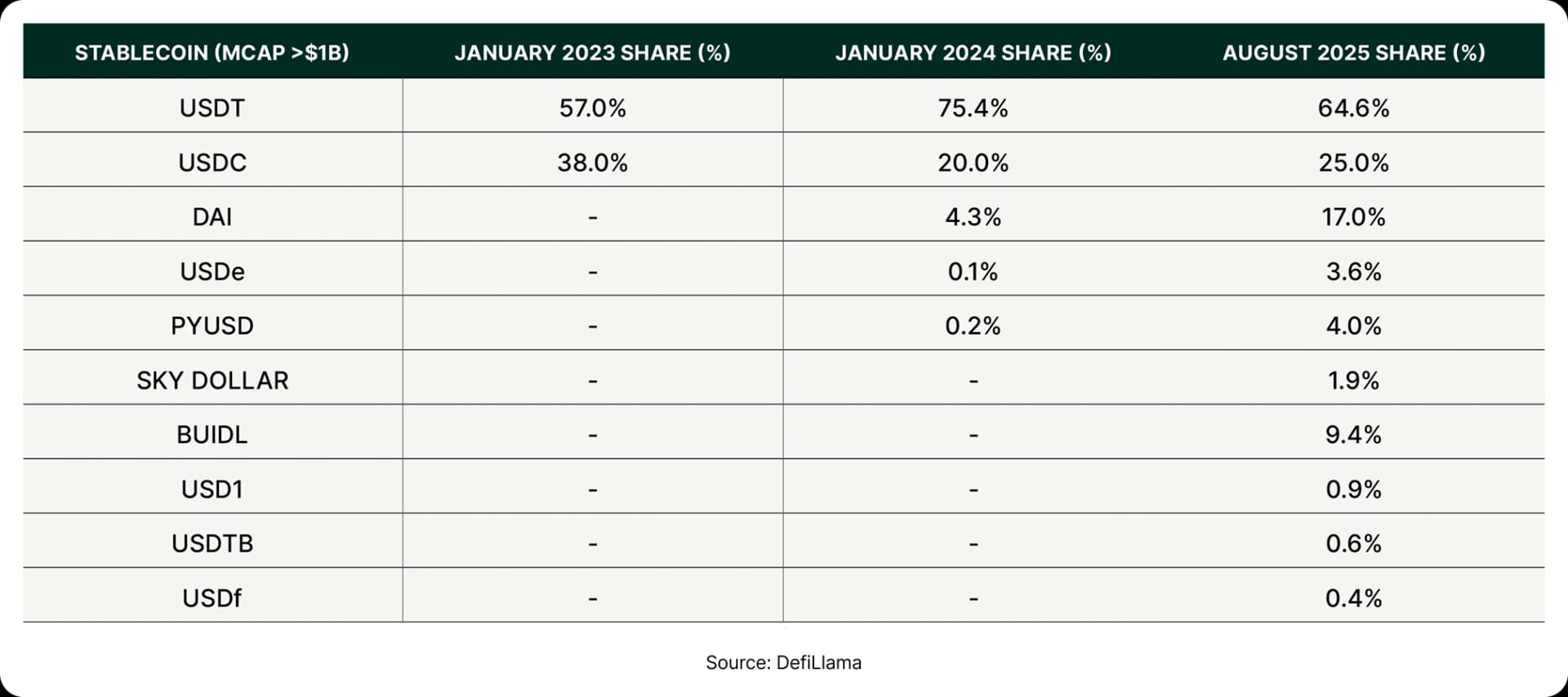
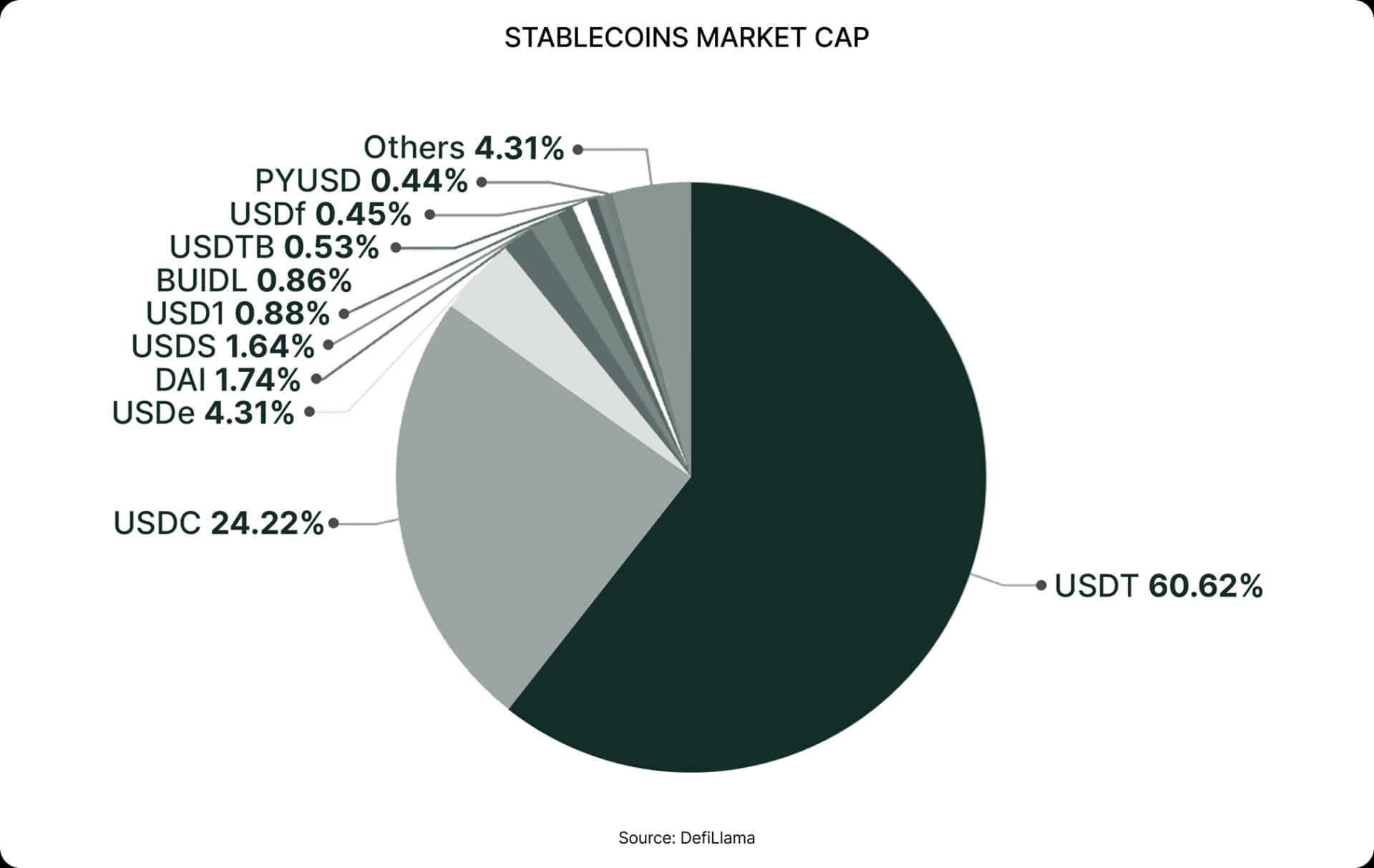
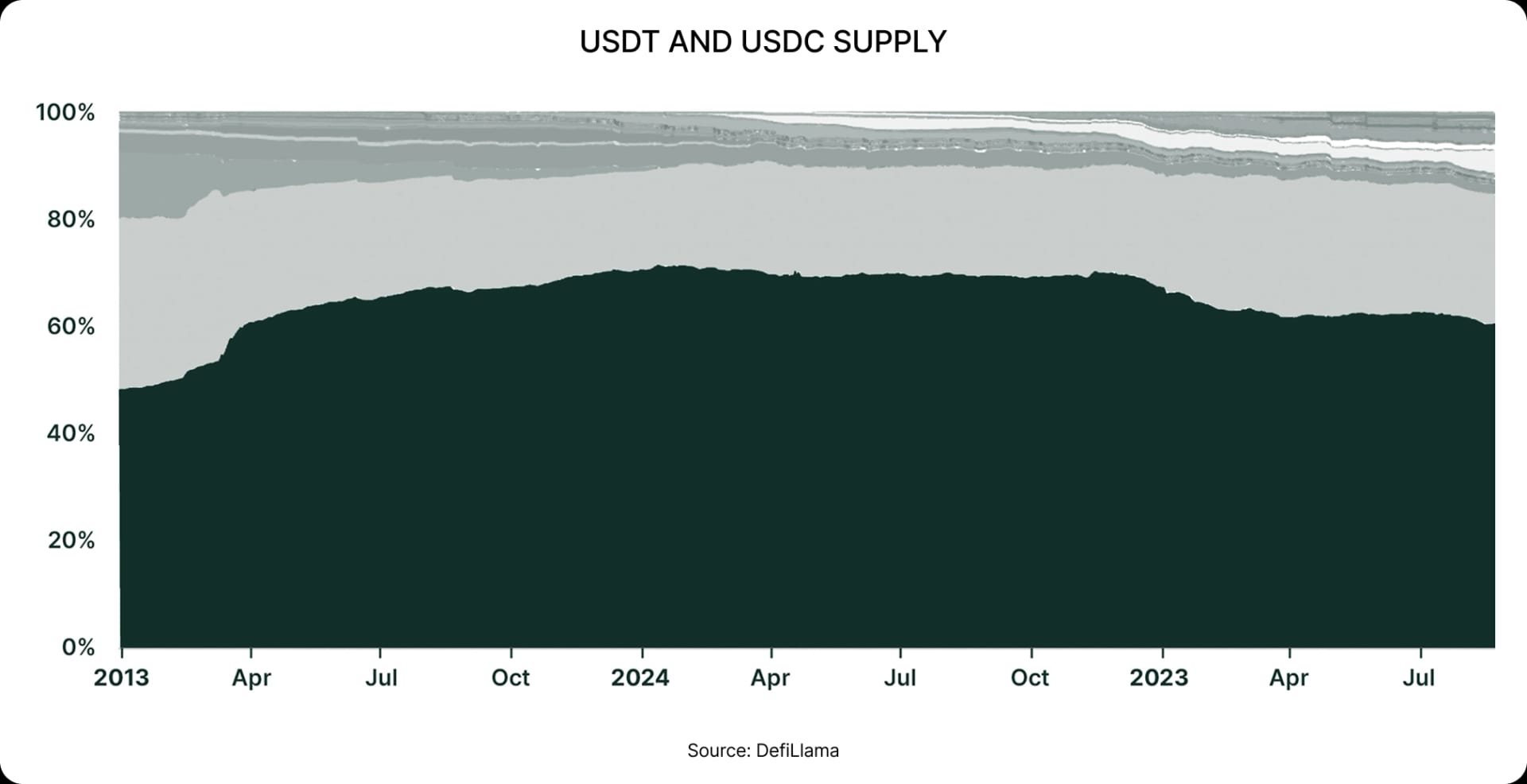
Despite this proliferation, dominance at the top remains clear. USDT and USDC together account for the majority of the supply. USDT holds around 60.6% of the market, while USDC accounts for 24.2%. Since the “sunset” of BUSD in early 2023, these two have consistently maintained their lead, with USDT fluctuating between 60% and 70% of the market share and USDC between 18% and 25%. In practice, this means that all other stablecoins are competing over a residual market share of about 25%.
Different Chains, Different Uses
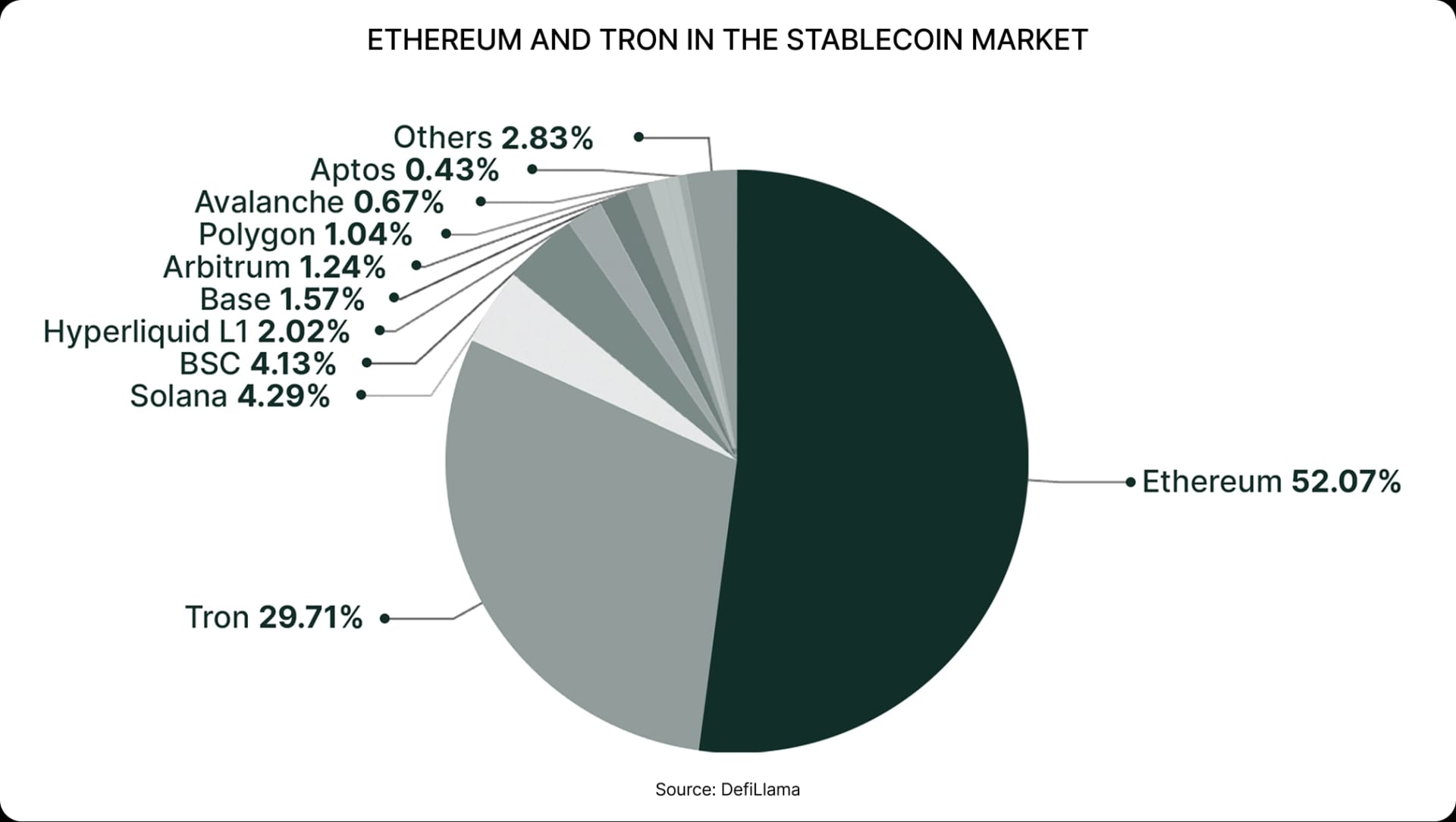
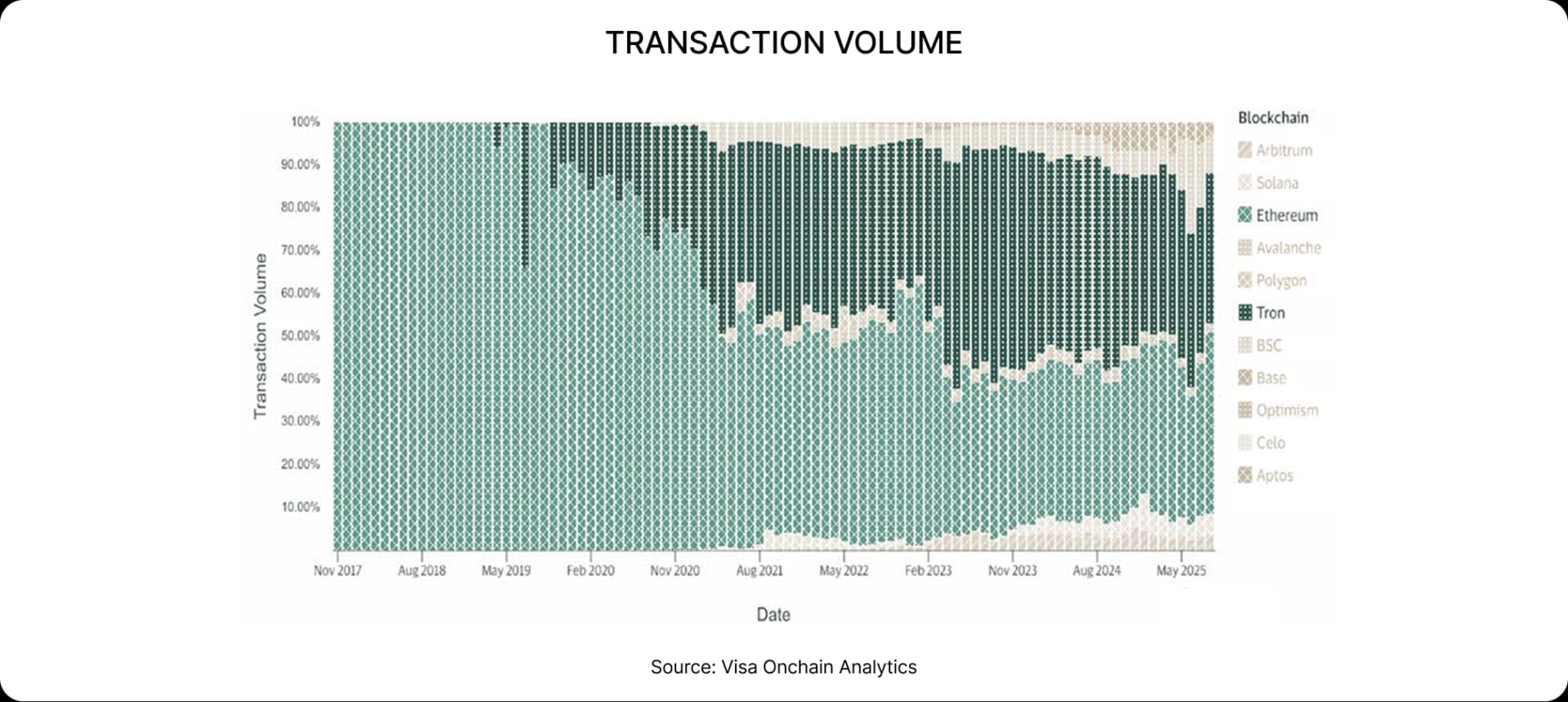
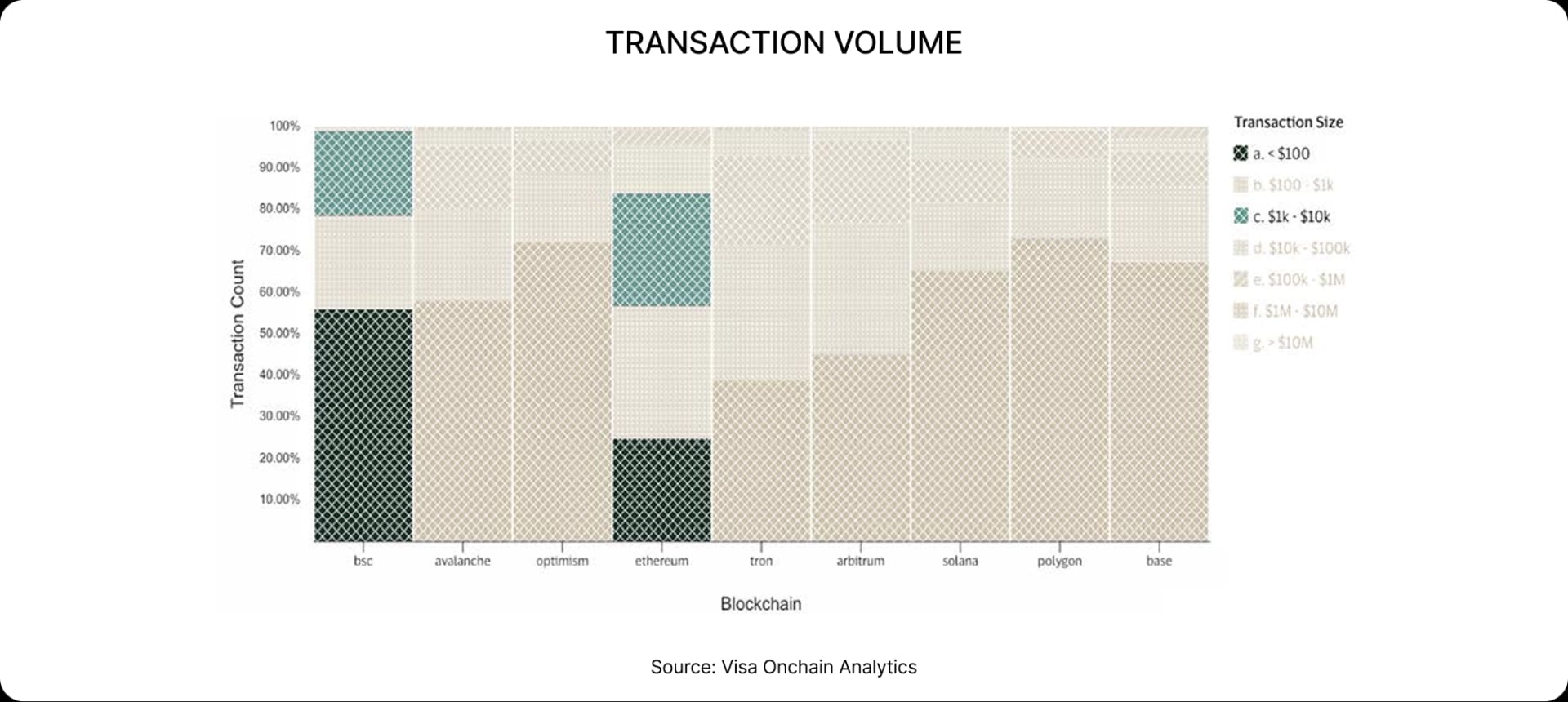
Stablecoins are distributed across many blockchains, but their supply and activity remain concentrated on a few dominant networks. Ethereum leads with roughly 52% of total stablecoin supply, followed by Tron with 29%. Together, these two account for 81% of the market, highlighting their role as the primary hosts of stablecoin liquidity.
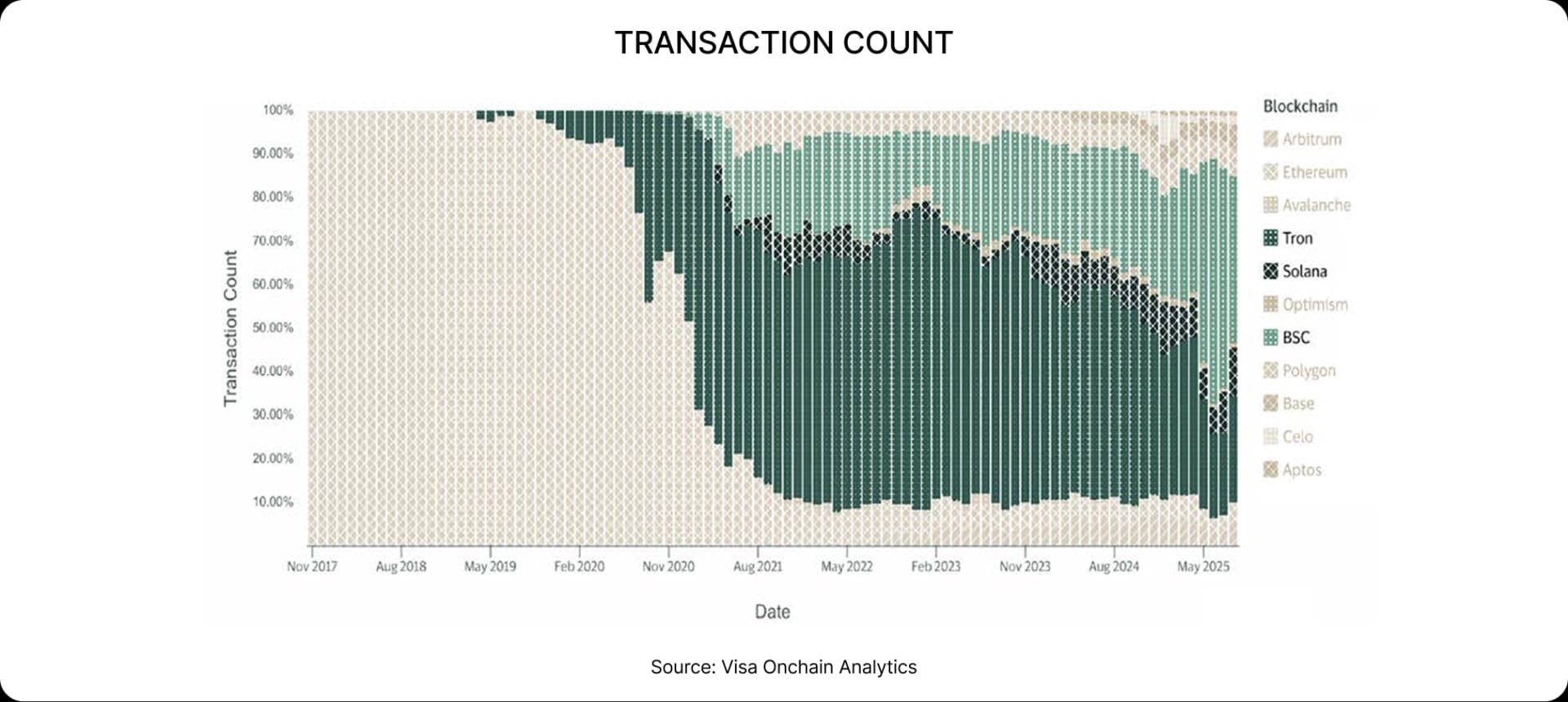
When viewed through the lens of transaction volume, the picture changes again. Ethereum leads with 42% of stablecoin volume, closely followed by Tron with 38%. Together, they account for around 80% of the total value moved. By comparison, BNB Smart Chain represents only 8.7% of volume, and Solana 5.1%.
Key Insights
Stablecoins have reached the scale of entire blockchains, with transaction volumes and activity that rival or exceed leading L1s. At the same time, supply is expanding with more issuers and tokens entering the market, while usage remains fragmented across chains and contexts. Ethereum is home to large institutional flows, Tron drives remittances, and BNB Smart Chain or Solana capture high-frequency retail activity.
Plasma’s positioning builds directly on these dynamics. By consolidating stablecoin activity within a purpose- built chain, it provides an infrastructure layer designed for growth while reducing the inefficiencies created by fragmented issuance and use across multiple networks.
Download the full report here
Download the "Plasma Redefining Stablecoin Settlement" report here (PDF)