



A brainchild of Ethereum co-founder Gavin Wood, the Polkadot network has been at the forefront of blockchain innovation since its mainnet launch in May 2020.
Today the network is in the midst of key advancements that will significantly expand its technological horizons, including the Join-Accumulate Machine (JAM) upgrade, which is expected to address longstanding challenges related to scalability and interoperability on the network.
JAM should also underpin efforts to innovate on Polkadot, as developers increasingly embrace decentralised physical infrastructure (DePIN) and make new forays into AI-driven applications.
What is Polkadot?
A purely sharded network by design, Polkadot operates as a multi-chain network that splits consensus, execution, and data availability between several Layer 1 networks, called parachains, and a central chain, called the Relay Chain.
Parachains handle specific tasks independently, but they are all connected and coordinated by the Relay Chain. The network’s top parachains include Moonbeam, HydraDX, Bifrost, Nodle, KILT, and OriginTrail.
Parachains operate by their own set of rules and logic, handling the execution of smart contracts or transactions.
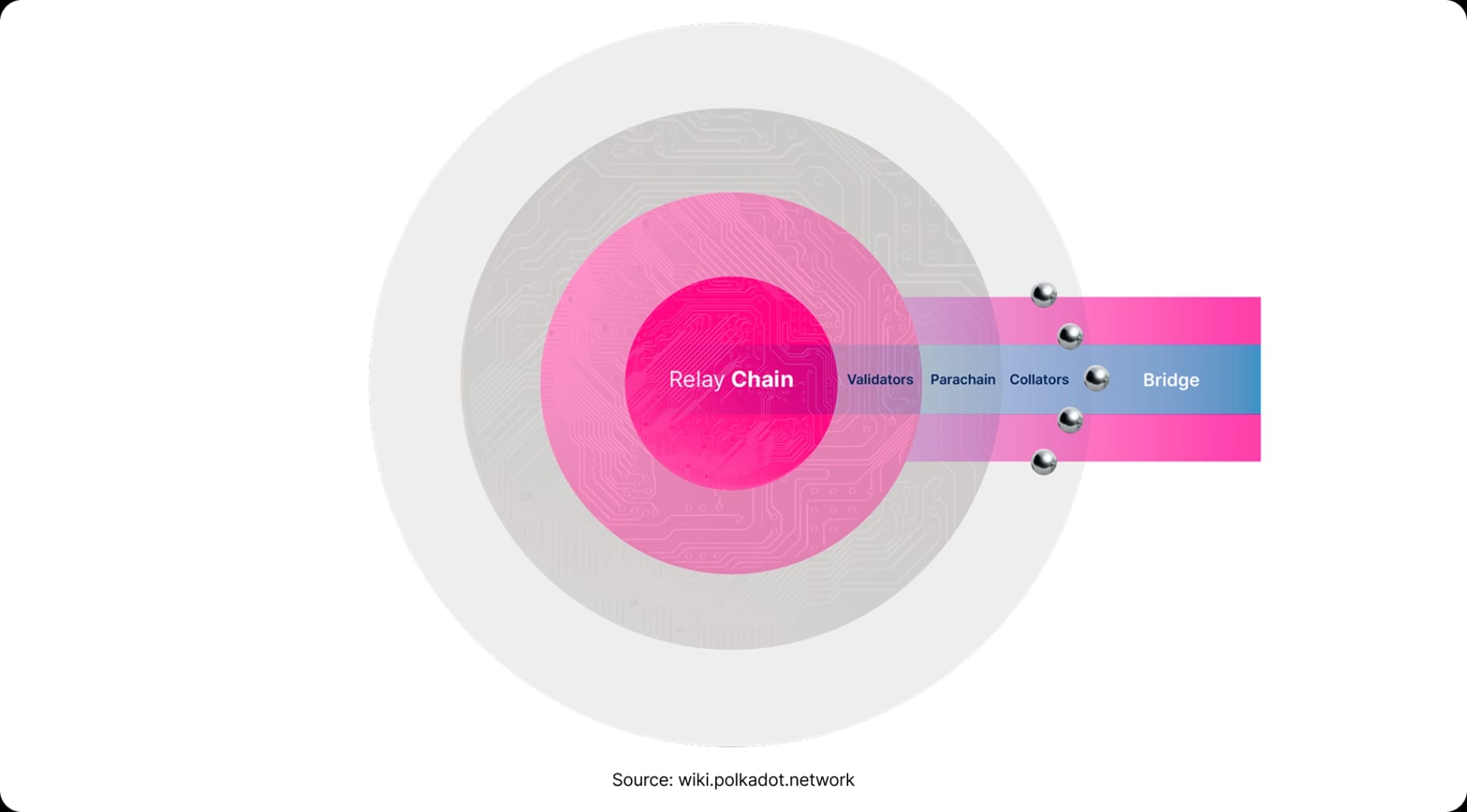
The Relay Chain is responsible for achieving consensus among the parachains and ensuring security and smooth network validation, using a consensus mechanism known as Nominated Proof-of-Stake (NPoS).
NPoS is a variant of the proof-of-stake (PoS) consensus mechanism. PoS uses validators who stake their tokens as collateral to verify and add transactions to the blockchain. In contrast, NPoS adds a democratic element by allowing token holders to nominate validators and participate in the validation process.
THERE ARE THREE CRITICAL ROLES WITHIN THE POLKADOT ECOSYSTEM:
Validators
The full nodes of the Relay Chain participating in the consensus process. Each parachain appoints a validator subgroup to accept blocks and conduct validity checks to ensure the consensus rules are followed.
Nominators
The network participant that delegates their DOT, Polkadot’s native token, to a validator to participate in consensus.
Collators
A validator’s consensus assistant, the collator constructs the parachain blocks.
An established leader in application-specific blockchain networks, Polkadot is now seeking to improve its use of core computational resources and become more of a ‘general services’ blockchain. The JAM upgrade is designed to help accomplish this goal.
With the JAM upgrade, the network addresses the inherent challenges of scalability and interoperability by increasing network performance, providing more access for developers, and enhancing user experience with more cost-efficient parachains.
The JAM Upgrade
Unveiled in June 2023 and detailed at the TOKEN2049 conference in Dubai in April 2024, the JAM upgrade includes plans to redesign the protocol’s relay chain, transforming the Polkadot network into cloud-like service infrastructure.

The upgrade will address several long-standing challenges related to interoperability and scalability. For example:
At present, anyone can create a parachain since the network is permissionless, but Polkadot connects only the best and most efficient parachains to its Relay Chain.
In November 2021, Polkadot introduced slot auctions to regulate the number of operational parachains at any time. Winning one of these highly competitive auctions can be expensive, requiring a significant amount of DOT.
Additionally, the process of building a parachain is both complex and time-consuming. Parachains use a tool called substrate pallets to build their internal structure, and because these pallets are not standardised, each parachain must be customised.
The JAM upgrade aims to solve these problems by replacing the network’s Relay Chain with a more modular and minimalist design. JAM’s main goal is to streamline data integration and maintenance while maintaining the network’s security and cohesion, meaning a faster, easier, and safe experience for users. The new hybrid system, which combines features of Ethereum smart contracts and Polkadot’s architecture, is called the Polkadot Virtual Machine (PolkaVM).
Because JAM is built as a distributed computer, decentralised applications (dApps) built on the PolkaVM will be transactionless. This means that data is processed in stages, validated for accuracy, and securely added to the chain without typical transaction approval.
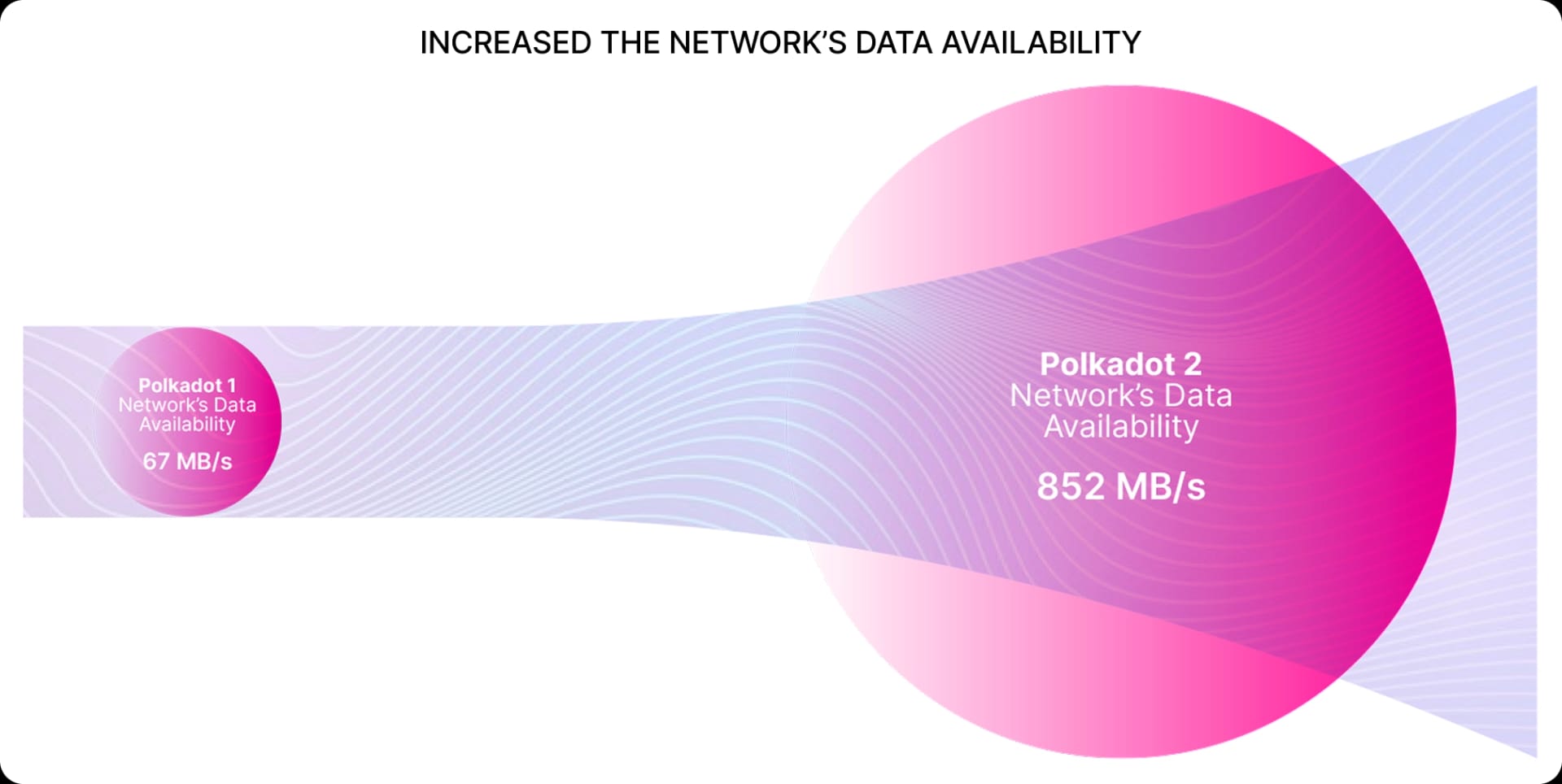
Things run faster with the JAM upgrade: 1023 validators totalling 341 cores — akin to off-chain virtual CPUs — significantly increase the network’s data availability from 67 Mb/s to 852 Mb/s, compared to earlier iterations. This increase makes JAM capable of handling 85 times the computation load.
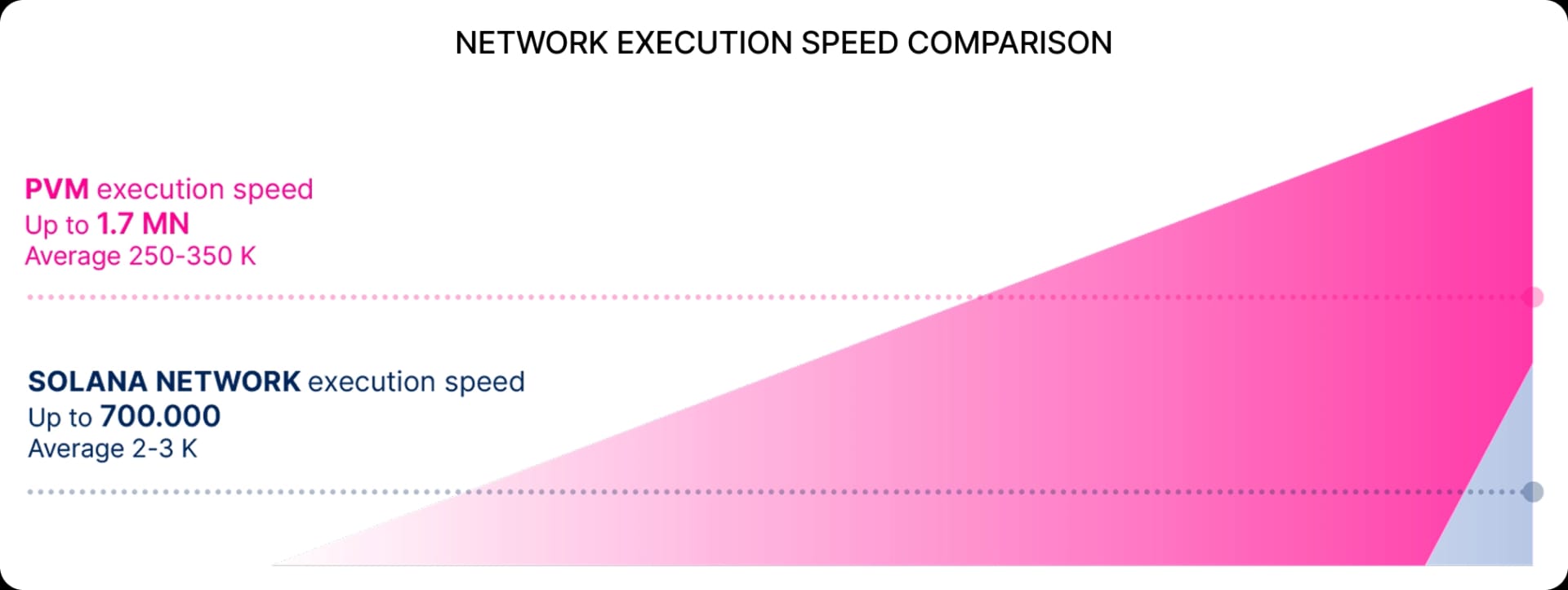
PolkaVM’s execution speed can theoretically settle from between 250,000 and 350,000 transactions per second (TPS), to upwards of 1.7m. In contrast, the Solana network can theoretically process up to 700,000 TPS but settles between 2000 and 3000 TPS on average.
JAM is still in its nascent stages and is expected to be complete within the next five years. Plans are also underway to build a supercomputer with more than 12,000 cores — dubbed the ‘Polkadot Palace’ — to test JAM before it goes live. When it goes live, the upgrade will further underscore ongoing innovation on the Polkadot network, with DePIN and AI-supported projects in particular set to benefit.
Polkadot and AI
Polkadot’s unique approach to network infrastructure could help crypto developers make new forays into AI-supported projects, by tackling one of AI’s most pressing issues: its intense energy demands.
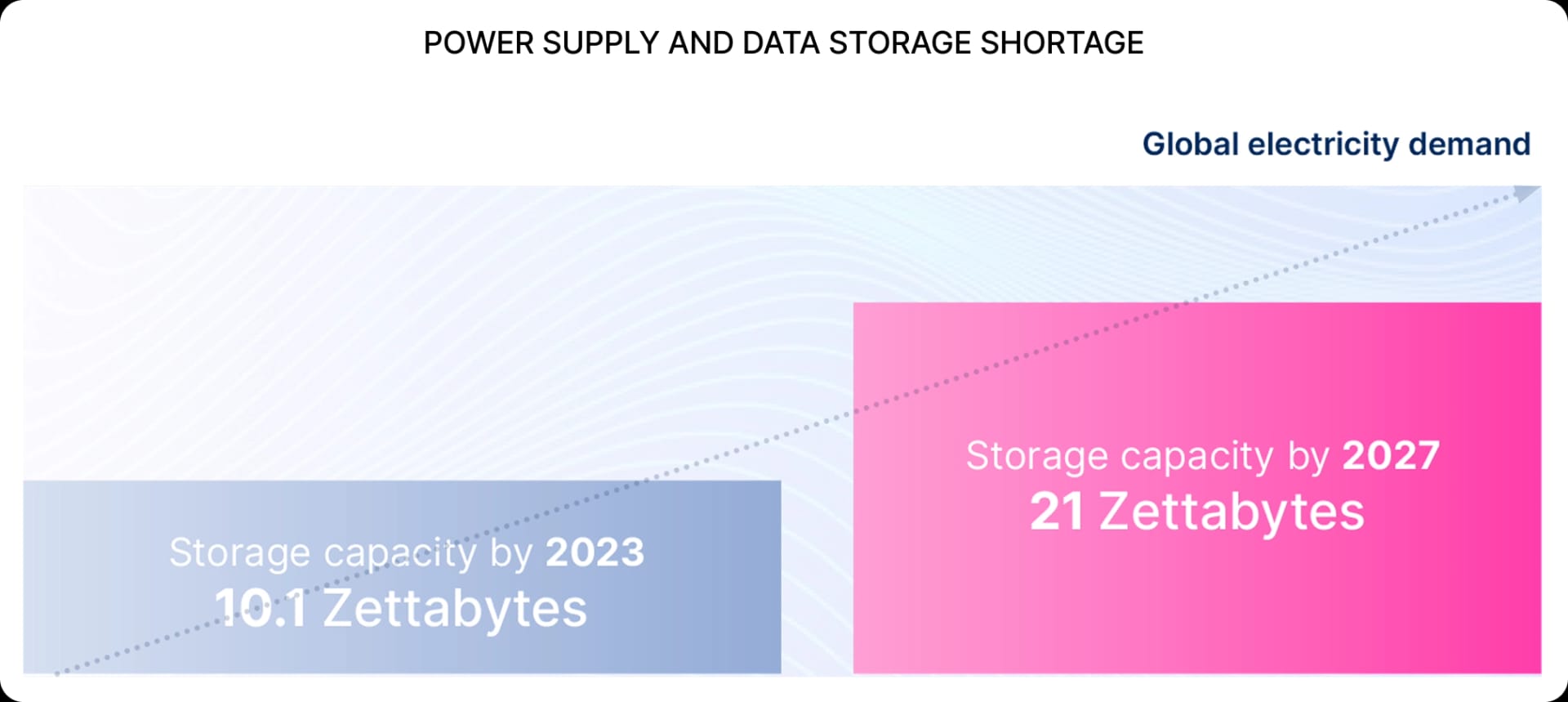
AI’s deep learning algorithms and large language models require substantial computational resources and energy, and processing power and data storage may soon be in short supply. The International Energy Agency expects AI adoption to double global electricity demand by 2026, and Data Centre’s 2024 Global Outlook report predicts storage capacity will double from 10.1 zettabytes in 2023, to 21 zettabytes in 2027.
However, Polkadot’s foundational infrastructure could offer a scalability solution for novel AI projects. Its sharded, multi-chain network allows for parallel transaction processing, which reduces the energy needed for AI tasks by distributing workloads across a decentralised network.
A number of AI applications — including OriginTrail and Phala — have begun building on Polkadot’s infrastructure, as developers seek to redefine what is possible at the intersection of blockchain and AI technology.
OriginTrail
One popular parachain in the AI space is OriginTrail. As detailed in its March 2024 Whitepaper 3.0, the project envisions a ‘verifiable internet for all’ by leveraging the complementarities of crypto, internet, and AI technologies.
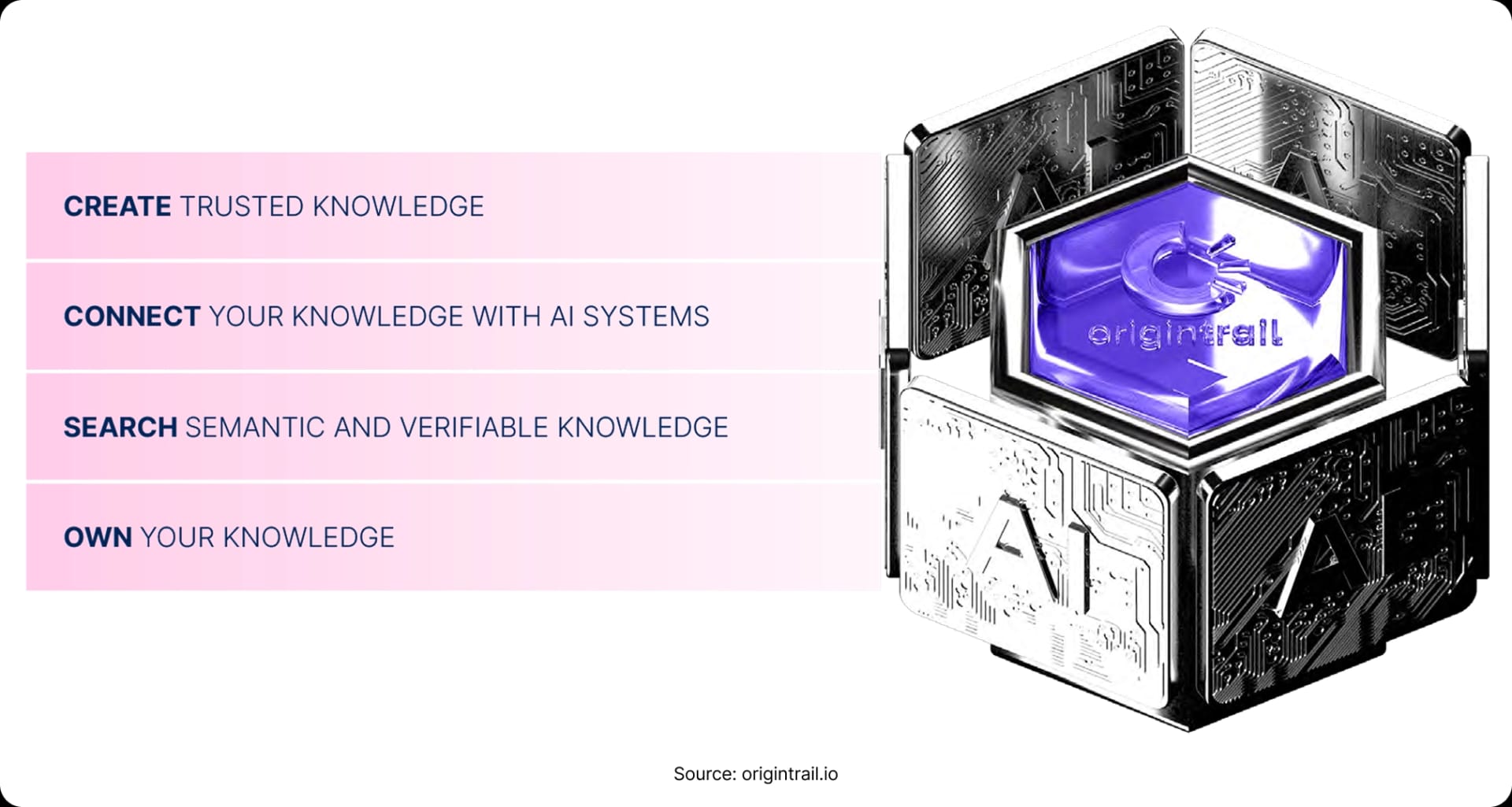
OriginTrail uses a special system called decentralised knowledge graphs (DKGs) to manage and share important information across a network. It can be thought of as a library system that organises information belonging to different users, while allowing them to easily connect and share information with each other.
With DKGs, businesses and individuals can create and add their intellectual property and information to their systems. This forms the basis of OriginTrail’s AI technology, which aims to provide AI responses based on verifiable information instead of conjecture.
The project began rolling out its latest iteration of the DKG in Q4 2023 on NeuroWeb, a permissionless EVM blockchain secured by validators of the Polkadot network.
NeuroWeb bills itself as the only blockchain focused on creating a ‘truly open and decentralised’ AI future using knowledge mining — the process of extracting meaningful information from vast amounts of data using AI and machine learning techniques.
OriginTrail’s efforts have attracted some high-profile partnerships. The project is collaborating with ontological knowledge blockchain ONTOCHAIN to work on the European Union’s data protection initiative, Next Generation Internet. Here, DKG-based tools were developed and integrated into ONTOCHAIN’s tech stack, enabling the creation and exchange of ontological knowledge.
Further, in March 2024, the British Standards Institution, the UK’s national standards body, partnered with OriginTrail to implement DKGs into the AidTrust medicine supply chain project. Polkadot showcased this work at a 2022 World Economic Forum-adjacent conference, hosted by Wood.
The project is also exploring the implementation of decentralised Retrieval Augmented Generation in developing the Polkadot network AI education tool, PolkaBot.ai.
Currently in beta, PolkaBot provides users with trusted information about various aspects of Polkadot, including its ecosystem, treasury proposals, and DOT tokenomics, using AI.
Phala
The decentralised cloud computing protocol Phala Network has lofty goals that rival giants like Amazon Web Services (AWS) and Google Cloud. Founded in 2018 by former Google software engineer Hang Yin and former Tencent product manager Marvin Tong, Phala left the Ethereum ecosystem and joined Polkadot’s Canary network Kusama in 2021.
Now building as a parachain in the Polkadot ecosystem, Phala acts as an execution layer for Web3 AI services, offering a multi-proof system for building with an assortment of toolkits.
Developers can use Phala’s infrastructure to integrate AI capabilities, and an AI co-processor assists with technical aspects like verifying data and executing smart contracts.
The network uses additional systems outside the main blockchain to handle large amounts of data.
This setup improves the blockchain’s performance by keeping the data secure and providing extra computing power for AI applications. It also ensures that sensitive information is protected with encryption and kept safe outside the main blockchain.
On April 8, 2024, Phala pivoted from using the ‘Phat Contract’ to the ‘AI Agent Contract’.
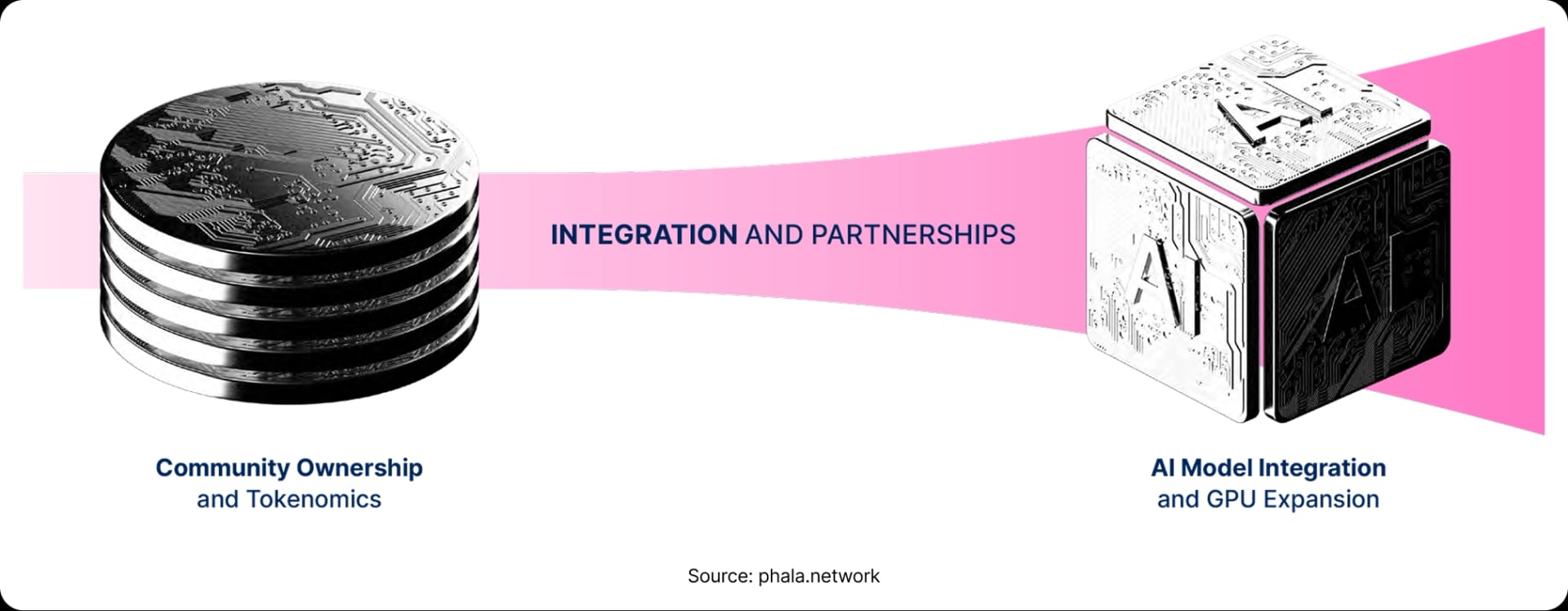
AI Agent Contracts are designed to improve blockchain functionality by helping integrate AI technology, spreading out who can own and earn money from these technologies, and allowing more kinds of AI applications to be developed. The idea is to create a marketplace where AI services can be bought and sold freely by anyone.
Phala plans to expand its graphics processing unit capabilities further to integrate large language models with Web3. It also anticipates publishing the Phala Whitepaper 2.0, although a timeline for the whitepaper has not been made public.