




Overview
Benefitting from pent-up demand for new investment products and ongoing efforts to regulate the sector, Europe’s digital assets industry has grown fast in recent years.
At the global level, the digital assets industry has faced notable challenges since 2022, as high- profile company meltdowns and a barrage of enforcement actions left stakeholders battered and demoralised. Europe, however, has been better insulated from the damage, and the growing pains now appear to be paying off.
Investment volumes and user numbers are rising, and the advent of exchange-traded products (ETPs) – a counterpart to America’s spot exchange-traded funds (ETFs) – has been a boon to the European market.
The rebound accelerated during the first half of 2024, and segments such as the tokenisation of real- world assets (RWA) continue to hold particularly high potential for future expansion. A growing cohort of young European investors is also supporting near-term prospects – the younger generation is far less risk-averse than previously believed.
At the same time, the European Union’s (EU) landmark digital assets legislation, Markets in Crypto Assets (MiCA) is expected to underscore consumer protection, paving the way for sustainable, long- term industry development despite some near-term growing pains.
Market Dynamics
Europe’s digital assets market is relatively small in terms of user size, but a a large and relatively wealthy population of increasingly risk-tolerant investors means it has plenty of room to grow.
American research firm Chainalysis reports that there were 31m cryptocurrency users in Europe in 2023, making the continent the world’s third-largest market behind Asia (263m users) and North America (38m users). In terms of market volumes, however, Europe punches well above its weight.
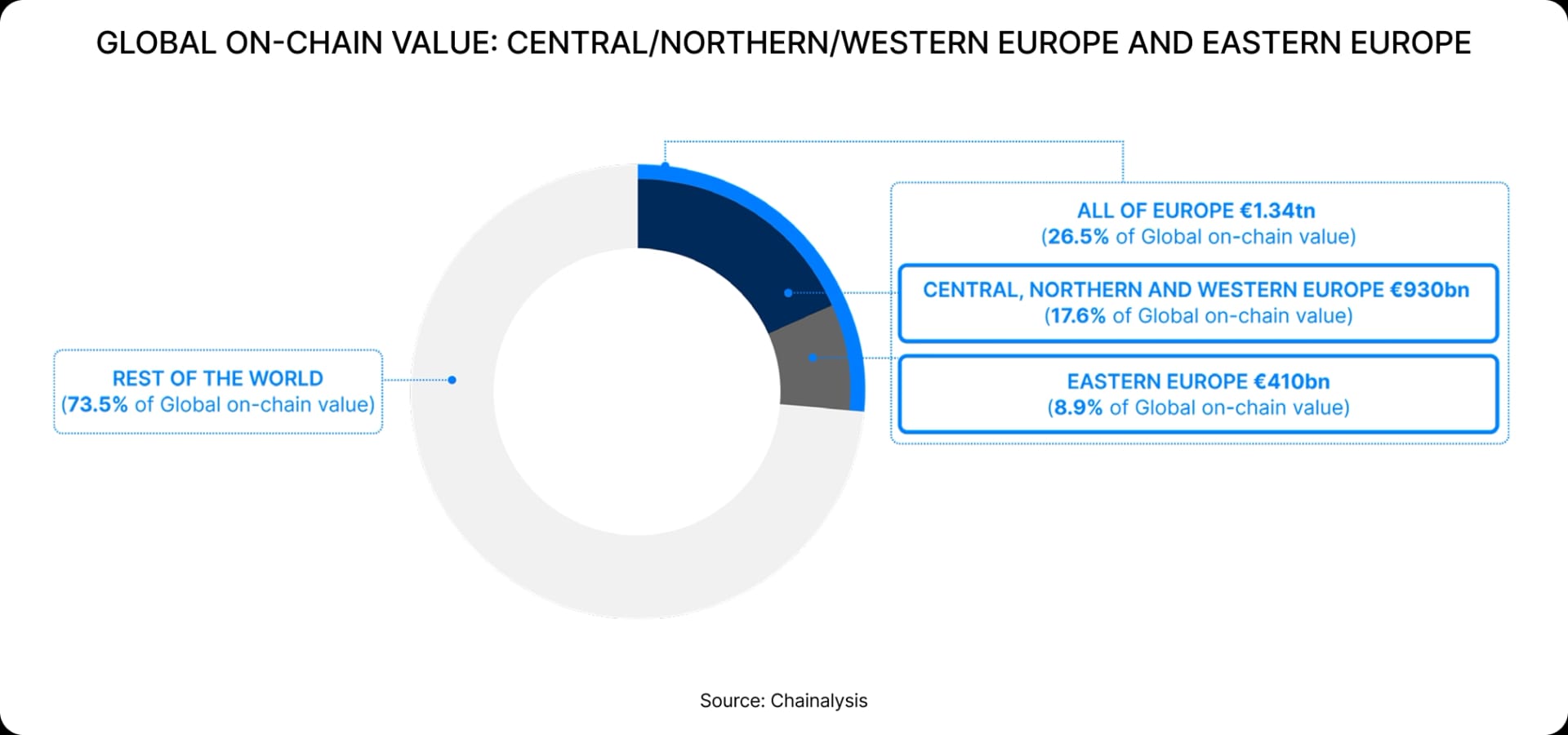
Chainalysis reports that central, northern, and western Europe accounted for 17.6% of global transaction volumes in the year to June 2023. With eastern Europe taken into account, Europe’s share of total transaction volumes rises to 26.5% of total global volumes, or €1.34tn in the year to June 2023.
Chainalysis found that the UK was the largest single crypto market in Europe as of June 2023, with $252.1m of trading volumes recorded between July 2022 and June 2023. The UK also ranked highest in Europe on Chainalysis’ global crypto adoption index, at 14th place globally.
The UK slips to fourth place in terms of European countries where most people are putting their greatest share of wealth into cryptocurrencies, with Chainalysis reporting that Ukraine (see Crypto in Conflict chapter), Turkey, and Russia make the top three.
A growing base of users, combined with upcoming implementation of the world’s most comprehensive digital asset regulatory regime, MiCA (see Regulation chapter), has seen many companies flock to establish operations in Europe.
According to the DL News Crypto Tracker, there were 11,597 crypto entities registered across EU at the end of 2023, with more than 1000 companies registering in the EU over the course of the year.
This figure does not include Czechia, with 9372 virtual asset service providers (VASPs) registered, since the figures have not been updated since 2022, and since 83% of registered entities are individuals, not businesses.
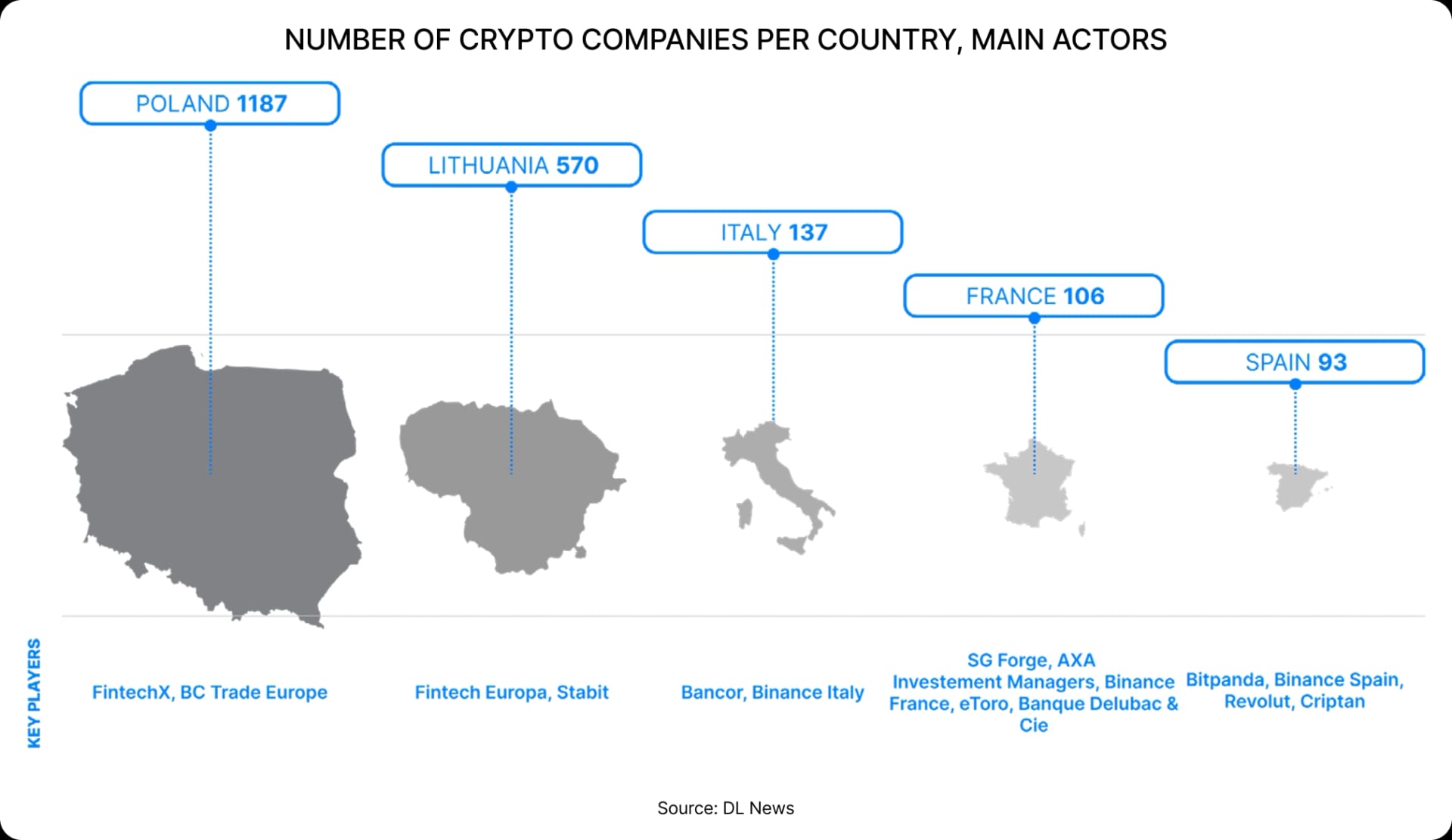
Excluding Czechia, Poland topped the list with 1187 VASPs, followed by Lithuania (570), Italy (137), and France (106).
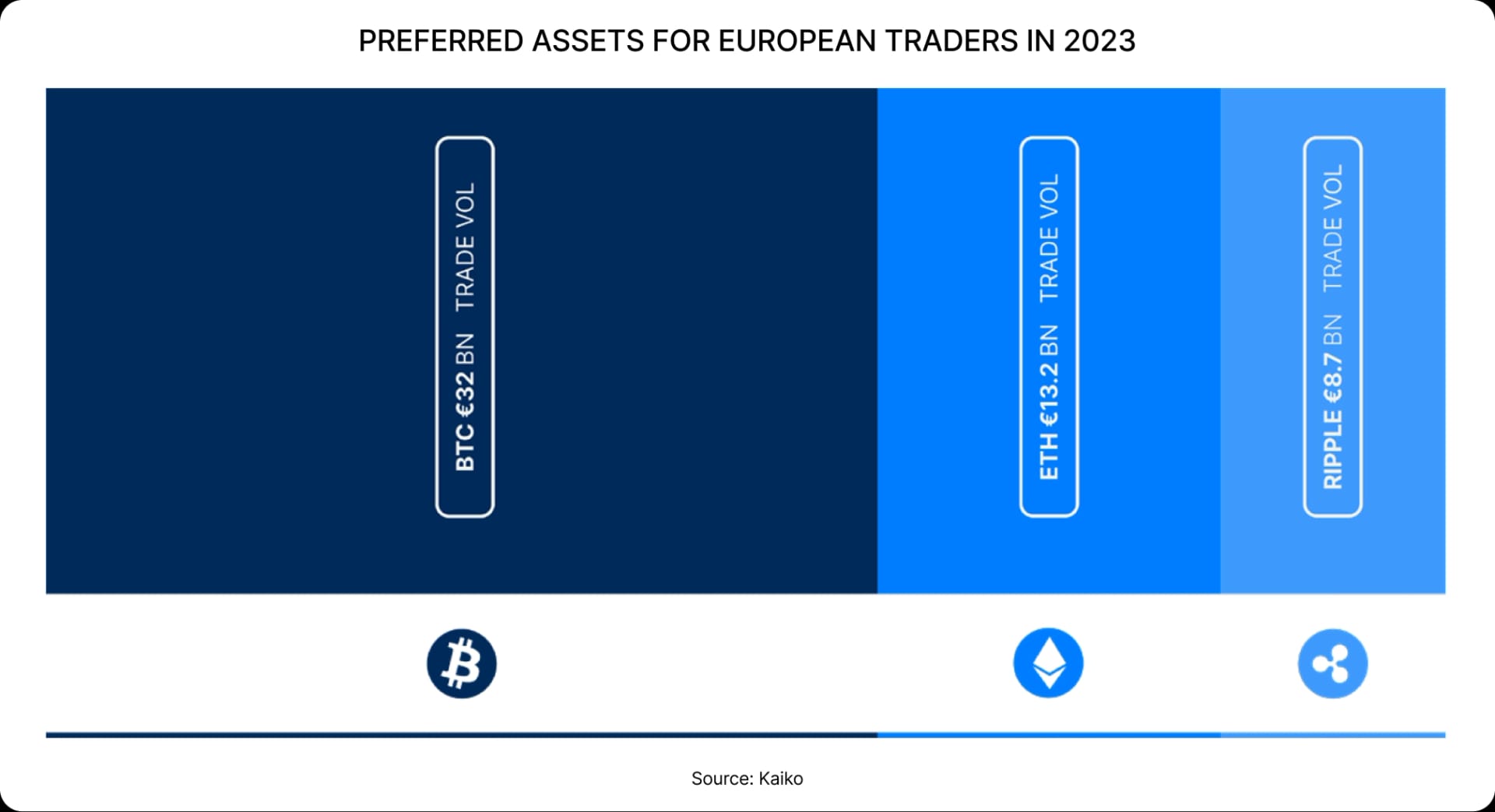
Despite the rise of VASP registrants in Europe, just five exchanges accounted for 97% of euro- denominated crypto volume, according to Kaiko. Bitcoin (BTC) was the preferred asset for European traders in 2023, accounting for €32bn of trade volume. Ethereum’s token, ETH, came in second with €13.2bn, and Ripple third with €8.7bn traded.
Europe led the digital assets industry in terms of employment creation, according to a 2023 report published by research firm CoinCub, with Germany ranking top globally (22,472 jobs) followed by France (17,693 jobs), Poland (12,086 jobs), the Netherlands (10,279 jobs), and Spain (6843 jobs).
Risk and Reward
The European Securities and Market Authority (ESMA) reported in April 2024 that 55% of global trading volume is executed on exchanges that are licensed in Europe, although it noted that most of these transactions occur outside of Europe.
This may explain why European investors have been relatively well-insulated from recent tumult in the market.
The global cryptocurrency industry faced a series of major challenges in 2022 after the collapse of several high-profile companies, including FTX and Terra/Luna, erased $1.35tn (€1.26tn) of market capitalisation.
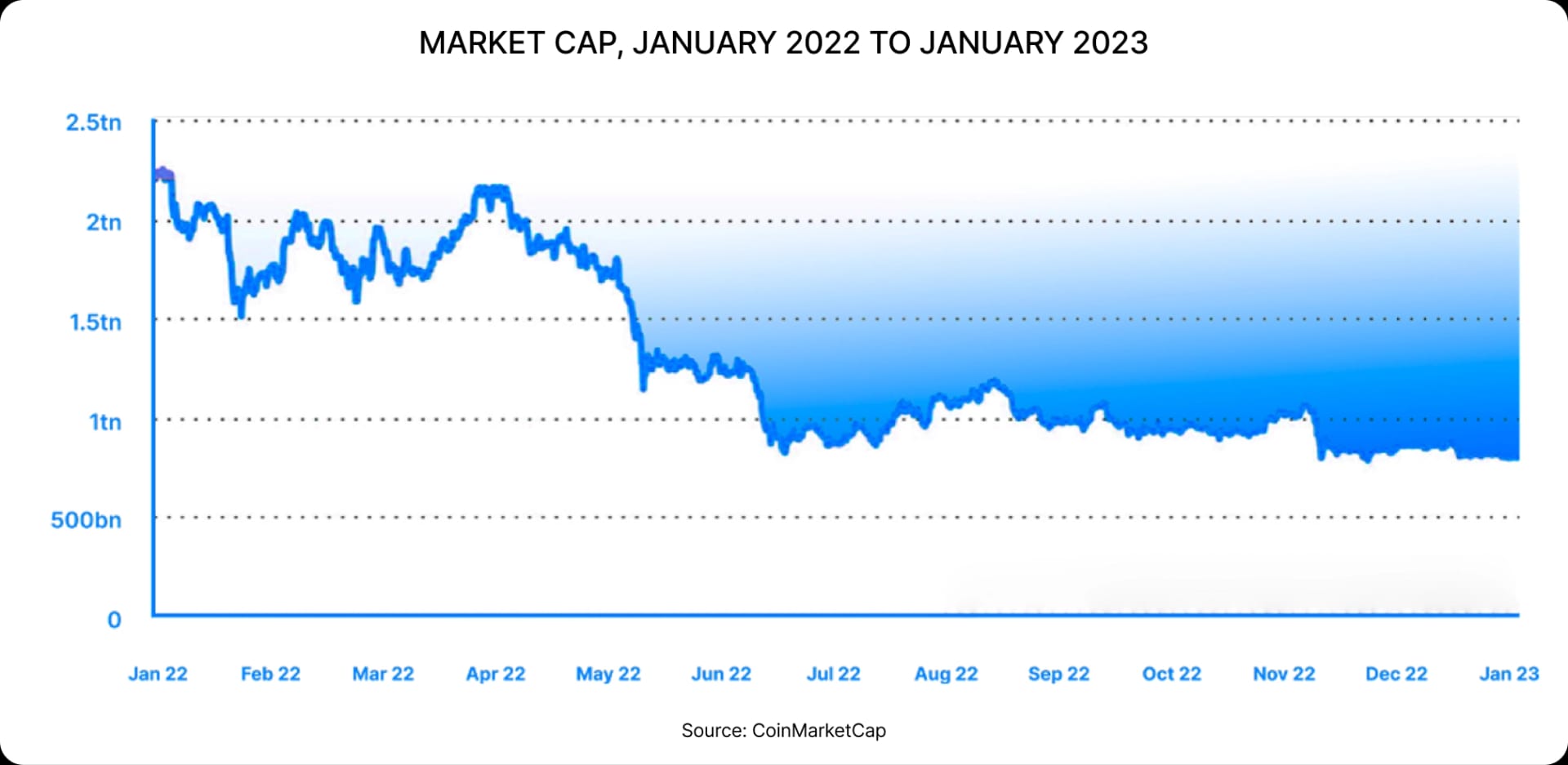
In Europe, however, the impact was less severe than in other markets, including the US. For example, while the fall of Bahamas-based FTX wiped $200bn from the global digital assets market in November 2022, the exchange’s sole European entity was based in Cyprus.
The entity, FTX EU, had approximately 1m registered users, but less than 10% of those were based in the EU, according to Steffen Kern, head of risk analysis and chief economist at the European Securities Market Authority (ESMA). Shortly after FTX EU’s licence was suspended by the Cyprus Securities and Exchange Commission, FTX EU began refunding its affected European users.
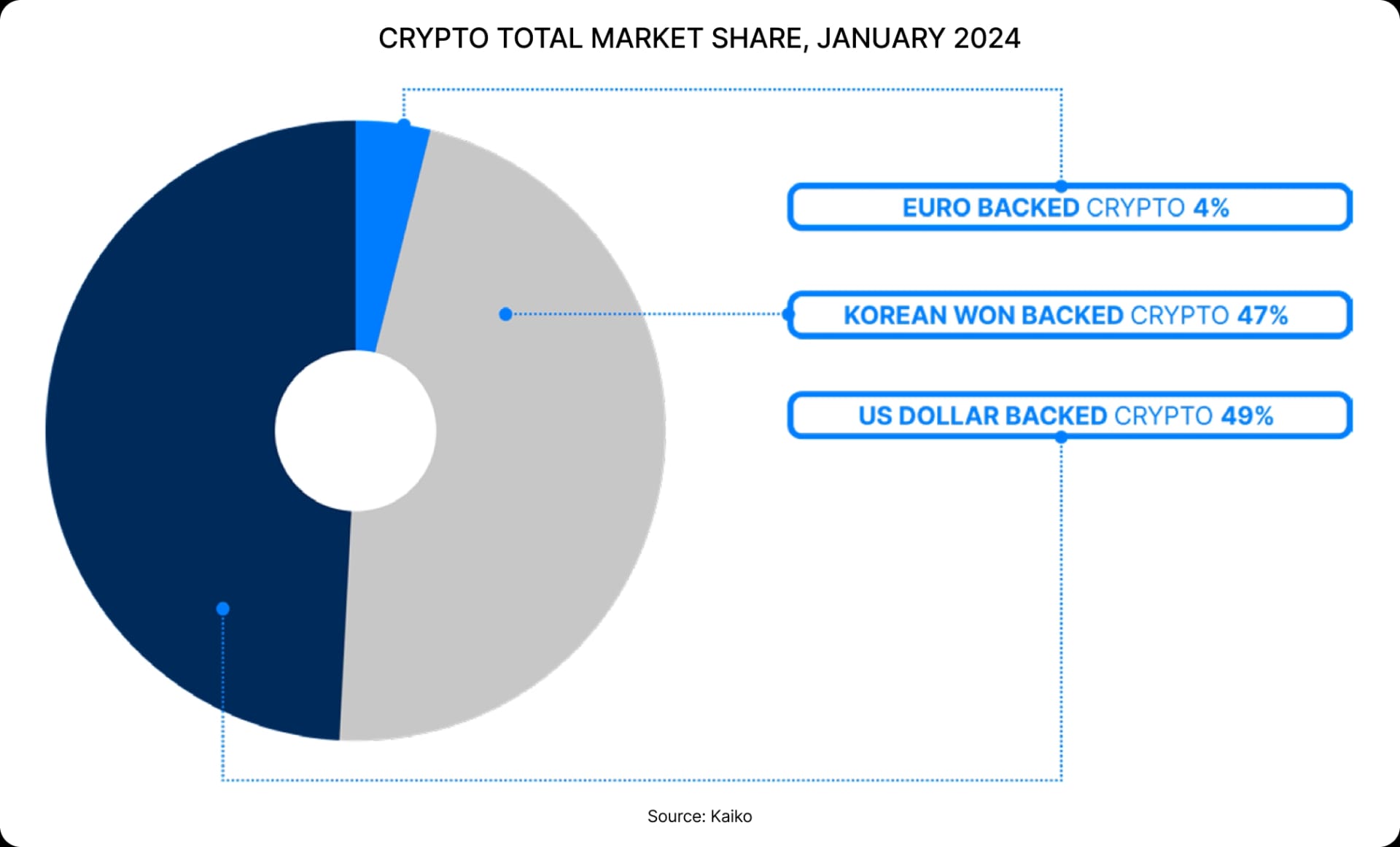
ESMA reports that global cryptocurrency markets remain dominated by the US dollar and South Korean won as key on- sets, staand off-ramps for traders, with the euro playing a relatively minor role in these activities.
“We are keen to understand vulnerabilities within the crypto asset system, for example the complexities of unbacked crypto asblecoins, and DeFi, and transmission channels through which shocks in crypto asset markets could spill over to the wider financial system.” — John Schindler, Secretary General, Financial Stability Board
Euro-denominated crypto trading volume increased 200% to €16bn from September to December 2023, according to a January 2024 report by crypto data research company Kaiko. But this is still a drop in the bucket, accounting for just 4% of the total market, while US dollar- and Korean won- backed cryptocurrencies hold a 49% and 47% market share, respectively.
Lower levels of euro-denominated activity do not necessarily translate to less digital asset market activity in Europe. They do, however, dovetail the view of the Swiss-based Financial Stability Board (FSB) on systemic risks posed by crypto.
According to FSB secretary-general John Schindler, cryptocurrencies do not pose a systemic risk to the European, or indeed global financial system – though the board continues to monitor the situation.
“We are keen to understand vulnerabilities within the crypto asset system, for example the complexities of unbacked crypto assets, stablecoins, and DeFi, and transmission channels through which shocks in crypto asset markets could spill over to the wider financial system,” Schindler told DL Research.
“This could include, but is not limited to, links between crypto asset markets and the core financial system such as financial institutions’ exposure to crypto assets, the composition of reserve assets of major stablecoins, and emerging investment products such as spot bitcoin exchange-traded products.”
Looking ahead, the upcoming implementation of MiCA legislation will further underscore both financial industry stability and consumer protection – although MiCA has been criticised as overly- burdensome for crypto firms operating in the EU, it is also expected to help Europe’s digital assets industry maintain a steadier and more stable long-term growth path (see Regulation chapter).
Recent Recovery
After a long and bitter crypto winter, the global digital asset market began to turn around in 2023, as two major narratives emerged over the course of the year.
The first was a series of enforcement actions against several previously lauded crypto industry CEOs, including FTX’s Sam Bankman-Fried, Celsius Network’s Alex Mashinsky, and Binance’s Changpeng Zhao, all of whom were charged with a variety of financial crimes. Bankman-Fried and Zhao were both serving prison sentences in the US at the time of publication.
The second involved anticipation of regulatory approval for spot Bitcoin (BTC) ETFs in the US, which was ultimately granted in January 2024 by the US Securities and Exchange Commission (SEC).
Approval for an Ethereum (ETH) ETF followed in May 2024.
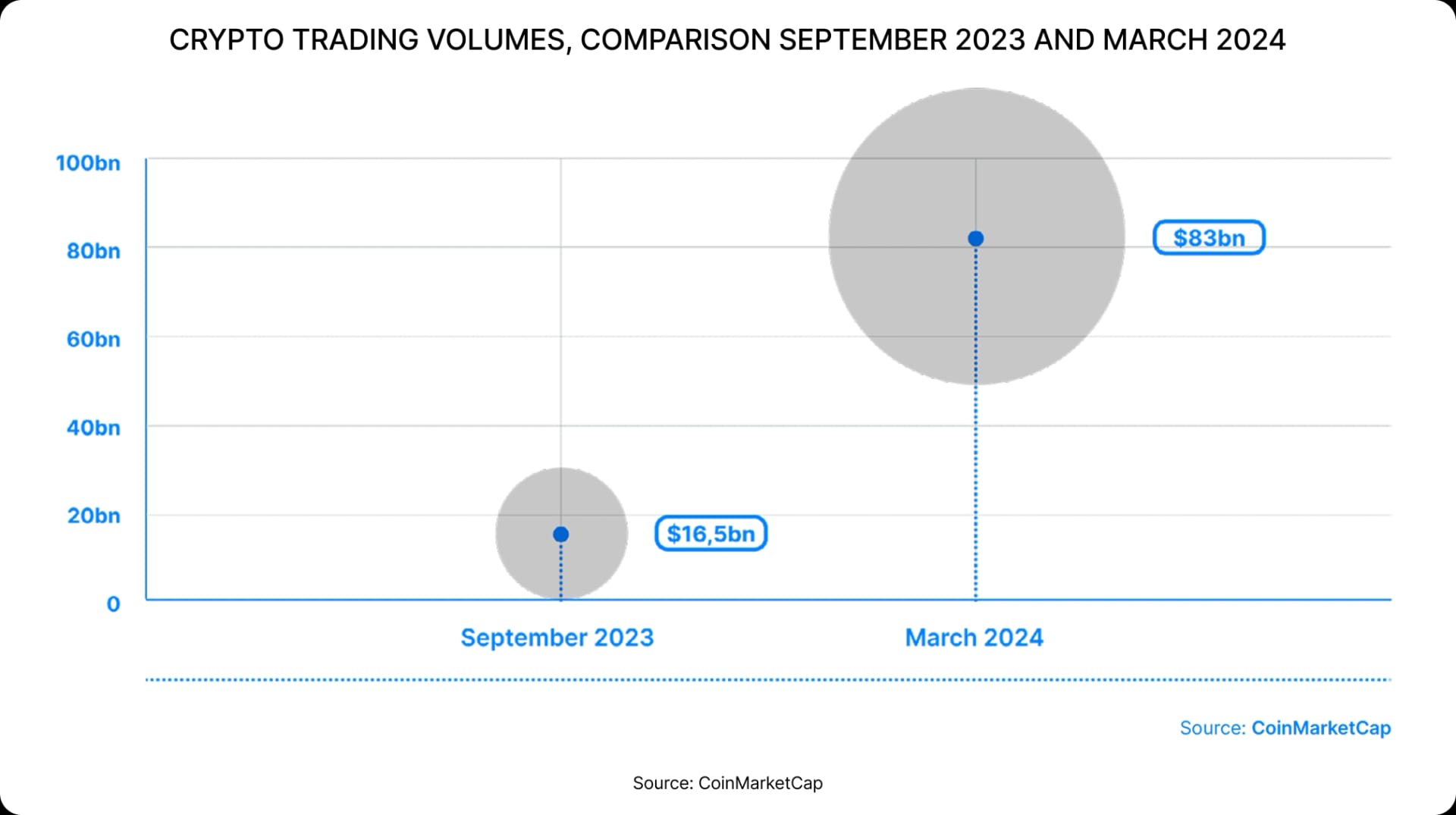
The global market has been buoyant in the months since: crypto trading volumes rose from a low of $16.5bn in September 2023 to $83bn in March 2024, according to crypto data site CoinMarketCap, while total market capitalisation rose by 20% in May 2024 alone to reach $2.4tn, according to CCData Insight.
The price of BTC and ETH rose 180% and 140%, respectively, over the same period, with BTC reaching an all-time intraday high of $73,127 in March 2024. As of late June 2024, BTC prices hovered around $64,000, while ETH prices were around $3500.
This has helped bring investors back to the market, including in Europe.
European Demographics
A common stereotype of European investors is that they are older, more conservative, and far more risk averse than their American counterparts.
For example: a DL News report from January 2024 found that ETPs, which behave like ETFs, were already available in the European market when the US Bitcoin ETF was approved. However, the report noted that the top five ETPs added up to a fund size of just $2.6bn. In comparison, Bloomberg Intelligence expected $4bn of Bitcoin spot ETF inflows on the first day of trading alone.
According to one expert quoted in the DL News report, Europeans were less enthusiastic about Bitcoin ETFs because their retirement strategies anticipate a far higher level of government support Economic Impact
Indeed, recent surveys of European digital assets investors reveal that they are young, like to gamble, and have a relatively high risk appetite. Their numbers are also growing steadily.
The UK’s Financial Conduct Authority (FCA), for example, reported in June 2023 that 4.9m UK adults, or 9% of the country’s adult population, held crypto assets, up from 2.3m or 4.4% in 2021. An estimated 91% of UK adults had heard of crypto assets as of August 2022, according to the FCA, an increase from 78% in 2021 and 42% in 2019.
As of February 2022, roughly 10% of the UK population was estimated to hold or have held some form of crypto asset, with Forbes reporting that 82% of this population still held crypto assets as of May 2024. An estimated 76% of crypto users in the UK are less than 45 years old, according to the FCA, while 69% are male. than American retirement strategies. But higher pensions in Europe also translate into lower salaries, which is making Europeans more likely to gamble.
The majority of FCA survey respondents purchased BTC and ETH as their preferred cryptocurrency, and a vast majority, 79%, said they purchased crypto using their disposable income, while 19% used long-term savings or investments, and 6% used credit facilities. The average size of crypto users’ holdings in the UK was £1357 (€1595), according to the FCA.
France is hot on the UK’s heels: the French Autorité des marchés financiers (AMF) recently published a report which found that in 2023, 9% of the French population owned cryptocurrencies: more than those who own stocks (7%) and ETFs (2%). Like the FCA, the AMF reported that a majority of new investors, 56%, were less than 35 years old, and 64% of investors were men.
In France, 66% of new retail investors said they planned to hold their digital assets for less than 10 years to increase the profitability and diversity of their assets, indicating a rising desire for higher, quicker returns despite the potential risks.
The same trend is playing out in Germany, where a May 2023 report by crypto exchange KuCoin, found that 49% of crypto investors in Germany believe cryptocurrency can help them realise their wealth accumulation plans.
KuCoin also found that 22% of crypto investors in Germany view it as a way to get rich overnight. As is the case in France and the UK, this demographic is also young – 51% are between 26 and 39 years, old – and male (63% of total respondents).
A growing appetite for crypto products is playing out in the European ETP market as well: Contrary to expert predictions, European crypto ETP holdings surged by 46% during the first half of the year. Crypto ETP assets under management amounted to €11.7bn as of late June 2024, according to data platform, ETFbook, compared to €8bn in early January 2024.
The trend is set to continue, both globally and in Europe. In March 2024, research by London-based investment manager Nickel Digital Asset Management revealed that 63% of institutional investors surveyed rank cryptocurrencies among their top-five assets over the next five years, trumping US equities (60%), European investment-grade debt (55%), and gold (12%).
Nickel reports that while just one-quarter of respondents have greater than 1.5% of their assets allocated to the digital asset sector, almost 88% estimate they will have 2% or more of their assets in the sector within three years, while 30% forecast that their portfolios will have a share of digital assets greater than 3%.
Growth Potential
One segment with high potential for future growth in Europe is real world assets (RWA). The digital tokenisation of RWA and traditional markets is expected to be a global driving force for the adoption of cryptocurrencies. Astute Analytica provides detailed growth projections and market forecasts through 2032 for the European tokenisation markets in an April 2024 report.
The report found that Europe accounted for 25% of the global tokenisation market in 2023, worth €743m. This market is expected to record a compound annual growth rate (CAGR) of 18.9% to hit $3.7bn (€3.5bn) by 2032, aided by MiCA and Europe’s progress in digital asset lawmaking (see Regulation chapter).
Interestingly, the report found that eastern Europe is emerging as an unexpected leader in the continent’s digital tokenisation market, with an 87% market share. The region has injected billions of euros into tokenisation efforts accounting for over €2.5bn, and more than half of eastern European fintech professionals believe that digital tokenisation will revolutionise traditional banking and finance systems within the next five years.
Real estate holds particularly high potential for tokenisation in Europe. The tokenisation of real estate in major European cities including Paris, Berlin, and Madrid amounted to approximately €150m in 2023, a 30% y-o-y increase. Half of real estate professionals in Europe believe that tokenisation will solve some of the industry’s toughest challenges, such as the high barrier to entry for small investors, according to the Astute Analytica report.
Outside of real estate, the banking, financial services, and insurance sector accounts for 20% of Europe’s digital tokenisation market, with France and Germany reporting an exponential rise in mobile banking users.
Given the EU’s investment industry is valued at a collective €20tn, according to November 2023 figures reported by the University of Luxembourg and Italy’s Bocconi University, tokenised investment funds also hold high potential for future growth.
At your service
Another high-potential segment outside of tokenisation is in digital asset service provision. Given the strong growth prospects for the European market, and the fact that digital asset service provision falls within MiCA’s purview (see Regulation chapter), areas like custody provision could see strong future growth in Europe.
Indeed, a July 2023 report in Forbes found that European banks were outperforming their American counterparts in terms of crypto custody provision. Major players in the industry including Deutsche Bank, Crédit Agricole, BNP Paribas, and DZ Bank, made considerable progress after announcing plans to offer digital asset custody services.
Some banks, such as BNP Paribas, are turning to partnerships with blockchain and cryptocurrency companies to develop a new line of crypto-friendly services. Germany’s largest federal bank, Landesbank Baden-Württemberg, has also announced plans to offer crypto custody services for institutional and corporate clients in the second half of 2024 (see Innovation chapter).
Download the full report here
Download the "The State of Digital Assets in Europe" report here (PDF)