

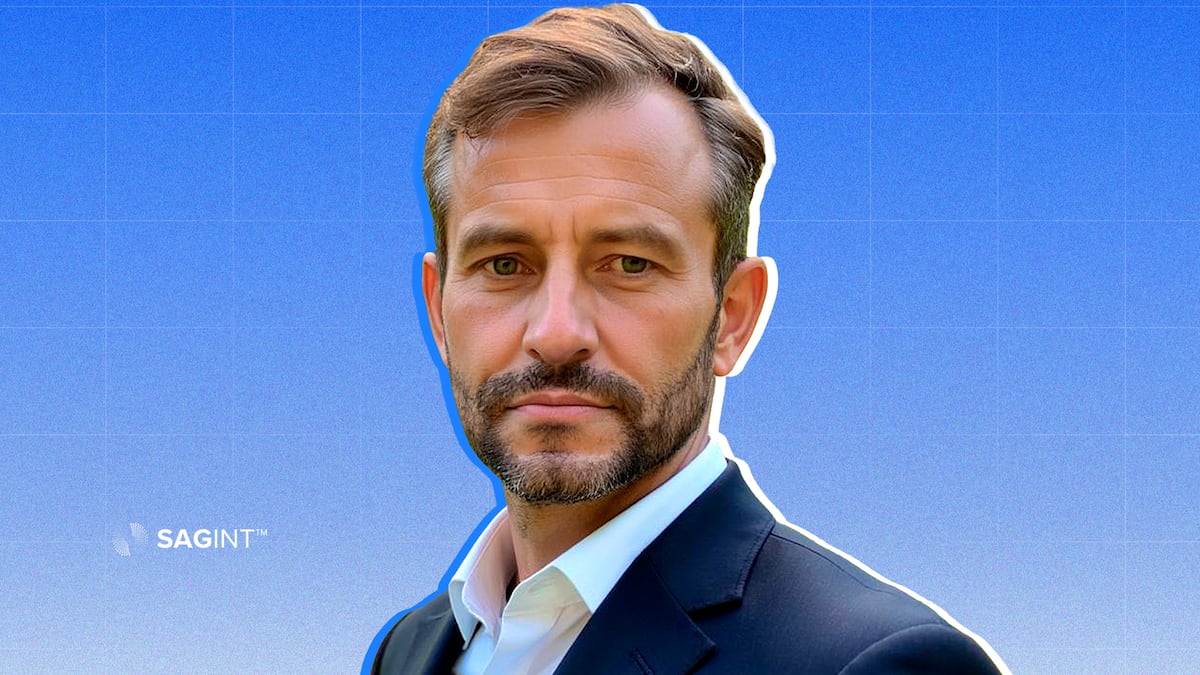
Mike Weeks has spent two decades working with governments and elite teams on resilience, decision-making, and performance under pressure. He brings that systems-level thinking to SAGINT, where he is helping to design next-generation digital infrastructure for real-world assets.
SAGINT is building a compliant exchange and settlement stack designed to digitise the lifecycle of commodities such as rare earth elements. By integrating OECD due diligence, Dodd-Frank compliance, and blockchain traceability from day one, SAGINT aims to break existing monopsonies, restore pricing power to producers, and strengthen US economic security in the critical minerals sector.
We recently spoke with Mike Weeks, Executive Chairman and Co-Founder of SAGINT, about the vulnerabilities in global commodity supply chains and how his platform is building a transparent, tokenised exchange for real-world assets.
Read more about SAGINT’s strategy to modernise the $28 trillion global trade economy in the interview below.
What problem in existing commodities and asset markets convinced you that a new exchange and settlement stack was necessary?
The commodities market is currently defined by opacity, inefficiency, and vulnerability, particularly regarding rare earth elements (REEs). This $28 trillion global economy still relies on outdated systems like fax and paper, resulting in $1.5 trillion in annual fraud and delays.
These operational failures are compounded by geopolitical risk. China’s dominance in REE processing actively erodes USD primacy as trade shifts to the yuan, creating hazards comparable to the 1970s OPEC crisis.
Buyers are already paying 45% premiums for traceable non-Chinese sources to de-risk, yet current exchanges cannot support them. These platforms handle spot trades but lack the critical traceability, compliance, and tokenisation required for real-world assets.
SAGINT stack was built to close this gap. We digitise trade lifecycles, anchor trades to the USD, and break existing monopsonies. By unlocking the tokenised commodities market, we provide the essential infrastructure for US economic security.
How does designing for OECD, Dodd-Frank, and multi-jurisdictional requirements from day one change system architecture?
Designing for regulations such as OECD Due Diligence, Dodd-Frank Section 1502, and EUDR requires a modular hybrid blockchain rather than a standard one. We built our architecture with internal oracles (SEER) and compliance engines (SOLACE) to handle these rules natively. This allows us to use ZKPs for private audits and VCs for provenance, ensuring we meet diverse legal standards without retrofitting.
To handle DFARS traceability specifically, we utilise Receipt Tokens (RTs). These are mutable warehouse receipts that enforce exclusions and flow-down clauses on-chain. By supporting interoperability via APIs for regional standards and using Sui’s high-throughput Layer 1, we ensure the system is scalable globally. This strategy turns compliance into a strategic asset and significantly lowers integration costs.
SAGINT works with governments and regulators to establish self-regulating organisations for commodities markets. Why is the SRO model important for digital asset markets, and what lessons can be drawn from traditional commodities exchanges?
The SRO model balances innovation speed with regulatory caution, building trust without halting growth. On traditional commodity exchanges like the CME or LME, SROs oversee surveillance and rule enforcement, identifying issues such as the 2010 Flash Crash and nickel manipulation.
They adapt faster than laws, reducing systemic risks. For digital assets and RWAs like minerals, SAGINT’s SROs with governments set standards for UT/RT audits and MALP pools. Lessons from traditional commodities show that SROs can significantly reduce fraud through ongoing oversight but need strong governance to prevent scandals.
We integrate SENTINEL custody into SROs for USD trades, empowering African and G7 producers. It is vital for scale, gaining institutional buy-in, and eroding foreign pricing power.
Traditional commodities markets rely heavily on periodic audits and reporting. How do SAGINT’s monitoring, asset registry, and surveillance systems shift this toward continuous, real-time assurance?
Periodic audits are merely snapshots that often miss ongoing fraud. SAGINT shifts this paradigm to continuous assurance. Our SEER oracles feed live data on mass, purity, and location, while SOLACE validates it against standards such as DFARS and OECD.
Simultaneously, SENTINEL tracks custody transfers. In our registry, mutable Receipt Tokens (RTs) are dynamically updated with every transformation, minted at the mine and burned upon consumption. We use ZKPs to provide proof without exposing sensitive data.
Furthermore, AI surveillance instantly flags anomalies, such as mismatches or unusual volumes. This proactive approach reduces audit costs and boosts premiums. It functions like an always-on SEC, providing contractors with immutable flow-down records and turning assurance into a competitive edge.
Critical minerals change form as they move from extraction to refinement. Why is it insufficient to tokenise a static asset, and how does SAGINT handle assets that evolve throughout their lifecycle?
Minerals transform physically from ore to oxide to magnet, altering their mass, purity, and compliance status along the way. Static tokens like NFTs cannot track these complex changes, which creates risks of double-spending or lost provenance when batches are mixed. SAGINT solves this with lifecycle-aware tokens. We use UTs for data payments and RTs as mutable receipts with updatable metadata.
Through SPAR, we burn and mint tokens during conversions to maintain strict OECD mass-balance and enforce SOLACE rules. This system accurately mirrors industrial reality, unlocking premiums and supporting stockpiles without the need for constant re-audits.
SAGINT selected Sui to power tokenised critical minerals. What specifically about Sui’s object-centric and mutable token model made it suitable for representing real-world industrial processes?
Sui’s Move language treats tokens as mutable, ownable, and composable objects. This structure mirrors the fluid nature of minerals perfectly. Unlike Ethereum’s rigid global state, Sui supports efficient, parallel updates to evolving batches, such as adjusting purity data after refinement. This mutability enables our Receipt Tokens (RTs) to handle atomic metadata changes, making them ideal for high-throughput tracing.
Furthermore, its support for ZKPs ensures private audits, while sub-second finality powers our MALP pools. We chose Sui because its scalability and lack of congestion provide the secure foundation we need to break monopsonies and support USD primacy.
What has deploying blockchain-based systems in real government environments taught you that whitepapers cannot?
Whitepapers promise theoretical perfection, but real deployments expose the friction of bureaucracy, legacy integration, and human behaviour. We learned that complying with standards like DFARS requires hybrid oracles to accurately link physical data, effectively solving the “oracle problem.”
We also discovered that true scalability lies in handling jurisdictional nuances. This means building mobile UIs for African miners and overcoming incumbent resistance through education, such as explaining the value of ZKPs. Early tests revealed significant gaps in legacy ERPs, prompting us to prioritise APIs over pure decentralisation.
Since governments demand auditable control, we designed our SROs to include validator sovereignty. Ultimately, no whitepaper can capture the impact of seeing tokenised REEs unlock premiums and secure supply chains. That is the only validation that matters.
If tokenised, compliant commodity markets become the norm, how do you expect global trade, pricing power, and intermediary roles to change over the next decade?
Tokenised markets will likely boost global trade volume in a way similar to containerisation. Real-time settlements will slash costs and virtually eliminate fraud. We expect pricing power to democratise as African and G7 producers leverage MALP pools to normalise ex-China REE premiums.
Traditional intermediaries, such as banks, will face disruption as DeFi fractionalises ownership and provides SMEs with direct stablecoin financing. Crucially, this shift strengthens the USD by leveraging RWAs to counter the yuan’s influence.
While regulatory splits remain a risk if SROs fail, the overall trajectory points toward efficient, inclusive markets where SAGINT drives US primacy in the AI era.