

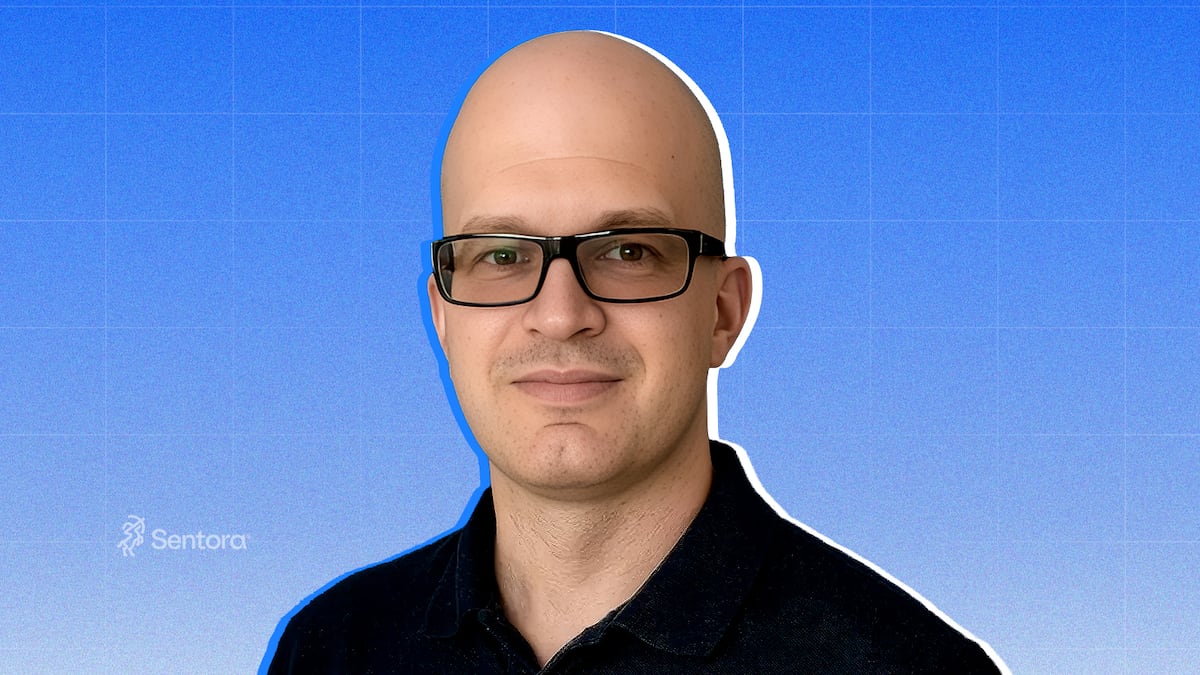
Jesus Rodriguez is a computer scientist, entrepreneur, and investor specialising in AI, Web3, and institutional finance. He is the co-founder and CTO of Sentora (formerly IntoTheBlock), a leading institutional DeFi platform and the incubator behind Firelight. He is also a co-founder of several AI ventures, including LayerLens, NeuralFabric, and Faktory.
Sentora provides a comprehensive suite for institutions entering digital asset markets, offering strategies, lending rails, risk systems, and stablecoin advisory services. Through its risk-engineering approach and new insurance primitives such as Firelight, Sentora aims to replace opacity with auditable, onchain protection.
We recently spoke with Jesus Rodriguez, Co-Founder and CTO of Sentora, about the barriers preventing institutional capital from entering DeFi and how his platform is engineering solutions for risk and insurance.
Read more about Sentora’s philosophy on risk ownership and the future of institutional DeFi in the interview below.
Sentora offers strategies, lending rails, risk systems, and stablecoin advisory under one umbrella. What philosophy ties all of these components together for institutions entering the digital asset markets?
Sentora’s mission is to build the best institutional-grade DeFi platform in the market. At Sentora, we view yields, lending, risk systems, and insurance not as separate verticals but as inseparable components of a healthy financial engine. By integrating these building blocks under one umbrella, we enable institutions to access DeFi’s upside without having to navigate its fragmentation.
This holistic approach enables us to work with the largest crypto companies and the top DeFi ecosystems. It also drives our scale. We currently have billions in assets deployed across more than 300 strategies, backed by over 1,000 live risk models and over half a billion in managed incentives. Ultimately, our goal is to make Sentora the single most robust source of sustainable, risk-managed yield in the digital asset space.
From a risk-engineering perspective, what are the core institutional blockers you still see, and how is Sentora architecting around them?
The core blocker is that institutions lack the frameworks to manage ‘protocol risk.’ In TradFi, you trust a bank. In DeFi, you must trust code and economic game theory. That shift from counterparty risk to technical and economic risk keeps institutional capital on the sidelines.
Sentora is tackling this problem with a ‘defence-in-depth’ architecture. We currently deploy over 1,000 risk models across our Smart Yields platform, ensuring real-time monitoring for every active strategy.
We also make these monitoring tools available to the public to raise industry standards. But the ultimate solution to risk is transferability. That is why we developed Project Firelight. By creating a scalable DeFi insurance protocol, we are finally enabling institutions to hedge against protocol failure, effectively completing the infrastructure needed for mass adoption.
Your recent publication, “Who Owns the Risk?,” argues that risk in DeFi is often misallocated across developers, protocols, users, and infrastructure. Where does institutional responsibility truly sit, and how should risk ownership evolve as DeFi becomes more institutional?
‘Who Owns the Risk?’ is a brilliant essay by my co-founder, Anthony DeMartino, that outlines foundational principles for thinking about risk in DeFi. In the essay, he argues that the current ambiguity in DeFi is unsustainable. We view risk ownership through a specific tripartite framework: the Asset, the Protocol, and the Manager.
Each layer has a distinct responsibility. Assets determine volatility and liquidity. Protocols define the execution rules and technical failure modes. Managers are responsible for the intelligent assembly and ongoing monitoring of those blocks. As we move towards institutional maturity, risk ownership must shift from implicit to explicit.
We can no longer operate in a world where ‘everyone and no one’ owns the risk. Protocols must provide explicit disclosures of technical and economic security, while strategy managers, such as Sentora, must accept end-to-end accountability for selection, execution, and monitoring. Institutional capital requires clear lines of liability, not vague community consensus.
You have described insurance as the next major missing piece in institutional DeFi. How does Firelight build on Sentora’s risk-engineering foundation to deliver insurance-grade protection for onchain exposures?
We view insurance as the final ‘missing primitive’ of the DeFi stack. No major financial market has scaled since the 18th century without a robust insurance layer, yet DeFi has grown to hundreds of billions in TVL with almost zero protection. Previous attempts failed largely because they lacked the data to price risk accurately.
This is where Sentora’s foundation is critical: you cannot insure what you cannot model. We have spent four years stress-testing risk models across the ecosystem. Project Firelight leverages this proprietary dataset to do what others could not: create a capital-efficient, large-scale protocol capable of underwriting technical and economic risk.
More than just a product launch, this represents the conversion of four years of risk engineering into the underwriting engine that allows institutions to finally hedge their onchain exposure.
Firelight starts from the premise that DeFi risk behaves very differently from traditional markets. How does that shape the design of your insurance architecture from first principles?
Our first principle is that traditional actuarial science relies on the independence of events. My car accident does not cause yours. The “money lego” nature of DeFi means risk is never isolated. Since protocols are built on top of one another, a failure in one location can quickly ripple through the whole ecosystem. Therefore, the Law of Large Numbers simply does not apply the same way.
Firelight is designed to handle this systemic reality. We do not treat protocols as generic assets. Instead, we treat them as unique software environments. Unlike home insurance, where risks are consistent across geographies, insuring Aave, Morpho, or Euler requires fundamentally different risk engines.
Consequently, we built Firelight with a modular architecture that isolates and prices specific risk vectors: smart contract integrity, economic game theory, and infrastructure dependencies such as bridges and oracles. We price the specific code, not just the asset category.
Firelight breaks protocol risk into granular technical vectors, runs structured simulations, and uses pattern detection to identify fragility early. How effective is this approach at surfacing tail-risk events before they become catastrophic?
Modelling technical risk is an adversarial game, not a static one. That is why Firelight covers not just economic vectors but specifically targets the ‘hard problem’ of technical exploits, along with oracle and bridge risks.
Our approach goes beyond simple heuristics. We have developed a proprietary framework that breaks technical risk into hundreds of granular vectors and runs simulations to detect patterns of fragility that often precede a hack. We did not build this in a silo. Instead, we spent months validating these models alongside the engineering teams of leading DeFi protocols.
While no model captures every black swan, this granular, vector-based approach offers the best statistical chance of accurately pricing tail risk before it materialises.
Many early DeFi insurance models failed because capital costs and premiums made coverage unattractive. How does Firelight address the cost-of-capital problem, and what kind of risk-return profile should capital providers expect?
The cost of capital was the fatal flaw of the first generation of DeFi insurance. The premise of locking 1 ETH in a risky insurance pool to insure 1 ETH in a blue-chip protocol is economically inverted. It simply does not scale.
Firelight solves this by fundamentally changing the collateral structure. Instead of recycling correlated crypto assets, we back our underwriting with assets that are poorly correlated with DeFi volatility and have a significantly lower cost of capital. This breaks the traditional bottleneck, enabling us to operate under different scaling laws from our predecessors.
The proof of this model lies in our launch capacity. We are not bootstrapping from zero. Firelight will go live with billions of dollars of committed capital, ready to underwrite risk from Day 1. We are moving from an era of ‘experimental coverage’ to one of massive, industrial-scale capacity.
In your view, what does a complete onchain insurance stack look like once DeFi reaches institutional scale, and where does Firelight position itself within that landscape?
We view the future stack as one in which insurance transitions from a static contract to a programmable primitive. While Firelight begins with a pragmatic foundation by insuring top protocols and vaults for institutional allocators, our ultimate destination is Atomic Insurance.
Imagine a scenario involving a cross-chain bridge. A user should not need an annual policy to move assets. With programmable insurance, they can attach a micro-policy to that specific transaction, paying a premium only for the seconds it takes to bridge the asset. If the transaction succeeds, the policy dissolves. If it fails, the claim is triggered automatically.
This level of granular, just-in-time protection is structurally impossible in traditional finance, but it is the native end-state of Firelight. We position ourselves as the engine that makes risk transferable at the speed of code.
If onchain insurance becomes viable at scale, which segments of DeFi do you expect will adopt it first?
We view adoption through the lens of necessity. Retail users are often yield-maximising and risk-tolerant, so they are unlikely to be first movers. The immediate demand comes from crypto-native institutions such as funds and exchanges, where protecting reputation and balance sheets is already a priority.
However, the most explosive growth will come from the ‘new wave’: fintechs and neobanks. For these players, insurance serves as a binary requirement for entering the space rather than a luxury. A neobank simply cannot offer DeFi yields to its customers without an insurance wrapper, as its risk mandates won’t allow it.
We are building Firelight specifically for this segment. Our goal is not just to service the current crypto market but to be the compliance bridge that enables traditional fintech to finally integrate DeFi infrastructure.