

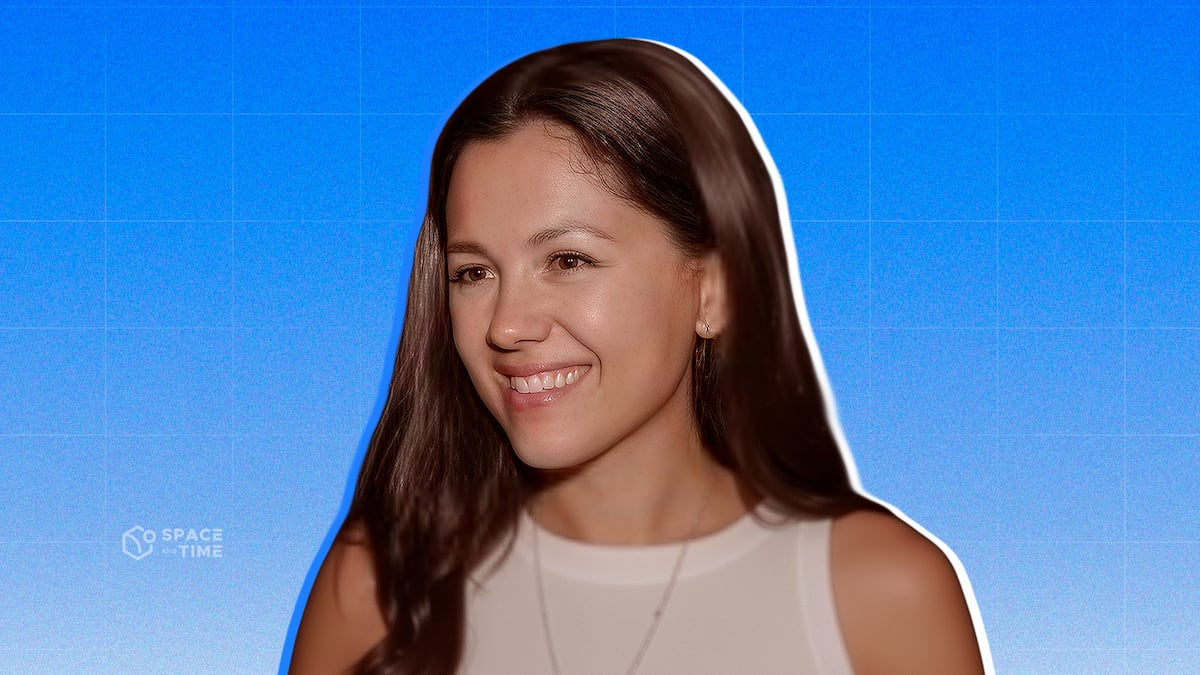
Catherine Daly oversees growth, brand, community, product marketing, and content for Space and Time. She previously handled full-funnel marketing for startups and major semiconductor companies, applying a data-driven approach to scaling complex technology. At Space and Time, her focus is on increasing the adoption of decentralised data, AI-enabled applications, and cross-chain development.
Space and Time is an AI-powered Web3 data repository that links on-chain and off-chain data to provide enterprise-scale analytics to smart contracts. It allows developers to create low-latency, scalable applications with cryptographic assurances using its Proof of SQL technology.
We recently spoke with Catherine Daly, Head of Marketing at Space and Time, about bridging the gap between Web2 data and Web3 smart contracts and the role of AI in the future of blockchain.
Read more about Space and Time’s growth strategy and the convergence of AI and crypto in the interview below.
You have a background in semiconductor marketing, which is a world built on precision and long feedback cycles. What perspective did that give you when you stepped into Web3, where everything moves at breakneck speed?
I had the chance to personally explore crypto during the last cycle. I had recently graduated from university and was starting to learn about NFTs, Ethereum, Bitcoin, and more. I did this on the side while working in semiconductor marketing, which, no offence to anyone, is quite dull. It is entirely B2B, marketing to other companies in the semiconductor supply chain. It involved a lot of PR and investor relations. It was challenging and technical, but somewhat boring.
Around 2022, my friend Scott Dykstra, whom I had known for years, reached out and asked if I could run marketing for a crypto startup he was building called Space and Time. I agreed, joined, and never looked back. I have been here for almost four years now and have seen it grow from the ground up.
You oversee growth, brand, community, product marketing, and content. Which one provides the strongest signal-to-noise ratio when testing new messaging?
The community. It is our greatest asset. You receive direct feedback on products, messaging, and relationships that you can’t find in Web2 B2B environments. When you have a live token, your community members are more than just part of a community; they are stakeholders. They have skin in the game, and their feedback is honest. It’s like having an extended workforce of tens of thousands of people invested in your success.
We hear a lot about AI and blockchain, but most of it seems hand-wavy. From your perspective, what feels real today and what still feels like hype?
The real development, or the one that could happen very soon, is AI agents transacting on-chain. Trading agents, autonomous agents, all of that, they already exist, and they are easy to build. There is a strong use case for Space and Time because those agents need context. They require historical data, on-chain activity, market context, and user context. Space and Time is designed to provide that combination of on-chain and off-chain data. It is ideal for agents.
As for the rest, I’ll avoid the pitchforks by not critiquing specific projects, but I genuinely hope the entire decentralised AI sector succeeds. The vision is what matters.
Are there any AI teams you work with today?
We have a close relationship with the Theoriq team. They are pre-launch and developing agents. We supply their agents with data, and in return, they help us train some of our internal agents to enhance the developer experience. We are also very connected with the Allora team.
Space and Time positions itself as an AI-driven Web3 data warehouse. When you meet someone who still thinks of indexing as “solved,” what is the simplest way you explain why SxT is not just an indexer with extra steps?
Indexing still remains unresolved. The main complaint we hear from clients is that they switched from other indexing solutions because the data was inaccurate, too slow, or lacked performance guarantees. Therefore, we are simply better.
But the main point is that you still require systems to manage, analyse, and send that data back to smart contracts. You can assemble various tools, many of which are points of failure due to centralisation. Alternatively, you can utilise Space and Time, which handles all of this within a single decentralised system and significantly reduces your development expenses.
Proof of SQL has become one of the more widely cited ZK primitives in the data world. What are people still misunderstanding about it?
I would not call it a misunderstanding, but many people still do not realise that they need it. The industry has spent years with two extremes: fully on-chain protocols that are very limited because they cannot access off-chain data, and off-chain protocols that rely on centralised databases, which create points of failure and can cause value loss if that data influences on-chain logic.
We became accustomed to that barbell. Protocols on both sides benefit from verifiable data, and many still do not realise it.
Space and Time links onchain and offchain data for both smart contracts and AI models. What tactics actually work to bridge the crypto and AI audiences?
Crypto developers primarily seek historical on-chain data or specific off-chain datasets to bridge trustlessly. AI teams require reliable context to inform their models and agent decisions. Enterprises, meanwhile, aim to connect their existing off-chain systems to blockchains in a seamless, familiar way.
For example, we are working with major banks exploring stablecoin payments and tokenised assets. They need to connect their internal databases to smart contracts in a verifiable manner, which is critical given the significant capital at stake.
Have conversations with banks increased over the last year?
Certainly. Microsoft invested in us, which helped connect us with many enterprise relationships early on. Initially, they mainly focused on analytics, such as “What are our customers doing on-chain?” Over the past six to nine months, the tone has shifted. Banks, both new and established, are exploring production use cases and see Space and Time as the appropriate solution.
Dreamspace, a no-code AI app builder powered by Microsoft Azure, went from zero to 15,000 users and 30,000 apps in three months. Can you explain to the marketers out there how your GTM strategy contributed to this growth? What else could you attribute it to?
We engaged with existing no-code communities, established agent communities, and platforms like Base, where people develop apps. But honestly, the product was something people wanted and could genuinely use. That is not true for many crypto products. Dream Space had broad appeal, which opened the funnel. Marketing enhances product-market fit. It does not create it.
You recently helped UGM and other SEA institutions put student credentials on-chain through Dreamspace. Tying in your marketing prowess with traditional education, where Web3 initiatives often fail at capturing significant traction, what made this one work? What did those education partners care about that the Web3 crowd usually ignores?
We are not doing enough for students as an industry. Students are tech-savvy, learn quickly, want to earn money, and face a tough entry-level job market today. Especially in Southeast Asia, crypto can be empowering.
We collaborated with Indomobill, the largest conglomerate in the region, and universities were very receptive. Putting credentials on-chain provides students with a verifiable record of achievement. Even if you attended a small college, you can still instantly prove your accomplishments. And yes, this is valuable in the West as well. People often lie about credentials on LinkedIn.
Marketing Web3 infrastructure can be thankless because the biggest wins stay invisible. What Space and Time milestone made you think people are finally getting it?
The pivotal moment was when our campaign introduced Space and Time data within Microsoft Fabric. By integrating our indexed data directly into Microsoft Fabric, their flagship data warehouse product, we enabled developers to access Space and Time effortlessly. The impact was immediate: the media picked it up, the Ethereum Foundation took note, and the story gained real momentum. We didn’t do anything extraordinary with our marketing; we simply told that story effectively.
You launched your token in May. Do you ever feel pressure to ramp up marketing when the token is down?
The token launched after three years of development. It marked a significant shift. However, we remain focused on fundamentals. We have customers, revenue, and a genuine product that addresses real problems. That alone sets us apart from most projects. Of course, everyone hopes the chart will rise. But over time, the product speaks for itself.
What broader trend in crypto feels undervalued, in terms of mindshare or otherwise, from a marketing and adoption perspective?
My prediction is a separation in both price and narrative. Bitcoin will become more of a household asset as institutional capital flows in. I observed that at SmartCon two weeks ago. Institutions are excited.
Meanwhile, cryptocurrencies other than Bitcoin return to their degen roots: gambling, meme coins, privacy, and more cypherpunk energy. Both sectors will coexist. Bitcoin might break the four-year cycle, while altcoins likely remain within it.
How important is that for working in crypto and speaking to your community?
I do not know how you manage this job without using the products. You do not need to be a great trader, but curiosity and firsthand experience are essential. It always surprises me how many people in crypto, especially at VC firms, never test anything themselves. At Space and Time, we believe using the products is crucial. It is easier than ever now. A few years ago, UX was terrible. Today, wallets like Base Wallet are incredibly smooth to use. Anyone can use them.
Last question. Crypto events and DevConnect are chaos in the best way. What is the most interesting conversation you have had so far?
It’s not about any specific conversation, but about meeting people face-to-face and putting faces to the names you see on Twitter, Telegram, or even within your own team. Cryptocurrency is global, remote, and sometimes anonymous. Meeting people changes everything. It fosters trust and energy in a way that online interactions cannot.