

Our State of DeFi report shows that by 2025, yield in DeFi stopped being a problem of access and became a problem of control. Capital now moves across more assets, chains, and instruments than earlier cycles could realistically manage through discretionary governance or ad hoc rebalancing. As a result, the defining challenge shifted toward enforcing risk limits, liquidity discipline, and repeatable execution at scale.
Vault curation emerged as a practical response to that reality. Instead of optimising for short-term APY, curated vaults encode mandates, define acceptable risk, and operate within explicit constraints. Automation plays a central role, but not as an autonomous decision-maker. Monitoring, logic, and execution are separated, ensuring that capital reacts to market conditions without introducing reflexive behaviour or hidden leverage.
kpk’s approach reflects this evolution. Its curated vault framework applies portfolio-style discipline to onchain capital, combining deterministic agents with transparent, non-custodial controls and continuous risk supervision. In this interview, kpk explains how vault curation reshapes yield markets, why instant liquidity carries structural trade-offs, and how professional treasury and fund management is increasingly expressed through onchain, policy-enforced systems.
Vaults and yield aggregators are now a major entry point into DeFi; what distinguishes a mature vault and curation ecosystem from the earlier chase the highest APY” phase of the market?
A mature vault ecosystem starts with a risk-first approach where yields are decomposed, position limits are explicit, and strategies operate within a consistent and transparent mandate rather than simply hunting for spikes.
Governance becomes process-driven rather than reactive, enforced through automatic execution pipelines, and users are given visibility into asset allocation. In that sense, the distinction is not the sophistication of the strategies, but rather the presence of an actual investment process behind them, one that looks more like portfolio management and less like yield farming.
As collateral types expand from ETH and stablecoins into LSTs, LRTs, and RWAs, what principles do you think should govern which assets are considered suitable for conservative yield strategies?
Conservative strategies should have explainable, observable, and controllable risk exposure, at least to a high degree of certainty. LSTs, LRTs, and RWAs introduce very different forms of technical, operational, and legal risk, so suitability depends on how transparent and predictable those risks are, especially under stress.
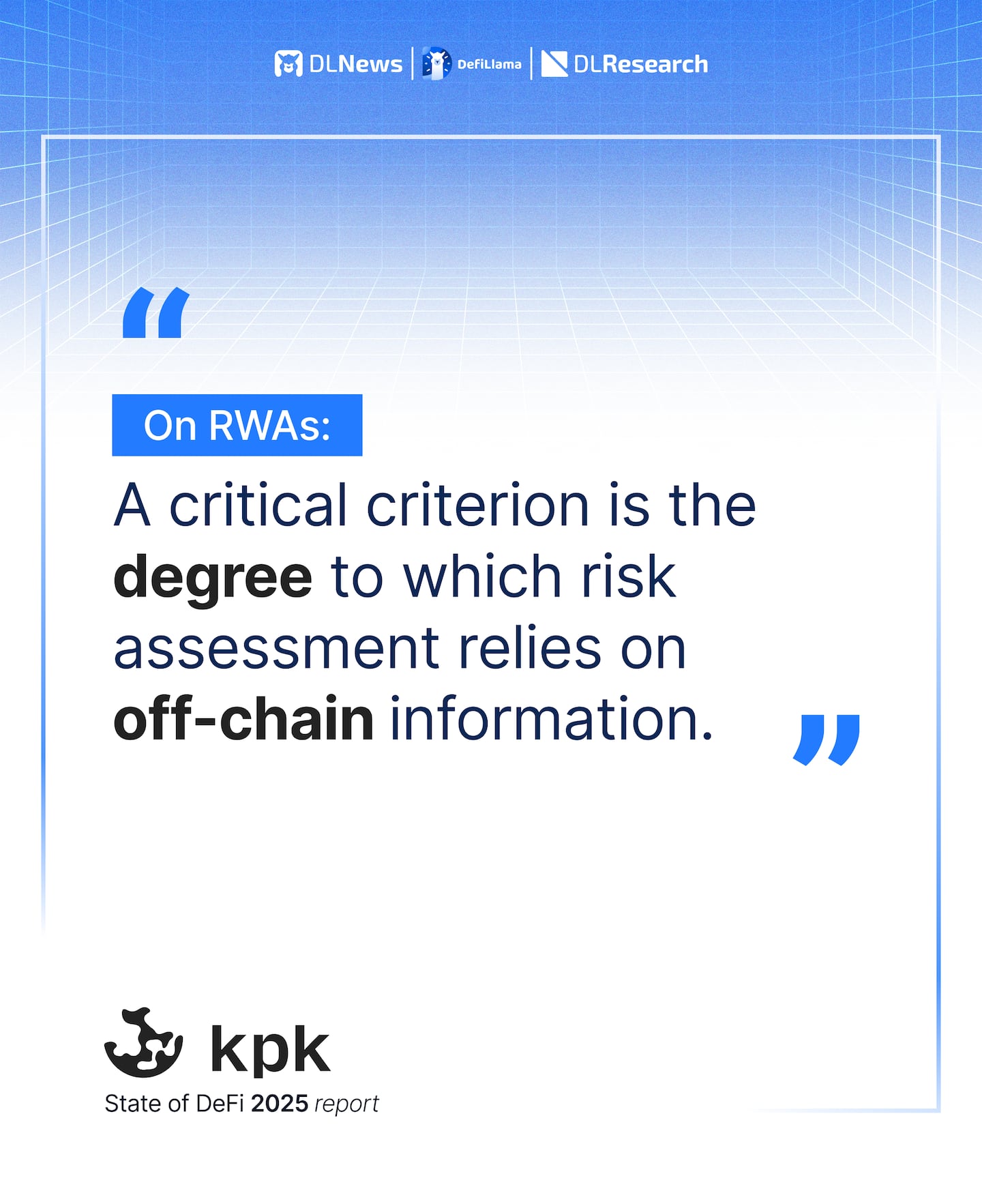
A critical criterion is the degree to which risk assessment relies on off-chain information. The more an asset depends on private agreements, unverifiable legal claims, or discretionary operator behaviour, the harder it becomes to accurately price its risk inside an onchain strategy. Conservative vaults therefore favour assets whose essentialmechanics e.g. validator performance; slashing exposure; redemption conditions; NAV calculation; duration mismatch; can be monitored and validated directly onchain. When off-chain components exist, they should be minimised, standardised, and backed by strong, transparent reporting, so that risk is not dependent on information asymmetries or trust gaps.
Many treasuries and funds now face a menu of restaking, credit, and RWA products; how do you expect their approach to portfolio construction to change as curated vaults become more common?
Many funds make allocation decisions on a per-position basis, often stretching themselves to understand a wide range of investment opportunities. As curated vaults mature, hybrid portfolio allocation frameworks are emerging, where funds retain direct control over certain high-conviction exposures but delegate a portion of assets to simpler, more constrained mandates that are executed by reputable counterparties.
These mandates have clearly defined investment universes, liquidity parameters, and risk limits, and they operate with quasi-automatic execution, which makes them cheaper to operate. This balance enables funds to maintain strategic discretion while offloading the operational burden of continuous monitoring, rebalancing, and risk assessment for the more predictable components of their portfolios.
We’re seeing this happening already in our curated vaults, where most of their supply/borrow liquidity is coming from yield aggregator vaults and liquid funds
RWA and tokenised credit products now sit side by side with permissionless DeFi strategies; what kind of curation or rating framework do you consider necessary before these assets can be mixed in the same vaults at scale?
We can already see meaningful dispersion in onchain credit yields. Permissionless lending markets like Aave and Morpho typically price senior stablecoin credit around the 4–7% range, depending on utilisation. Tokenised private credit platforms e.g. Goldfinch; Maple often offer 9–13% yields for diversified senior or senior-secured pools, with higher rates for mezzanine or emerging-market exposure. Meanwhile, short-duration RWA Treasury products have recently been yielding 3–5% on fully collateralised U.S. T-bill exposure. These differences reflect not just market conditions but the underlying risk stack, and highlight exactly why a consistent rating framework is necessary before mixing these assets at scale.
Credible frameworks should assess both onchain and offchain risks as first-class, measurable attributes: smart-contract audits, protocol governance, oracle design, liquidity behaviour, NAV accounting, legal enforceability, counterparty trust, collateral quality, etc.
These metrics can’t be measured on a one-time underwriting exercise. They should also include ongoing, automated monitoring, so that risk is not merely evaluated at inception but continuously supervised throughout the life of the asset.
Automation and agent-based systems are increasingly used for monitoring and execution; what new categories of risk or misconfiguration do you think the industry underestimates when it delegates day-to-day management to agents?
Automations create reflexivity. If many of them react similarly to market signals, they can amplify volatility by triggering similar execution patterns. A way to prevent these events is to implement changecontrol processes, circuit breakers, and a clear separation between monitoring and execution to prevent automation from becoming a systemic risk.
Another underappreciated risk is configuration drift: small, unnoticed changes to agent parameters or external data sources that meaningfully affect behaviour. At kpk, we maintain a simple scope and deterministic approach to agent parameterisation, so we keep control of the outcomes at any point in time.
Instant exit liquidity is becoming an expectation for onchain products; how do you see this shaping the way protocols manage duration, rehypothecation, and liquidity buffers in yield markets?
The expectation of instant exit liquidity forces protocols to reconcile user convenience with the reality that many yield sources are inherently term-based. If redemptions need to be available at all times, then strategies must preserve liquidity buffers, limit how much capital is locked into long-duration positions, and reduce reliance on heavy rehypothecation.
Instant liquidity isn’t free; it shows up as lower deployment ratios, lower yields, stricter risk controls, and more active management of cash or liquid collateral. Over time, I expect protocols to explicitly segregate exposures into distinct risk classes, where liquidity becomes recognised as just another core dimension alongside duration, counterparty exposure, and strategy complexity.