


The State of DeFi 2025 report shows that as onchain markets scaled in volume and complexity, data quality and execution integrity became first-order constraints. Price formation, liquidation logic, and risk management now sit directly inside the critical path of market outcomes. In this environment, oracle infrastructure functions as active market plumbing, shaping how trades clear, how risk propagates, and how value is ultimately settled.
RedStone sits inside this execution layer. Built as a modular oracle system, it delivers data through multiple consumption models, including pull-based feeds, push-based updates, and sub-20ms delivery for high-throughput environments via Bolt - the fastest Push oracle on the market. This architecture supports markets where latency, update frequency, and data provenance directly influence solvency, capital efficiency, and execution outcomes.
Report data points to growing demand for this class of infrastructure in 2025. As perps venues, money markets, and issuance platforms converged into shared trading stacks, protocols increasingly required oracle systems that could operate under continuous load and real-time conditions. RedStone’s expansion across derivatives, lending, and tokenised asset markets reflects that requirement, with adoption tied to operational fit inside execution-heavy environments.
This interview with Marcin Kazmierczak, RedStone co-founder, examines how they approach oracle design in markets shaped by compressed latency, rising Oracle Extractable Value, and increasingly automated execution, and how those design choices interact with the broader evolution of onchain market structure.
As spot DEXs, perps DEXs, and issuance platforms converge into one trading stack, how do you expect the role of oracles in execution quality and risk management to change over the next cycle?
While platforms will increasingly verticalize their offerings through either prime brokerage-style unified UX or full vertical integration like Euler or Fluid on EVM networks, the underlying technical stack will remain specialised. We’re seeing more acquisitions and consolidations, but the teams building each component continue to operate as specialised units focused on their domain. Oracle infrastructure follows this same pattern: the end-user experience becomes seamless and abstracted away, but the role of dedicated data providers in execution quality, risk management, and security remains critical. As an analogy, you can add as many electronic gadgets and additional features to a car to make it more useful - but if the engine (the oracle) malfunctions, the whole system can get a hit or crash fully.
Most DeFi users won’t directly interact with or even notice oracle infrastructure, yet specialised teams will continue innovating on these complex, multilayered systems. The convergence is happening at the product and brand level, not at the technological expertise side. One can observe that with specific oracle offerings, i.e., in the case of RedStone oracles offering Low-latency (Bolt), Efficiency (Atom), Risk (Credora), or RWA feeds.
How do you think oracle infrastructure should adapt to a world where much of the order flow is driven by intents, RFQ systems, and routing algorithms rather than direct user swaps?
At its core, an oracle aggregates different inputs from data providers, i.e. Market Makers, or direct sources, i.e. a DEX or aggregator, and calculates the most objective price as a function of those inputs.
RedStone’s modular approach has proven our technology can ingest data in various formats from different providers, making it adaptable to evolving market structures. The design choices we made in 2022 allow us to adapt to the ever-evolving data sourcing vertical. Whether prices come from traditional order books, RFQ systems, intent-based protocols, off-chain TrafFi systems, or proprietary routing algorithms, they ultimately represent yet another input format for price discovery.
If there’s demand for incorporating these new trading schemas into Oracle feeds, we’re positioned to develop the necessary infrastructure to capture that volume and maintain the most secure and specialised onchain price feeds available.
What are the most important oracle design trade-offs that high-throughput perps venues and order book DEXs are wrestling with today, and how do you see those trade-offs evolving as latency and volume increase?
High-throughput oracles present unique design trade-offs that RedStone has been addressing extensively with RedStone Bolt, which delivers onchain oracle data in a Push model with previously unprecedented sub-20 millisecond latency for chains like MegaETH and Monad.
The fundamental challenge starts with a chicken-and-egg problem: building technology capable of sub-20ms delivery is meaningless without actual demand from decentralised applications. Traditional blockchain network constraints made this level of granularity impossible, but new high-performance chains are finally creating the infrastructure where demand can materialise, enabling builders to experiment with what’s possible in such a high-velocity data environment.
Euphoria, powered by Bolt, can be a good example. A critical design choice involves the aggregation algorithm used to produce the final onchain price from multiple data inputs. With real-time delivery, every incremental trade on underlying exchanges affects sequential prices significantly, making the choice between median, weighted median, or other mathematical functions far more consequential than in traditional oracle designs.
Additionally, technical factors like geographical proximity to data sources become dramatically more important at this frequency level, as even minor latency differences compound when delivering prices dozens of times per second. These high-frequency oracles represent one of the most technologically advanced oracle categories in blockchain infrastructure, requiring specialised expertise across aggregation mathematics, network architecture, and real-time data processing that most teams simply cannot replicate.
Our team has always followed a ‘builders, for builders’ motto, hence we enjoy such technical challenges.
As Oracle Extractable Value becomes more visible, what is the right way for the ecosystem to handle it so that perps venues, money markets, and traders all see it as a feature rather than a hidden tax?
Oracle Extractable Value is an inherent part of DeFi infrastructure that can be managed effectively with adequate design. As the onchain market grows and DeFi volume scales, OEV solutions will play the key role to redistribute this value to the appropriate participants. RedStone Atom, developed in partnership with FastLane, represents a fundamental reimagining of how oracles handle OEV by capturing it through atomic liquidation auctions and routing it back to the protocols that generated it in the first place.
What makes Atom distinctive is that it doesn’t just redistribute value, it actively improves protocol performance. By introducing zero-latency oracle updates that trigger exactly when liquidations become possible, Atom allows lending protocols to offer higher LTV ratios and deliver better risk-adjusted returns than competitors using legacy push feeds. The atomic auction mechanism bundles price updates, liquidations, and OEV payouts into a single transaction under 300 milliseconds, eliminating front-running while capturing over 90% of liquidation value that would otherwise leak to MEV bots.
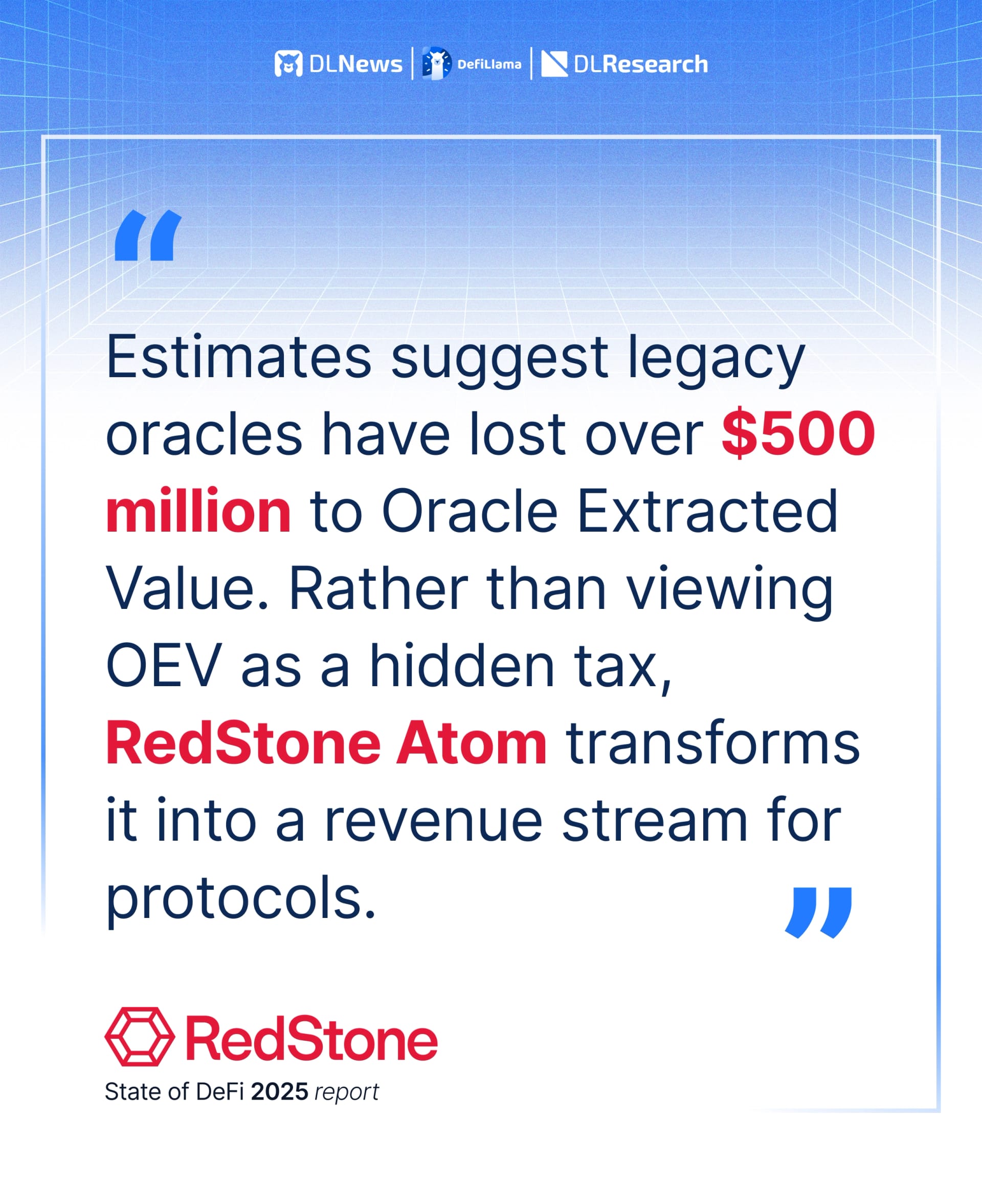
Conservative estimates suggest legacy oracles have lost over $500 million to OEV. Rather than viewing OEV as a hidden tax, Atom transforms it into a revenue stream that protocols can use to boost user yields, reduce borrow fees, or fund development, turning what was previously value extraction into a competitive advantage for protocols that adopt it.
In a future where perps, spot, and issuance all lean on the same data backbone, what kind of failures or feedback loops worry you most at the oracle layer, and how can the industry preempt them?
Derivative products typically leverage spot prices as their underlying reference, which creates natural spillover risks. A vulnerability in the spot token’s smart contract or an issue with exotic spot asset pricing could cascade into derivative markets built on top of that data. However, with rigorous due diligence when evaluating and constructing oracle price feeds, placing data intelligence at the front of the process, these risks become manageable. A good example of potential risks was visible on the 10th of October crash, where a flash depeg report by the internal CEX oracle of margin assets like USDe caused an even bigger liquidation cascade.
The key is maintaining that disciplined approach as the ecosystem scales. At RedStone, we haven’t experienced a single mispricing event, and our operational focus is on continuing that track record.
Perps venues increasingly list long tail assets and structured products; what kind of market structure or liquidity conditions do you believe should exist before an oracle feed for a new market is considered safe?
There’s a strong need for quantified and objective oracle requirements when deciding to support new market feeds. At RedStone, we maintain clear thresholds based on liquidity metrics across both onchain venues and centralised exchanges that asset issuers must meet before we’ll consider developing a price feed.
Having clear-cut rules around market depth, trading volume, and liquidity distribution is essential for determining when an asset has sufficient market structure to support a safe oracle feed. Our proprietary framework protects both the oracle infrastructure and the protocols relying on it from manipulation risks inherent in thin or fragmented markets. A great example is markets powered by HyperStone, a bespoke Hyperliquid HIP-3 oracle.
Our team, together with the deploying party, like Felix, carefully selects assets supported and helps to navigate new market parameters like max leverage or open interest. We see a great opportunity in commodities like gold or stocks like TSLA.