



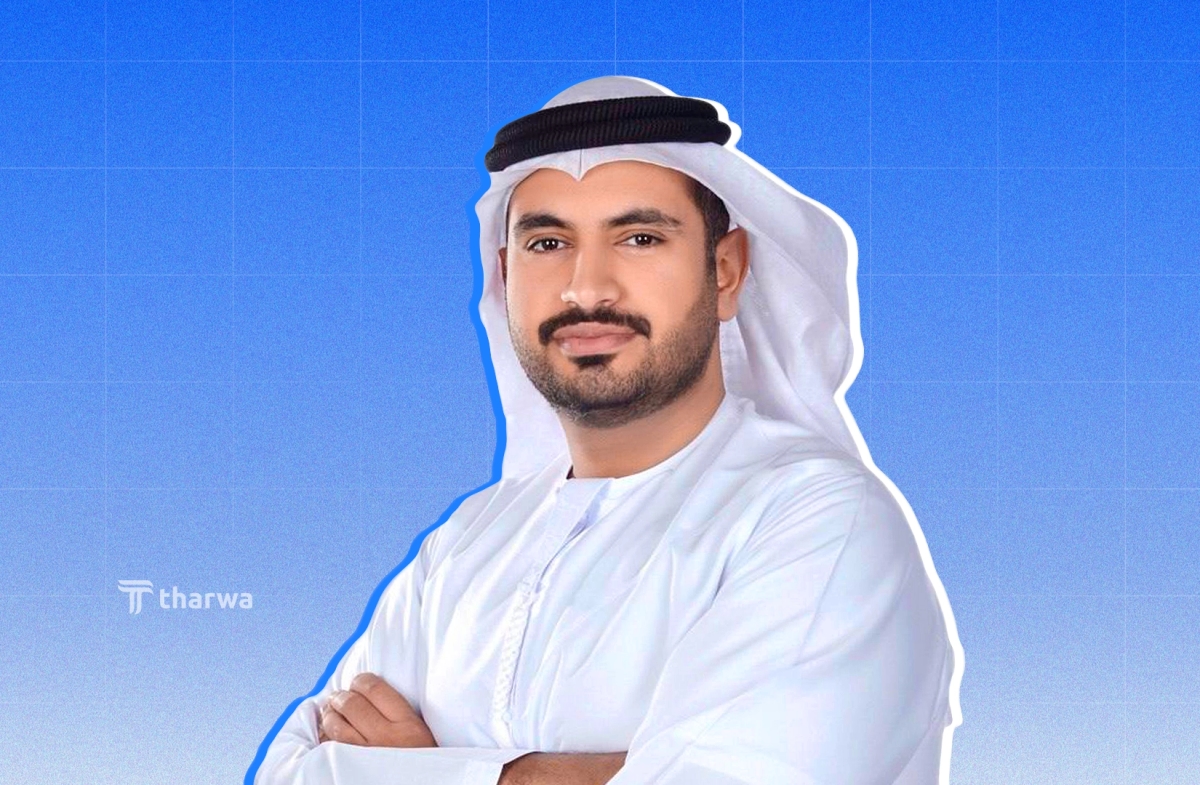
As a member of one of the UAE’s most prominent business families, Saeed brings not just vision, but access. His family has been a cornerstone of the UAE economy for decades, with active roles in real estate, automotive, and large-scale capital deployment. With roots in Abu Dhabi’s financial and commercial landscape, Saeed understands the challenges and opportunities facing traditional finance. At Tharwa, he is applying that insight to the next frontier: programmable, risk-managed capital on-chain. Saeed is also the driving force behind Tharwa’s position in the UAE, a fast-growing hub for blockchain regulation and RWA integration. His network enables direct engagement with asset originators, institutional partners, and regulatory advisors, giving Tharwa a structural edge that is difficult to replicate.
We recently spoke with Saeed Al Fahim, Founder of Tharwa, about bridging the gap between the physical economy and digital assets, and how his background in large-scale industrial procurement is shaping a new financial infrastructure.
Read more about Tharwa’s mission to optimise yield and automate capital allocation in the interview below.
Your background is deeply rooted in the physical economy, where you have managed supply chains for some of the region’s largest energy and industrial platforms. Do you see a parallel between the inefficiencies you solved in traditional procurement and those you are now solving in capital markets?
Yes, the inefficiencies are the same, just at a different layer. In the physical economy, value was trapped in slow, fragmented systems. In crypto and capital markets today, liquidity is abundant yet misallocated, circulating on-chain without consistently reaching productive use. Tharwa is built to change that by turning stablecoins into Shariah-aligned, yield-bearing capital rails.
We are routing on-chain liquidity into SME financing and real-economy supply chains, thereby strengthening in-country value while keeping capital liquid, transparent, and globally interoperable.
Many RWA founders come purely from tech or finance, but you have overseen and optimised industrial portfolios exceeding $500M annually, while physically sourcing and deploying strategic materials across real-economy supply chains. How does this hands-on experience with real industrial assets give Tharwa an edge in understanding what actually needs to be tokenised versus what is just hype?
Tokenisation only works when it maps to reality. Having operated at the physical layer of the economy, I know which assets generate real cash flow, carry enforceable rights, and survive cycles. Tharwa tokenises economic primitives, not narratives. We bring real-world assets on-chain with the same discipline, transparency, and risk controls that govern industrial systems.
Previously, you achieved $23M in savings by rethinking sourcing strategies, and you are currently digitising procurement via Oracle Fusion. Tharwa promises ‘optimised yield’ and ‘AI capital infrastructure.’ Are you applying the same philosophy of aggressive cost-reduction and operational efficiency to DeFi yields?
Absolutely. The same mindset applies. In procurement, value is created by eliminating friction, automating decisions, and making capital work harder through better data and controls. Tharwa applies that exact discipline on-chain using AI to reduce inefficiency, optimise risk-adjusted yield, and turn passive liquidity into productive, transparent capital. It is operational excellence, rebuilt for Web3.
Tharwa is described as an ‘AI agent-driven hedge fund.’ In a market filled with RWA projects, how do these AI agents interact with on-chain assets? Are they managing risk, executing trades, or automatically sourcing the best yields?
Tharwa is not a black-box trading bot. The AI agents are designed as an intelligence and orchestration layer, not unchecked executors. They analyse on-chain conditions, risk parameters, and yield opportunities, then inform and automate allocation logic as the system is progressively activated.
Execution remains governed by predefined rules, transparency, and human-defined constraints. In short, AI guides capital with discipline first, and automation follows, optimising yields without sacrificing control or trust.
You mention that Tharwa creates ‘programmable, risk-managed capital.’ Given your current role involves strict governance and compliance across multiple entities, how strongly does that ‘corporate governance’ mindset influence the code and smart contracts you are building at Tharwa?
Governance is the foundation. Having operated in environments where controls, audits, and accountability are mandatory, we design Tharwa’s smart contracts accordingly: clear rules, hard risk limits, and no hidden discretion. The goal is programmable capital that behaves predictably on-chain, with institutional-grade guardrails and crypto-native transparency.
Tharwa famously reached the ‘Top 300 global projects’ within its first two months of operation. What was the specific factor that led to this scale-up, and what is the next milestone for the protocol in 2026?
Momentum came from conviction, not hype. Tharwa gained traction by focusing on disciplined capital design, relevance to the real economy, and credibility rather than short-term narratives. Even when markets shifted, that foundation remained intact.
The 2026 milestone is about scale and permanence: rebuilding momentum into sustained TVL growth, deepening real-world integrations, and establishing Tharwa as a durable on-chain capital layer that serious ecosystems rely on.
How does coming from a family with such deep roots in ‘tangible’ assets influence your approach to the volatility of the crypto markets? Does it make you more conservative or more ambitious?
It makes me more ambitious, not cautious. Growing up in the UAE, where long-term value creation is central, instilled a belief that the biggest outcomes come from building real infrastructure, not chasing cycles. In crypto, that means leaning into volatility while engineering systems that compound through it. Tharwa is built to turn disruption into durable, scalable on-chain capital for the long term.
You are positioned in the UAE, which is becoming a global regulatory hub. How does your network, which enables direct engagement with asset originators and regulators, help Tharwa navigate the regulatory grey areas that stall so many other DeFi projects?
It gives us speed with credibility. Being anchored in the UAE means we engage early with asset originators and regulators instead of building in isolation. That allows Tharwa to design on-chain products that anticipate compliance rather than react to it. We move faster through grey areas while others are still guessing. We build with regulators in mind, so innovation scales rather than stalls.
You presented at ADIPEC 2023 on circular-economy initiatives, in-country value, and ESG-driven support for local suppliers and innovation. Do you see Tharwa following a similar path, bridging Web3 capital with traditional institutional audiences, or do you expect on-chain capital to remain largely separate from industrial capital?
The future is convergence, not separation. Just as circular-economy and ICV ideas moved from niche to mainstream, Web3 capital will follow suit. Tharwa is built to be that bridge, translating on-chain innovation into structures that traditional institutions understand while preserving the speed and transparency of crypto. Over time, industrial and Web3 capital will not compete; they will operate on the same rails.
You’re building a high-growth blockchain protocol while operating within a highly regulated, large-scale corporate environment. How do you balance the discipline and accountability of an enterprise mandate with the speed and 24/7 nature of a crypto startup?
It comes down to structure and leverage. Enterprise environments instil discipline and prioritisation, and I apply that same rigour to Web3 by building systems in which smart contracts and automation handle execution continuously. That allows me to focus on strategy and direction while the protocol runs 24/7 by design.