

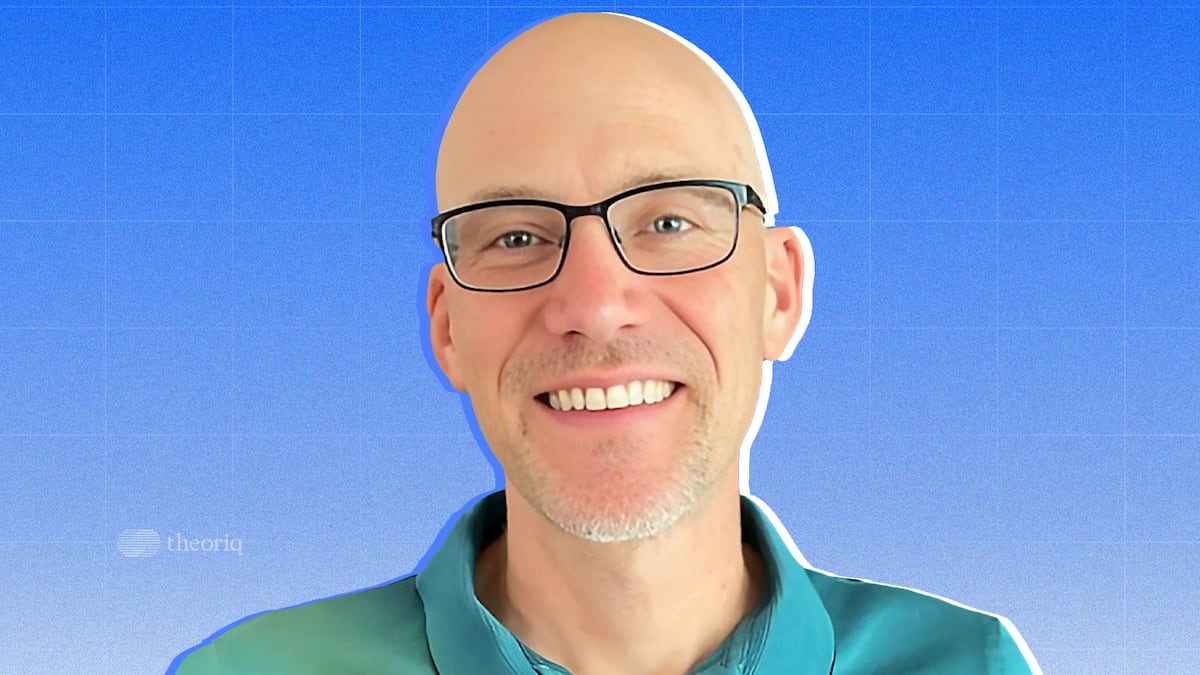
Ron Bodkin is the co-founder and CEO of Theoriq Labs. Theoriq is an Artificial Intelligence (AI) agent swarm protocol that enables specialised AI agents to collaborate, fostering the agentic economy. Ron has over 15 years of AI experience. He was responsible for Applied AI and Responsible AI in the Google Cloud CTO office. He was also the VP and GM of AI at Teradata, following the acquisition of his company, Think Big Analytics, and led AI Engineering, as well as serving as CIO at the Vector Institute.
We recently spoke with Ron Bodkin, Co-Founder and CEO of Theoriq Labs, during Abu Dhabi Finance Week, about the evolution of AI from simple chatbots to autonomous swarms and how the newly launched Mainnet is building the infrastructure for an agentic economy.
Theoriq develops AI-powered infrastructure for autonomous DeFi portfolio management, integrating automated capital allocation with interactive intelligence through specialised agent swarms that offer transparent, explainable decision-making within smart contract-enforced safety constraints.
Read more about Theoriq’s vision for a modular, agent-driven financial system in the interview below.
You’ve led applied AI at Google Cloud, built AI engineering teams at Vector Institute, and founded companies long before agents became mainstream. Reflecting on your experience, what problems or limitations did you observe across those environments that ultimately led you to autonomous, multi-agent systems?
It has been an ongoing evolution. Throughout my career, I have witnessed AI improve rapidly. I started working in machine learning and AI 15 years ago and have observed significant progress, with improvements accelerating over time. During my time at Google, we recognised a major breakthrough: LLMs could respond to prompts and perform useful tasks. Later, at the Vector Institute, there was considerable enthusiasm among our corporate sponsors and large Canadian companies about applying conversational AI.
I recognised this would become a significant trend and was eager to introduce it to the community in a way that wasn’t dominated by a few monopolists controlling an increasingly powerful set of AI technologies.
Driven by this concern, I aimed to help people build their own systems with good governance, so they function effectively, rather than having a handful of billionaires control the AI everyone depends on. That was the vision, and throughout my 20-year career, I have consistently believed AI to be the most impactful technology.
To turn this belief into reality, we founded Labs to develop Theoriq, aiming to improve the real-world functioning of that kind of AI. When we began, many people in Web3 were sceptical about agents and LLMs.
However, the landscape shifted quickly. While ChatGPT opened the world’s eyes to AI, few understood that the technology would evolve from conversational bots to fully autonomous agents. Recognising this inevitable trajectory, we built the Alpha Protocol to coordinate these agents and enable them to perform complex tasks across various industries.
This thesis was validated through our testnet conducted at the end of 2024. We observed significant excitement around deploying agents in DeFi, which led us to spend this year carefully honing the concept for the Agentic Economy. We focused on critical questions: How do you develop agents that truly address DeFi challenges? How do you automate processes, improve reliability, and design an architecture where you can trust the output? That remains the focus of our vision.
What was the earliest version of Theoriq’s thesis? Did you always believe the future would depend on swarms, or did that emerge through experimentation?
It emerged through experimentation. The first focus was on creating a decentralised machine learning platform for various models. It was only after ChatGPT was released that we recognised the significant demand specifically for using LLMs and that this was the clear use case.
That experimentation led us to believe that specialised agents with unique knowledge and data, but leveraging the powerful AI capabilities of LLMs, would be important. Therefore, having them work together through a protocol to enable this was also crucial.
We came up with that idea and started working on it in late 2023, drawing from our experimentation with projects like Space and Time to develop early versions of agents for them. We learned from that experience and began building towards it, writing a litepaper in summer 2024, and launching a testnet to demonstrate what could be achieved.
For people hearing about Theoriq for the first time, can you walk us through the Mainnet stack (AlphaProtocol, AlphaSwarm, AlphaVault, the Agent Registry) and how these modules work together?
The Alpha Protocol serves as a coordination system for agents. It features registries that allow agents to mint on-chain NFTs for identification and communicate through pub/sub messaging. This key feature was inspired by the limitations we observed with “Crypto Twitter agents.” Twitter proved to be a poor communication bus, so we implemented a scalable, decentralised publish-and-subscribe model to provide a much more reliable method for agents to work together.
We integrated this with Alpha Studio, a user interface designed to simplify tasks like chatting with agents, registering them, and exploring their capabilities. Aiming to enable agents to assist with on-chain DeFi transactions, we launched a community beta that makes it easy to deploy swarms of specialised agents. As part of this, we collaborated with Kaito, an innovative InfoFi platform.
Our goal was to enable users in the Kaito ecosystem to stay informed with the latest news while performing direct actions. This includes creating transactions where an agent assists in setting up and managing liquidity positions within DEX pools.
While the ability to create transactions was a major unlock, we recognised that users do not want to constantly monitor and adjust an agent’s actions. To solve this, we introduced the Alpha Vault, which allows agents to curate strategies. The system remains non-custodial, meaning users deposit funds and retain control while the agent advises on how to achieve the best returns. Currently, we have an Allocator Agent within the Alpha Vault that selects from various high-return, moderate-risk strategies for compounding ETH.
The Mainnet launch is positioned as more than just an infrastructure update; it is being called an “operating system for AI-native finance.” What does this shift unlock for developers who want to build on Theoriq right now?
It really is a fundamental shift. We are moving from a manually operated DeFi landscape to an automated agent economy. Until now, developers building autonomous agents had no unified environment for deploying, coordinating, and accessing capital.
Mainnet solves that problem. We are providing tools like the Agent SDK to simplify integration, and the Agent Registry to enable developers to mint verifiable identifiers. It effectively connects the crypto rails to AI brains, allowing developers to build agents that don’t just talk but execute real-time strategies directly on-chain. It turns Theoriq from a platform into a programmable foundation where autonomous intelligence meets usable capital.
How does AlphaVault route liquidity to agents, and how do Epochs and reputation determine allocation? What does this unlock for agent-based competition?
Our vision is to establish a continually evolving environment where developers can showcase agent capabilities and evaluate risk in real time. While our token will initially secure the network, we will broaden its utility to include restaking and delegation. This enables users to actively support high-value agents.
In return for supporting an agent, users earn rewards and exclusive benefits, such as terminal access. Importantly, this staked capital also functions as a security bond. If an agent behaves maliciously, the stake can be slashed, effectively providing an insurance layer that instils confidence in the agent’s trustworthiness.
Theoriq emphasises structured swarms instead of monolithic AI models. Why is swarm architecture better suited for DeFi execution?
We believe that much of DeFi centres on various practical ways to participate in and leverage DeFi protocols. Combining multiple agents can offer better risk-adjusted returns. You avoid putting all your eggs in one basket with an exciting agent, while still limiting your exposure and attaining a competitive blended return. Therefore, one idea is to reduce the risk involved with having multiple agents in DeFi.
Another point is that we also observe agents being highly valuable for collaboration and mutual support. These agents, often specialists with supplementary data, make particularly significant contributions, such as unique analytics or risk assessments. The first version involves multiple agents capable of managing sub-vaults, which can be integrated to achieve a better risk-adjusted return.
The next topic is swarm agreements, in which agents collaborate to solve problems. Just as we hire specialists in human teams, we anticipate there will be specialists within agent teams as well. Consider projects like Cambrian, which are generating highly interesting data for DeFi; their agents can form part of a swarm that contributes to other execution agents who are experts in providing liquidity, hedging, real-time risk analysis, social analysis, or spotting new arbitrage opportunities.
$THQ staking is now live. What role will stake-weighted reputation play as agents compete for capital?
I believe staking is a strong indicator of reputation. Reputation must be assessed carefully. In Defi, key factors to consider include risk-adjusted returns, not just APR or APY, but also maximum drawdown, Sortino ratio, and Sharpe ratio. However, focusing only on these opaque performance metrics can cause you to overlook other important aspects.
The fact that community members can evaluate and decide to stake in an agent sends a strong signal that they genuinely believe in the agent. They consider this agent highly promising and persuasive in its work.
This provides an opportunity to decide how else you can perform risk analysis on the agent. Examine the team, review the track record, and consider what is publicly available on GitHub. However, this is a double-edged sword. In DeFi, people often hesitate to open-source their alpha. We do not typically see the best AI agents fully open-sourcing everything. People can easily inspect what an agent does; it is quite simple to trade against an agent when you know exactly how it operates. Therefore, it is unlikely to be fully open source.
I believe that, over time, interesting developments such as the use of Trusted Execution Environments (TEEs) will emerge, enabling an AI agent to audit another agent and assess its risk. Everything remains within the Trusted Execution Environment, so the only output is an audit score. This approach allows inspecting internal processes without exposing secrets.
Looking ahead, what happens when thousands of autonomous agents compete across liquidity, market-making, risk management, and yield? What new strategies or developer ecosystems do you expect to emerge?
Everything is moving incredibly fast. I find the concept of agents generating yields and returns very appealing. There is significant innovation in DeFi, ranging from new products such as perpetuals and derivatives like Pendle to advancements in fundamental decentralised market making. We are particularly excited about projects like Angstrom, which provides an MEV auction that aims to create a fairer environment for liquidity providers.
AI agents can automate all of this DeFi innovation. However, this automation introduces significant complexity. The real breakthrough lies in AI’s ability to generate real-time playbooks and patterns that reliably automate and utilise these intricate systems.
At the same time, the pace of innovation in AI is truly remarkable. Every month, we see major improvements in quality and the complexity of tasks the technology can manage. We are speaking just a day after the release of OpenAI o3, which highlighted benchmarks showing that tasks that typically take human experts 6 hours are completed swiftly. This will clearly translate to DeFi, where an agent can now perform six hours of strategy analysis or market evaluation in five minutes.
For those exploring Theoriq for the first time, where should they begin? And what key milestones should the industry watch over the next 6–12 months?
We are looking forward to the mainnet release scheduled for next week. We believe it will be very significant, and the community is highly excited about it. This will continue to develop. We have just launched our Alpha Vault, our first vault, and we are steadily adding agents and strategies to support further growth.
We are eager to encourage more third-party developers to contribute. We believe there is scope for various strategies, including not only ETH strategies but also stablecoins and other assets such as Bitcoin or Solana. We also think the pace of change is so rapid that we are building incrementally, using community feedback and signals to determine the highest-priority tasks.
There is an immense amount of work to be done in this space, but one thing I am certain of is that the Agentic Economy is progressing rapidly. This makes the idea of building an ecosystem of agents that can coordinate and curate vaults extremely powerful.