



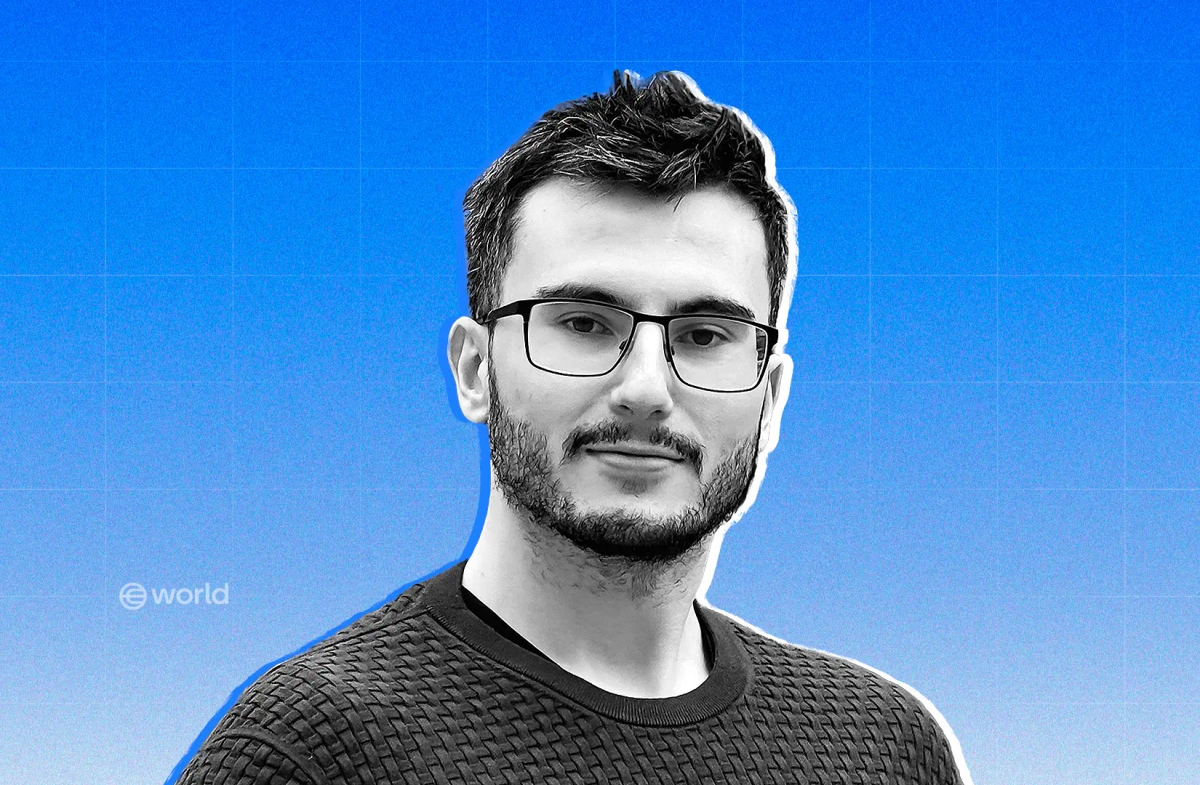
We recently spoke with Dominik Clemente, a Research Engineer at the World Foundation operating under the pseudonym dcbuilder, about the evolving landscape of digital identity, agentic coding, and the critical need for "proof-of-human" primitives.
He focuses on protocol research and engineering, the decentralisation of the World ecosystem, and initiatives that support the project’s mission. His broader interests include programmable cryptography, Ethereum, distributed systems, and decentralised AI. Outside of the World project, he is a co-organiser of ETHPrague, an active angel investor, and an advisor to various projects across crypto and AI.
Read more about his insights on the launch of AgentKit and the future of the internet below.
You've worn a lot of hats: building open learning resources, engineering core protocol infrastructure, and now working on decentralisation and grants. What ties it all together for you?
I consistently gravitate toward problems where I can drive the highest impact. That focus has taken many shapes over the years, from education and protocol engineering to decentralisation and proof-of-human. I simply love seizing massive opportunities.
Recently, I stepped back into hands-on engineering. The incredible leaps in agentic coding since late 2025 made that decision very easy. We can iterate so much faster now. Complex issues that used to stall us for weeks get resolved in a few hours.
This shift completely redefines what a solo engineer can accomplish. There has never been a better time to be an active builder in this space.
You were an advisor at Modulus Labs, which was developing ZK-based AI accountability before being acquired by TFH in late 2024. How much did that experience influence your thoughts on the AI identity problem that AgentKit is now attempting to address?
I have been focused deeply on agents, identity, and cryptography ever since joining World. Early on, I worked on ZKML experiments, and building those initial learning resources is exactly what connected me and Tools for Humanity (TFH) to the Modulus team.
Modulus, which is now part of the TFH Applied Research team, was one of the few groups exploring verifiable and accountable AI systems from the very beginning. That experience strongly reinforced a core idea for me. Without solid proof-of-human primitives, reasoning about accountability in an agent-driven world becomes extremely difficult.
The combination of programmable cryptography, identity, and AI is incredibly powerful. Technologies like ZK, MPC, and TEEs will absolutely materialise into foundational layers over time.
AgentKit builds directly on that exact foundation. We initiated it to explore how to successfully prove an agent is acting on behalf of a real human. We designed it to be technically sound while remaining highly practical for real-world products to implement.
AgentKit launched last week. What was missing in the x402 standard that made this the right moment to build it?
The x402 standard is highly effective at managing payments between agents and services. It allows any agent with a wallet to make programme-driven payments for access. The key missing element is identity. The standard entirely overlooks the question of who is actually operating the agent.
This creates a massive problem in constrained systems like ticketing. When agents can autonomously pay, they can easily monopolise scarce resources. Relying solely on a payment layer simply cannot enforce fairness or equitable access.
We designed AgentKit to introduce proof-of-human as a required complementary primitive. It enables platforms to enforce rate limits or allocate access strictly on a per-human basis, even when agents are performing transactions on someone's behalf.
As agents rapidly become the default interfaces to the internet, proof of human identity becomes an essential prerequisite. Every system managing limited resources needs this basic layer to ensure fairness.
Coinbase's x402 processed 100 million payments in its first six months. That's fast adoption. Why did World choose to build on top of x402 rather than develop its own payments layer?
We prefer building on open standards rather than fragmenting the ecosystem. The x402 standard already gained early traction, boasting strong distribution through Coinbase and Cloudflare alongside a growing set of integrations.
That existing momentum made it a natural foundation. Our primary focus with AgentKit is on developing proof-of-human primitives for agents.
Layering that functionality onto an existing payments standard accelerates adoption across the board. It is far more effective than competing to establish a redundant payment network.
A small number of actors deploying agent swarms to distort engagement metrics is already a documented problem. How much did watching that play out in the wild shape AgentKit's design?
This directly influenced the design of AgentKit. In early agent-driven platforms like Moltbook, two destructive patterns emerged. We observed humans pretending to be bots and others running large bot networks.
Both behaviours artificially distort metrics and severely degrade the core product experience. That made it perfectly clear that attribution is of utmost importance.
Without a dependable way to associate activity with individual humans, digital systems become impossible to understand.
AgentKit enables that crucial attribution at the level of individual humanness. It achieves this while staying fully privacy-preserving and anonymous, effectively protecting users from spam and Sybil attacks.
Micropayments slow down bad actors, but don't solve the uniqueness problem. In practice, how do you expect platforms to weigh the two? Will most use both, or does proof-of-human become the stronger default?
Payments successfully introduce friction through cost. However, they lack the ability to enforce uniqueness on their own. Proof-of-human provides absolute uniqueness without adding any financial burden to the user. We will see the most robust systems requiring both mechanisms to work in tandem.
The ideal implementation relies entirely on the specific use case. Certain products inherently require a transaction fee, while others will remain completely free and rely solely on proof of human verification to manage access.
High-demand scenarios, such as ticket sales, absolutely mandate both elements. Combining a financial cost with verified human identity effectively neutralises spam attacks. It stops swarms of automated agents from hoarding scarce resources, regardless of their willingness to pay the fees.
The beta requires a verified World ID, which means access to Orb. Does AgentKit's thesis depend on World solving distribution first, or is there a credible path to scale without it?
Future versions of AgentKit will support multiple verification methods, including World ID Credentials, e.g. via NFC-compatible passports.
The ultimate goal is to move beyond any single verification method. We are merging multiple high-quality signals into one unified proof-of-human layer.
AgentKit 1.0 is tied to the World ID 4.0 rollout. What's the dependency there, and what does 4.0 change that makes a more robust version possible?
World ID 4.0 will vastly improve both usability and decentralisation. Users gain access to advanced features such as account abstraction, key rotation, and account recovery, making the proof-of-human layer far more resilient.
Simultaneously, third parties can now build their own authenticators. This reduces reliance on a single client and greatly improves user privacy. AgentKit benefits directly from both of these major upgrades.
World describes AgentKit as a layer that can sit alongside other identity systems. But if agentic commerce standardises around a single proof-of-human primitive, there will be one winner. Why should it be World ID?
Like x402, World ID functions as an open standard that anyone can contribute to. As it establishes itself as the leading standard, third parties will naturally collaborate, contribute, and build upon it.
We are building an open, flexible standard that offers strong privacy protections and is widely accessible. Because this maximises utility for our partners and relying parties, adoption will naturally follow.
The system must stay open, decentralised, private, and fully interoperable. Proof-of-human is too fundamental to be controlled by a single closed platform. These values are absolutely essential for achieving widespread adoption.
Five years from now, what does the internet look like if AgentKit and proof-of-human become foundational infrastructure, and what does it look like if they don't?
Agents should act as a layer that enhances human capabilities rather than replacing them. This leads to quicker markets, more effective coordination, and systems managing complexity on your behalf, all firmly rooted in real human intent.
Failing to solve proof-of-human guarantees the opposite. We risk creating an environment where telling real participation from synthetic activity becomes impossible.
That complete erosion of signal destroys trust across platforms and renders meaningful interaction impossible. It steers the internet directly towards the "dead internet theory" scenario.
The key difference lies in anchoring agents to humans in a credible, verifiable manner.