



Introduction
Decentralised exchanges are a critical component in DeFi, allowing assets to trade seamlessly without centralised order books. Yet despite their role as a foundational layer, automated market makers (AMMs) have struggled to scale as institutional-grade venues for liquidity. The structural cost of impermanent loss has consistently undermined returns, with empirical data showing that most liquidity providers underperform the simplest possible benchmark: holding their assets.
Many improvements have been attempted, such as concentrated liquidity strategies, which have improved efficiency at the margin but remain extremely complex to operate and still suffer from technical frictions like loss-versus-rebalancing (LVR).
In practice, most pools rely on incentive schemes to offset these structural losses. While incentives may temporarily compensate providers, they add yet another layer of risk: for retail users, the promise of double-digit yields is often tied to volatile assets, for protocols, subsidies become an ongoing expense to maintain liquidity and for institutional allocators, this model is fundamentally unacceptable. Capital cannot be deployed into structures that rely on external incentives while consistently lagging behind their benchmarks.
Here enters YieldBasis, a protocol designed to eliminate impermanent loss by restructuring how liquidity provision is built. Instead of requiring users to supply both sides of a pool, YieldBasis allows a single-asset deposit and automatically borrows the corresponding counter-asset to form a balanced position. The result is a systematically maintained leverage, ensuring that providers track the linear performance of the underlying asset while still earning trading fees.
In this report, we will explore why impermanent loss has remained the central barrier to capital deployment in AMMs and how YieldBasis proposes a structural solution. We then move from theory into practice, examining the mechanics of leveraged liquidity and its integration with Curve Finance. Building on this, we analyse the economic and governance design, assess the market potential across wrapped, restaked, and idle Bitcoin, and finally consider the key risks that must be addressed for institutional adoption.
The Problem: Impermanent Loss as a Barrier
Automated market makers (AMMs) have been a cornerstone of DeFi, providing continuous liquidity without centralised order books. But the very design that makes AMMs elegant also embeds a structural cost: impermanent loss.
For retail participants, impermanent loss often hides beneath the promise of double-digit yields. For institutional allocators, however, it is the single most important deterrent to deploying capital into liquidity pools. The inability to keep pace with simply holding the underlying assets has constrained AMMs from scaling as a serious venue for capital.
The Mechanics of Underperformance
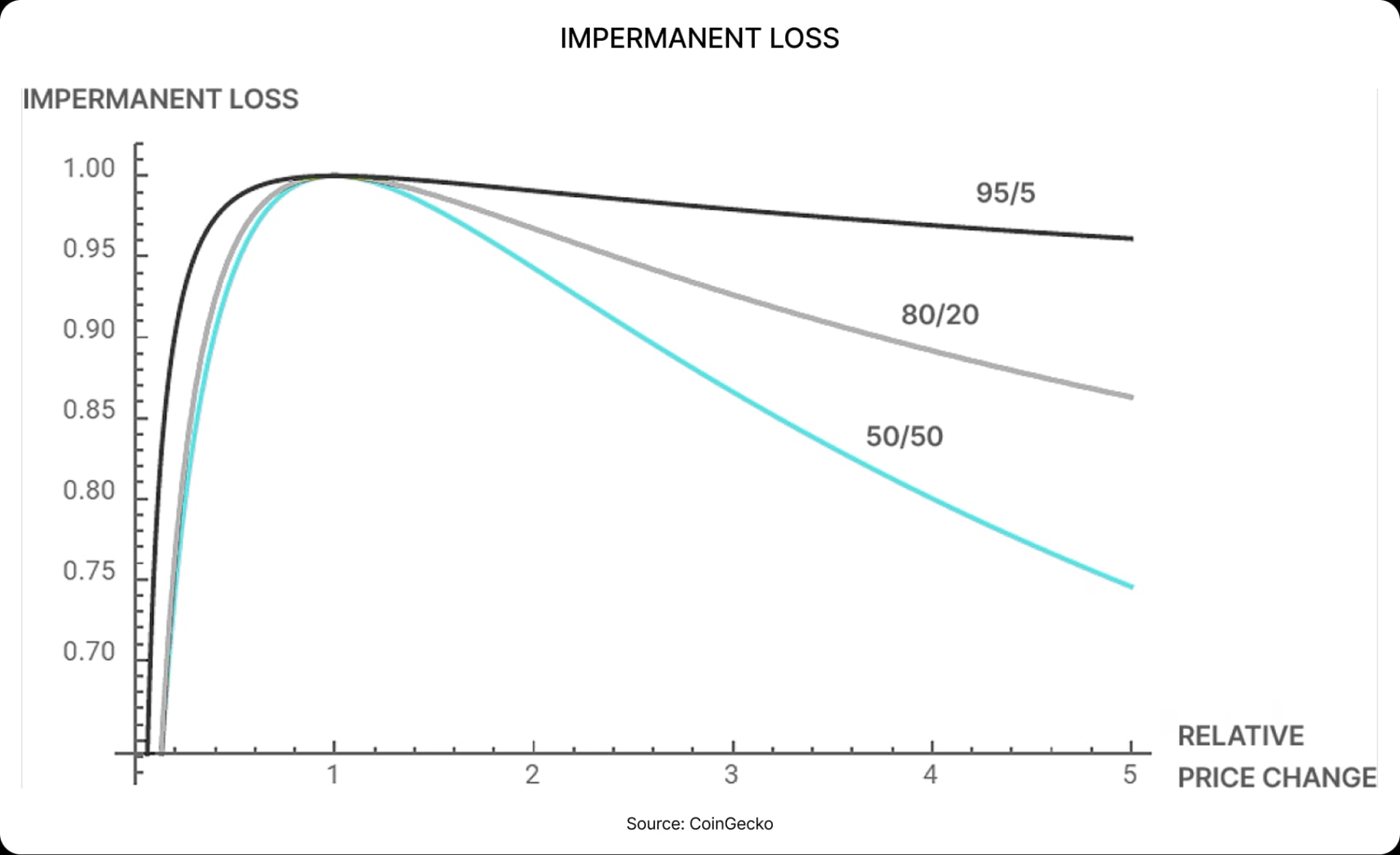
Impermanent loss (IL) occurs whenever the market price of assets diverges from the ratio held in an AMM pool. From that moment, the value of a liquidity provider’s position underperforms in terms of its total value compared with simply holding the assets outright. This underperformance appears immediately once prices move away from parity, even if no further trades take place.
The cause lies in the design of AMM pricing curves. As prices shift, the combined value of assets in the pool increases less than it would through direct ownership, creating a structural shortfall for LPs. This is not the result of rebalancing or trading activity, but an inherent property of AMMs themselves. However, impermanent loss arises only when the pool moves away from parity, restoration of parity returns it to a state with no impermanent loss.
Because of this, impermanent loss is both unavoidable and persistent. It represents the built-in cost of providing liquidity: traders gain reliable access to markets, while liquidity providers accept the risk of underperformance.
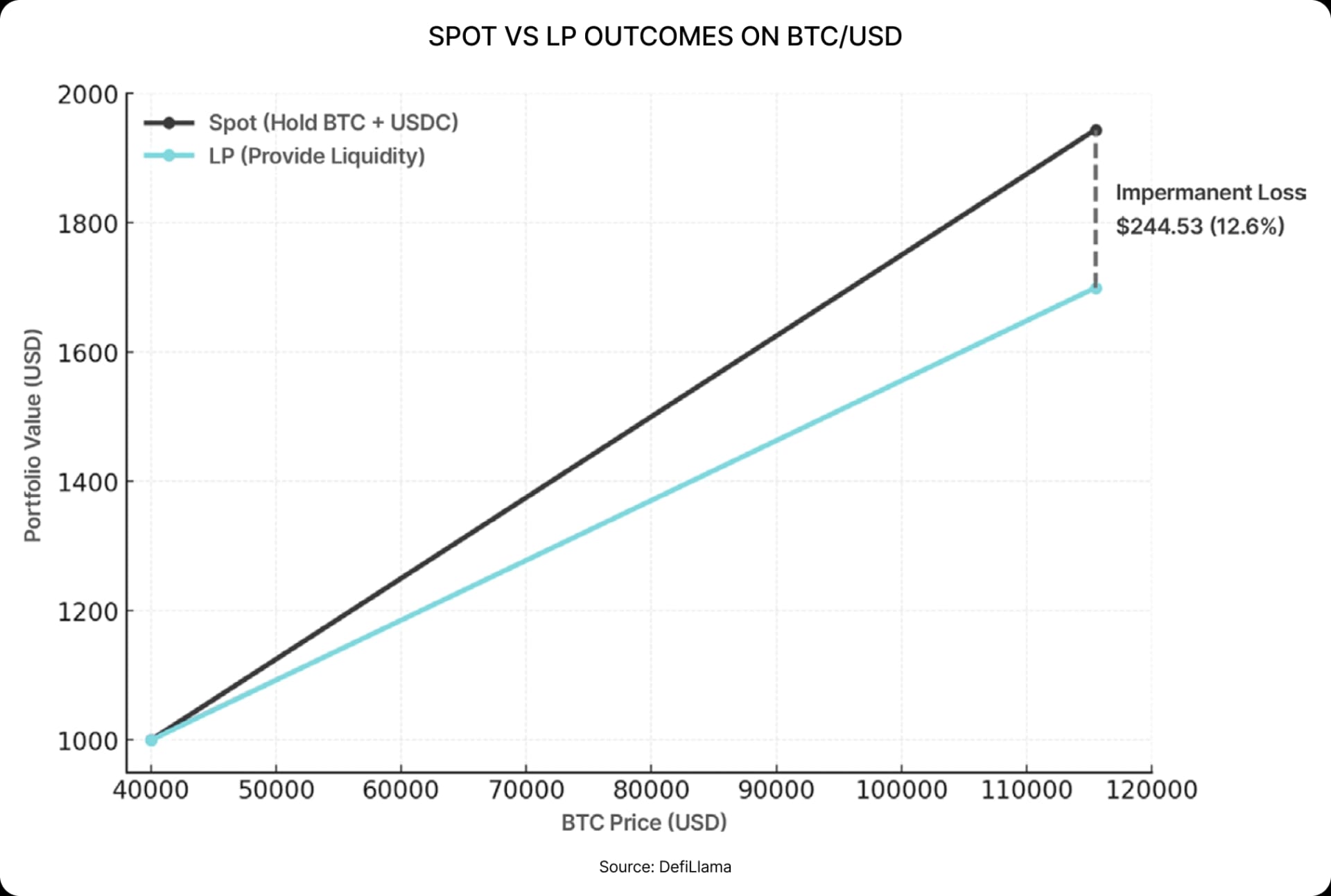
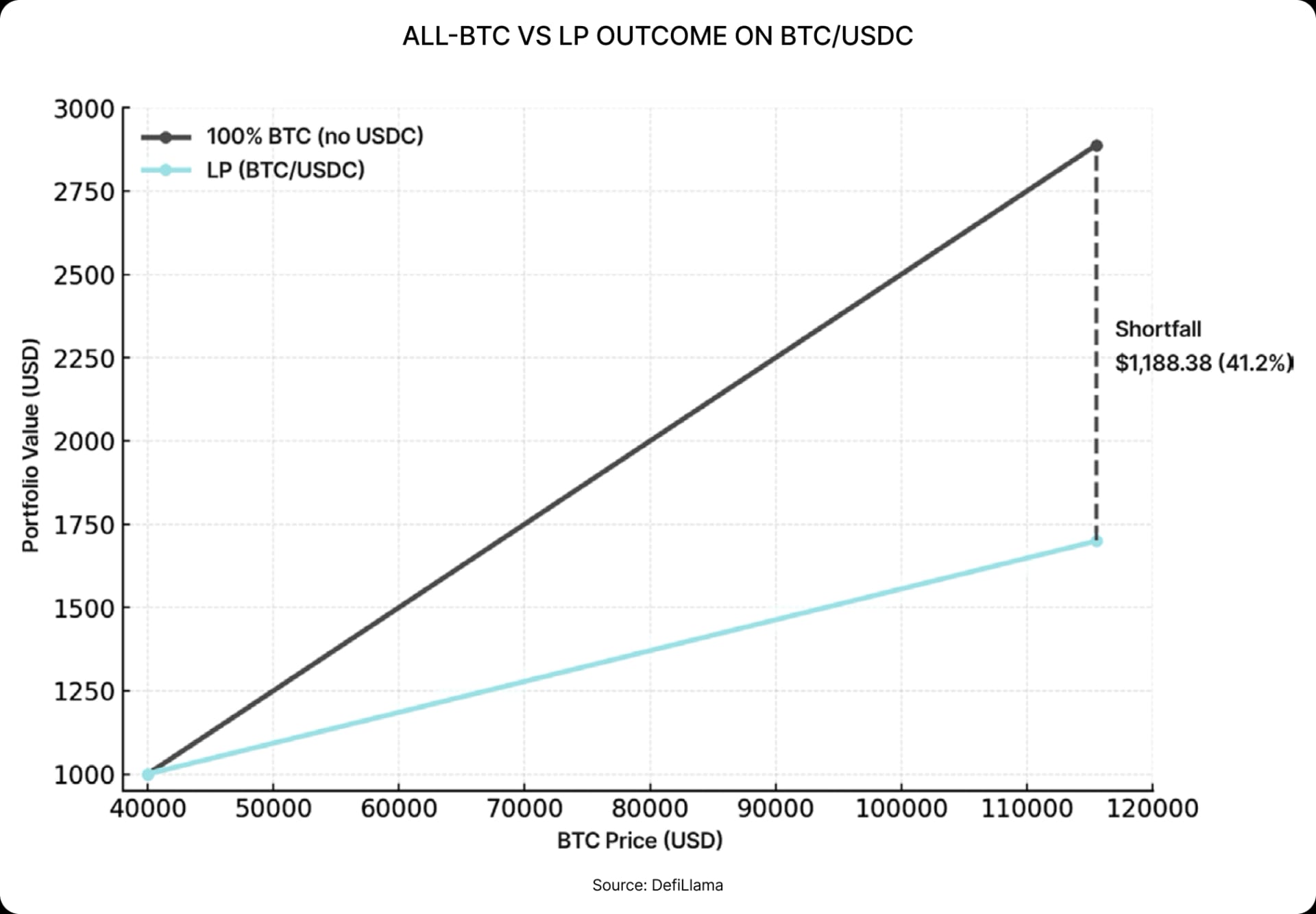
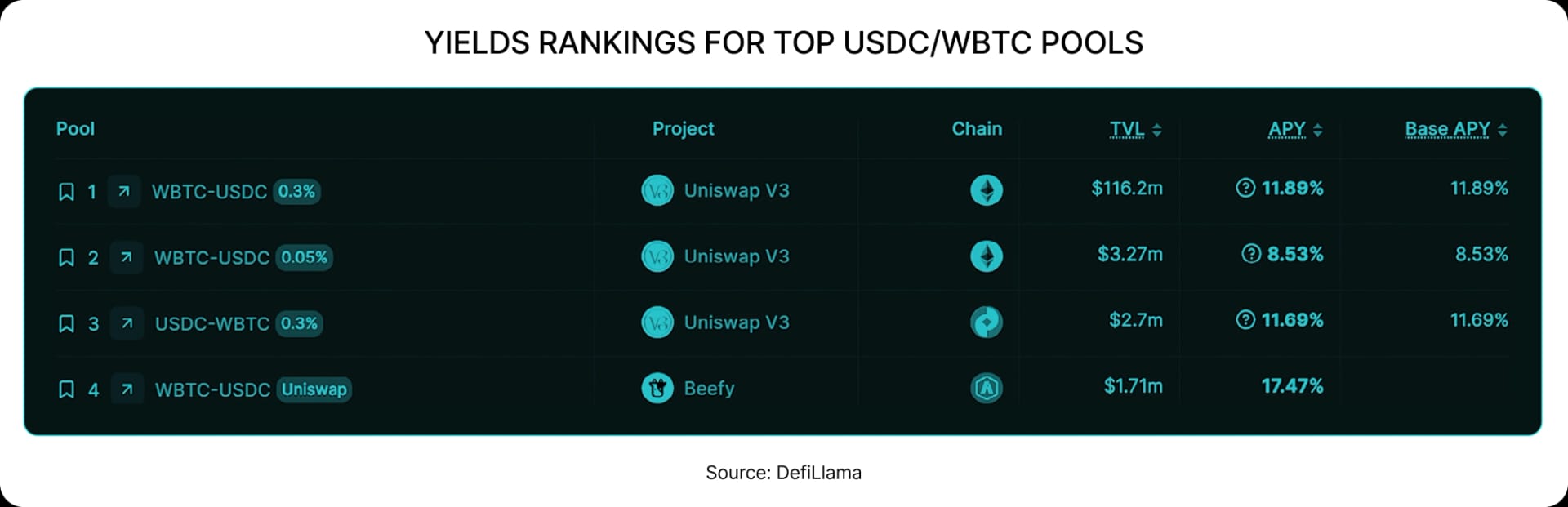
We can even go a step further. If instead of splitting between BTC and USDC, the investor had held the full $1,000 in Bitcoin, the position would now be worth $2,887.70. Against this outcome, providing liquidity looks even less attractive, with a shortfall of nearly $1,188, or more than 40%.
Empirical Evidence of Underperformance
And while you might think that the example above was just the result of cherry-picked data, you would be wrong. In fact, countless academic studies over the past few years have reached the same conclusion: for most participants, providing liquidity in AMMs has been an unprofitable business.
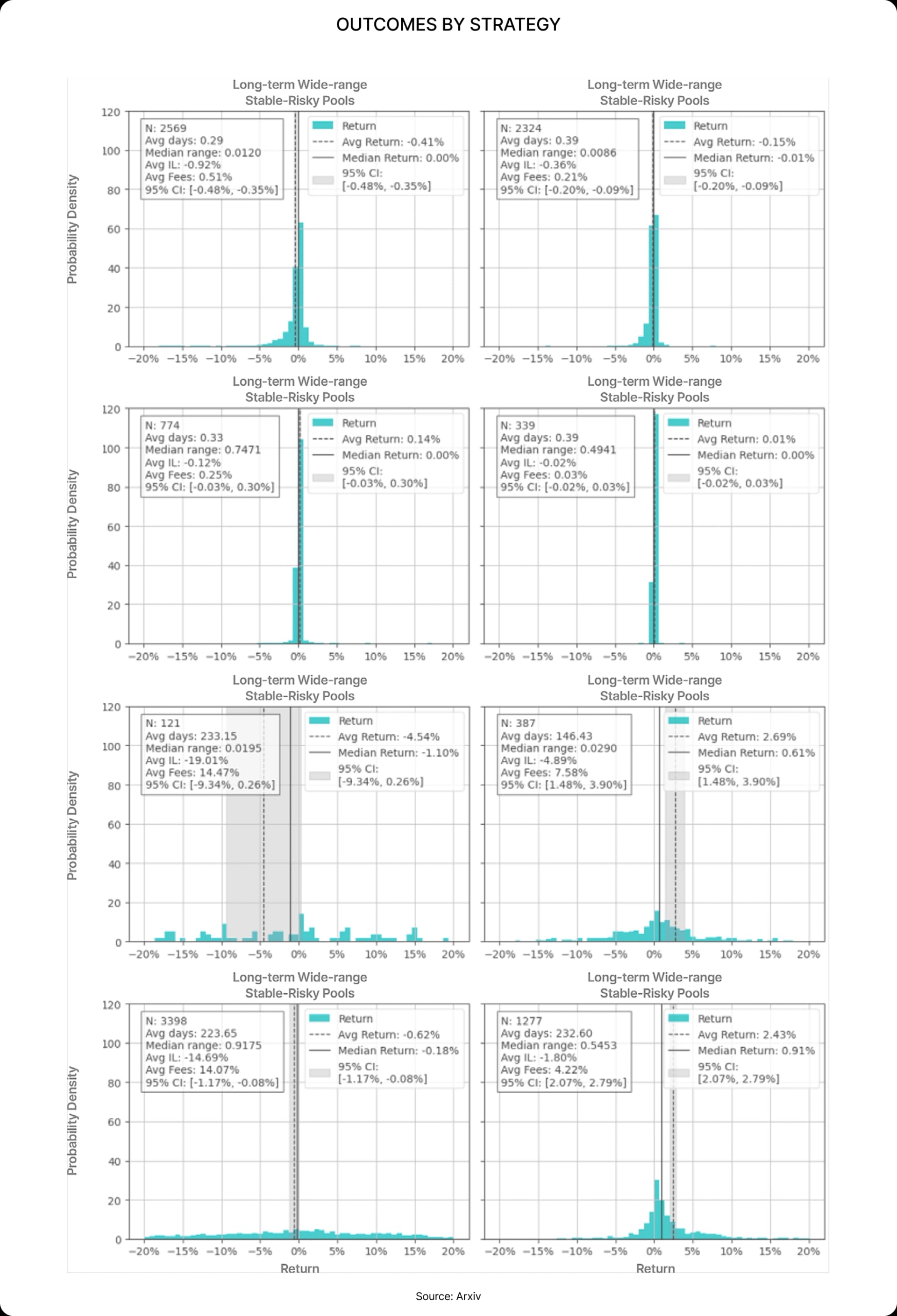
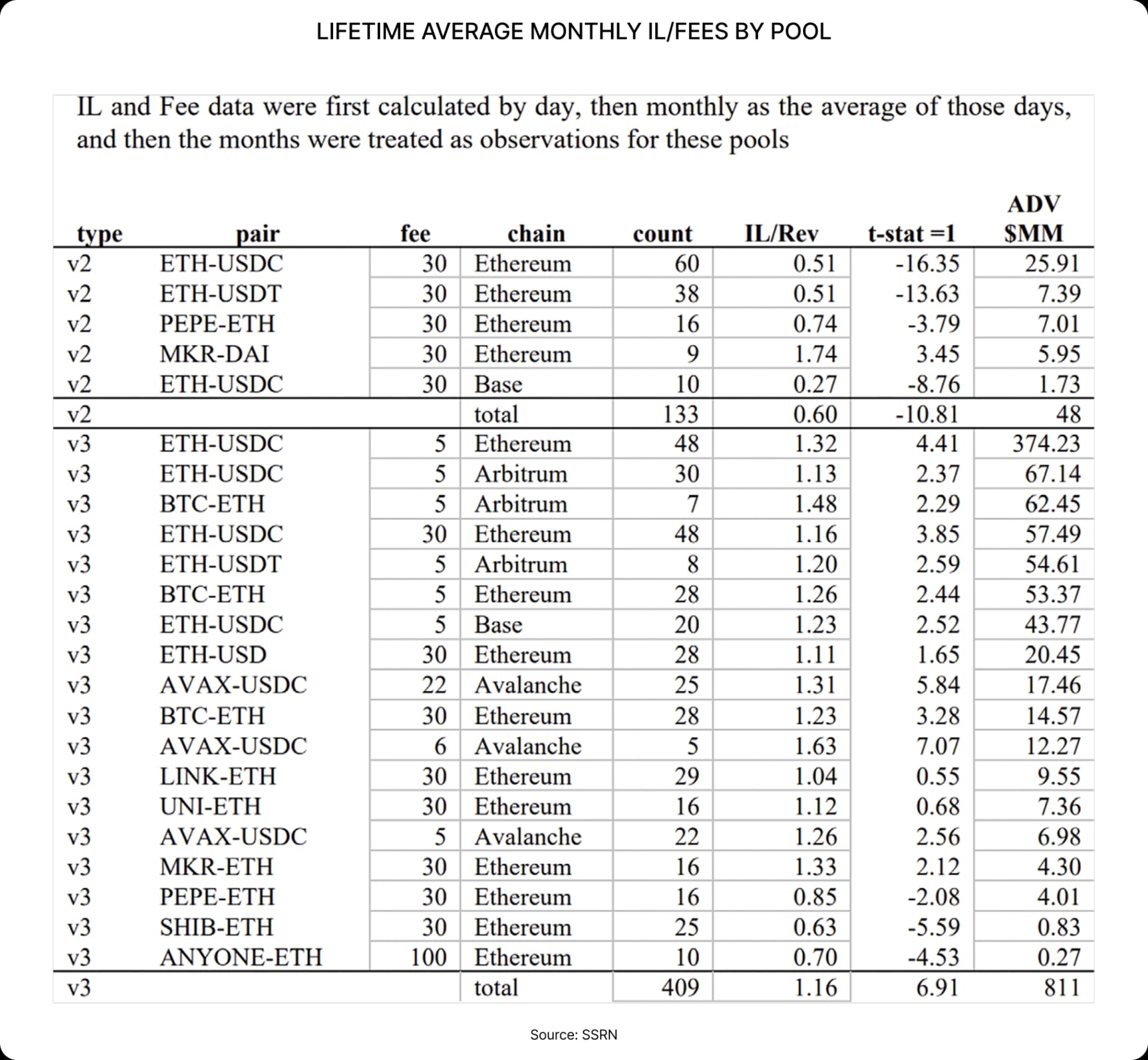
Drossos et al. (2025) analysed 700 days of Uniswap v3 data across nine pools to test whether liquidity provision beats simply holding the assets. Using a loss-versus-holding (LVH) framework, they compared impermanent loss (IL) to fee income across thousands of LP positions.
The results showed that most strategies failed. Nearly half of all positions (49.5%) generated negative returns, and the majority of outcomes clustered within a narrow band of –1% to +1%. On average, LPs realised an IL of –3.8% compared to a buy-and-hold portfolio, meaning that fee income rarely offset the losses from price divergence.
Why Capital Stays Away
Retail providers often tolerate the structural drag of impermanent loss because they are lured by short-term incentives and high advertised yields. Larger capital allocators, however, cannot justify the economics. Their performance is benchmarked against simple holding strategies, and an allocation that underperforms Bitcoin by 12.6% over a cycle is untenable.
There are ways to hedge impermanent loss, but they are far from straightforward. LPs can, in theory, reduce their exposure by pairing positions with perpetual futures, rebalancing ranges, or using options to buy back gamma. Falkenstein (2025) also shows that LPs who run arbitrage strategies alongside their positions can capture the profits that normally leak to external traders, offsetting part of their losses.
The problem is that all of these methods introduce new costs, require active management, and demand a level of sophistication that most participants do not have. It is not realistic to assume that the average liquidity provider will be able to execute complex arbitrage programs or manage derivative overlays on top of their LP position. For the vast majority, impermanent loss remains a structural drag, which is why passive liquidity provision continues to underperform holding.
This difficulty in achieving consistent profitability also helps explain why DEX total value locked (TVL) has stagnated since the 2021–2022 peak. Despite market recovery in 2023–2025, DEX TVL remains well below its previous highs, while lending protocols and liquid staking have regained momentum.
DEXS TOTAL VALUE LOCKED [INCLUDE_CHART]
https://dl-production-assets.s3.eu-central-1.amazonaws.com/images/1773635829286-asset.webp
The inability of most LPs to outperform simple holding has constrained AMMs’ ability to attract and retain capital at scale, leaving them lagging behind other sectors of DeFi in both institutional adoption and TVL growth.
The Solution: YieldBasis and Leveraged Liquidity
But would it not be nice just to provide liquidity and earn trading fees without having to deal with impermanent loss? YieldBasis thought the same thing and came up with a way to do this through what it calls leveraged liquidity.
To understand leveraged liquidity, recall how a normal AMM works. As soon as prices move away from parity, liquidity providers experience impermanent loss: the value of their position grows less than if they had simply held the assets outright. This shortfall appears immediately once the pool drifts from balance, even if no new trades occur. The reason lies in the AMM curve itself, where LP value grows sublinearly with price (following √p rather than p in the case of CPAMM).
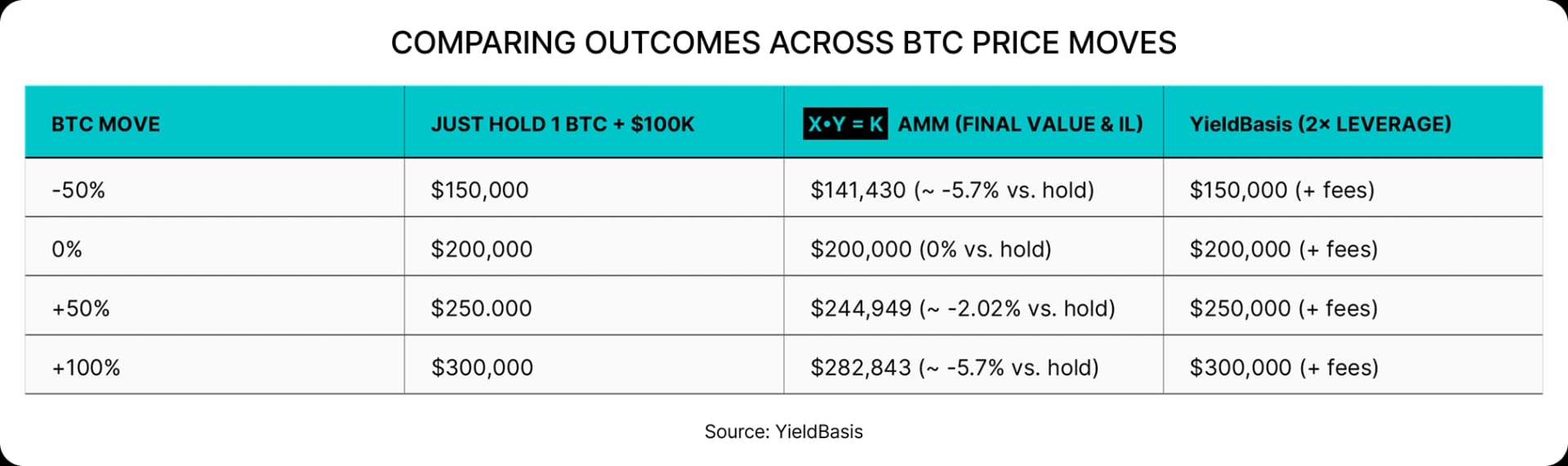
YieldBasis addresses this with compounding leverage. By borrowing against the pool position share, the system adds a controlled slice of extra exposure and continuously rebalances it to maintain roughly 2x effective exposure. Crucially, this mechanism eliminates IL without waiting for further trades: the shortfall is offset structurally as soon as prices move. Mathematically, when leverage is fixed at 2, the sublinear √p curve is squared back into a linear p curve, so the LP’s position tracks the asset directly. In practice, this is achieved through a dedicated special-purpose AMM that handles re-leveraging, implemented via Curve pools with crvUSD borrowing.
Download the full report here
Download the "YieldBasis: The Future of Bitcoin Yield" report here (PDF)