



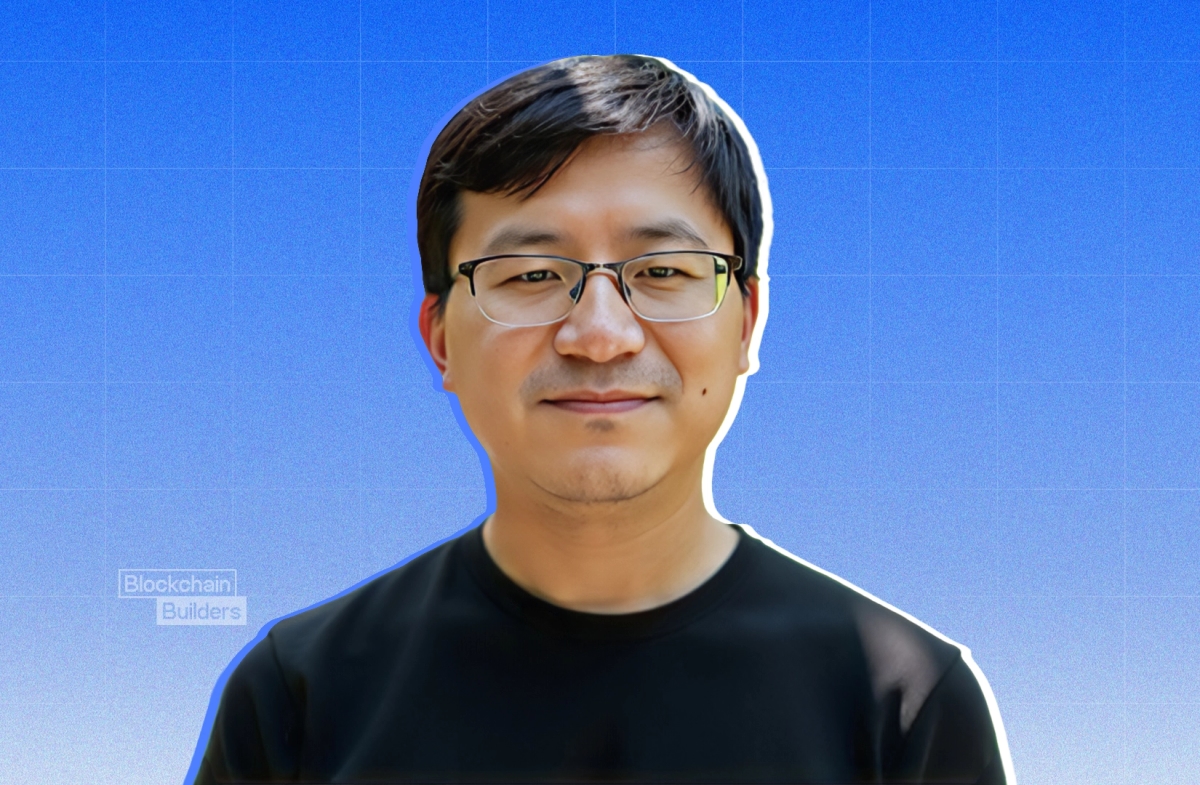
Kun Peng is a founding partner of the Blockchain Builders Fund and the founder of the Stanford Blockchain Accelerator, which he launched in 2022 to build a community for crypto-native founders. He also spearheaded the revival of the Stanford Blockchain Club and is the architect behind the Blockchain Applications Stanford Summit.
Born in China and raised in Argentina, Kun offers a distinctive perspective on the global crypto landscape. He combines this international background with deep technical expertise, having previously served as VP of Product at Convex Labs and worked on various Layer 1 and NFT projects.
We caught up with Kun Peng, Founding Partner of the Blockchain Builders Fund, in Hong Kong last week to discuss his unique global perspective on crypto adoption and the shift towards AI-centric blockchains.
Read more about why Kun believes the future internet will be designed for machines, not humans, in the interview below.
You were born in China, raised in Argentina, and now operate within the US startup ecosystem. That is three very different crypto realities. How has that shaped your thinking about global crypto adoption?
It gives me a distinct threefold perspective. In Argentina, adoption is driven by the necessities of an emerging market. New banking solutions and stablecoins make sense because the local financial infrastructure is often broken. Stablecoins provide a perfect alternative to the existing system.
On the US side, we see institutional adoption. Big financial institutions and Wall Street firms are embracing the industry because the regulatory roadmap is clearer. It is a top-down approach, compared with the grassroots adoption in Latin America.
For China, although its economy is as advanced as that of the US, there are considerable alternative applications. This is particularly evident in cross-border trade, given the permissionless nature of cryptocurrencies.
It makes it a very good tool for heterogeneous markets across different banks and financial systems. These three specific angles definitely shape how I evaluate global adoption.
The World Crypto Rankings report we prepared for Bybit found that several countries are now developing local-currency stablecoins to reduce their dependence on the dollar. Does that trend create or destroy opportunities for protocols like those your fund invests in?
Top-tier funds within the region, specifically in Brazil or Argentina, understand these needs perfectly. However, global VCs often struggle because they lack the local context required to value the opportunity.
They frequently question whether the specific pain point represents a venture-backed market size. Without experiencing the daily friction of local finance, they find it hard to validate the thesis.
Furthermore, there is a structural “exit problem.” Even if a company scales massively in an emerging market, it typically needs to exit in the US to generate venture returns. This additional hurdle forces global investors to price in significant execution risk, often leading them to pass on deals where the product utility is undeniable.
You’ve been a product builder, an L1 project manager, an NFT founder, an index protocol operator, and now an investor. How does that experience shape how you underwrite early-stage crypto startups?
The early days of crypto were very playful. It was not always about starting up but about playing around with different tech. I remember the NFT days, playing around with data and sniping. That experience gave me a comprehensive perspective as an operator and founder.
Evaluating early-stage startups is hard because finding product-market fit is extremely difficult. There is a lot of luck involved. What I learned is that founder quality matters most. Whatever the starting point, it might not be the end result.
It might not look very promising at first. However, after several iterations, it might evolve into a much bigger, venture-backed product. I have conducted so many experiments that I appreciate the founders’ potential to pivot and execute above all else.
What was a belief you held as a founder from 2018 to 2021 that you now strongly oppose as an investor in 2026?
Back then, there was a lot of free money. Many theses seemed to work just because liquidity was high. However, a good-looking price does not mean the model is sustainable. You definitely need time to prove whether something is false or has fundamental value.
I think a lot of people will agree nowadays that sectors like GameFi or NFTs might have some value, but were probably overvalued at the time.
We now see strong product-market fit for crypto technology. We see this as a payment technology and as a stablecoin infrastructure that unlocks use cases in cross-border commerce.
We also see the potential for democratising access to assets globally. That tech has fundamental value. So there is less noise now, and builders are focusing on the right direction: finance and FinTech.
You’ve been around crypto long enough to see multiple hype cycles. How does AI fit in now? Is it the structural shift that permanently changes blockchain architecture?
I think AI is quite interesting because many of the things we have designed, such as the internet and mobile apps, are very human-centric. The internet and advertising are for human consumption. APIs and SaaS are designed for human developers.
But in the future, I think we might evolve into a more machine-centric world. We will likely redesign the internet to be more agent-friendly, so that hundreds of millions of machines can interact with one another.
Right now, fewer than 5% of homepages are easily crawlable by agents. If web agents can crawl the entire internet to gather data, then credit card and API systems would become highly inefficient. They are too slow for machine-to-machine interaction.
What is user-friendly for machines is actually crypto. They can naturally talk to each other using a digital asset ledger to record their interactions. We will see many micro-transactions between them. We are moving towards an internet designed for machines.
Are we moving towards blockchains that serve humans or AI agents?
Blockchains are uniquely suited for AI agents. The fundamental value of the technology is that it allows even malicious actors to contribute productively because the system itself is trustless.
This applies perfectly to the coming wave of AI. We will soon have millions of agents, and we cannot assume they will all be benign or trustworthy. Blockchain provides a neutral framework where these agents can interact.
As long as an agent delivers the verified result, the system accepts the work regardless of the mechanism or intention behind it. This makes blockchain the ideal substrate for agent-to-agent interaction.
Security tooling and AI-powered vulnerability triage are becoming embedded in dev workflows. Do you think AI-native security becomes mandatory infrastructure for crypto?
I do see a future where many white-collar jobs, especially computer-facing ones, will be automated by machines or agents. So a lot of programming work will eventually be done almost entirely by coding agents.
If that is the case, we probably need AI-native security and quality assurance as a fundamental infrastructure. We need it to guarantee the security of the code that crypto relies on.
So we see a future with many more agents interacting with each other. They will be doing the security design and the quality assurance as well.
Tristero used trusted execution environments rather than heavy cryptography. Do you think the future of crypto infra will favour pragmatic speed over maximal purity of decentralisation?
Right now, execution speed is the defining factor. The industry is heavily adopting trusted execution environments because they offer a “good enough” security guarantee without the latency penalties of heavy cryptography.
Unless we see a massive leap in the performance of zero-knowledge proofs, it will be very difficult to move away from TEEs. In reality, the market consistently prioritises transaction speed over the theoretical purity of decentralisation.
What is a mistake early-stage crypto founders are making right now that you think will be obvious in hindsight?
Many founders mistakenly believe that the idea itself is their most valuable asset. In reality, ideas are cheap. Execution speed is the only metric that truly counts. The winning strategy is to secure support from angels or VCs and simply start building.
We speak with many founders, and the concepts are often repetitive rather than unique. Success comes from choosing a direction and iterating based on feedback.
Another major pitfall is over-reliance on mentors. Listening to too many voices pulls the vision in different directions. You must maintain a strong conviction and a relentless bias toward action rather than letting external advice dilute your focus.
If a pre-seed founder walks into your office tomorrow, what is the one thing that immediately earns conviction from you?
What matters most is that the founder is resourceful. At the very early stage, you probably do not have much reputation or brand. However, if you are resourceful, you can achieve a lot with limited resources.
Success depends on your ability to build trust with partners and VCs. You need to gather their feedback and navigate the ecosystem to move your project forward.
To me, those are signs that you are good at execution. As I mentioned earlier, execution skill is what allows you to run an experiment, learn from the feedback, and iterate on it.
The World Crypto Rankings report we prepared for Bybit found that several countries are now developing local-currency stablecoins to reduce their dependence on the dollar. Does that trend create or destroy opportunities for protocols like those your fund invests in?
We view this as a massive creator of opportunity. Currently, USD-backed stablecoins dominate the market because people primarily use them to preserve value rather than for everyday transactions.
The emergence of local-currency stablecoins signals a fundamental shift. It means users are moving beyond hedging against inflation to actually using blockchain for everyday transactions.
This transition from a savings mechanism to a daily medium of exchange is a strong validator for our portfolio and a bullish signal for the entire industry.
What DeFi thesis are you most confident about today?
I am most bullish on DeFi’s ability to provide capital to underserved sectors. Traditional banks are slow to evolve and risk-averse, often refusing to lend to new industries despite clear revenue models.
The Creator Economy is the perfect example. Key Opinion Leaders (KOLs) on TikTok or YouTube generate massive amounts of data that can be used to build robust risk and revenue models. Yet, they find it nearly impossible to secure working capital from a bank. DeFi solves this gap.
By pooling crypto capital, we can fund these loans based on verifiable data. This generates healthy yields for investors while providing essential liquidity to a massive, growing sector that the legacy system ignores.