


- New laws have provided clarity for DAOs.
- These organisations can now more easily do business and pay taxes.
A version of this story appeared in The Decentralised newsletter on April 7. Sign up here.
GM. Eric here.
The organisations running many of the world’s biggest decentralised finance projects have officially been recognised by three US states.
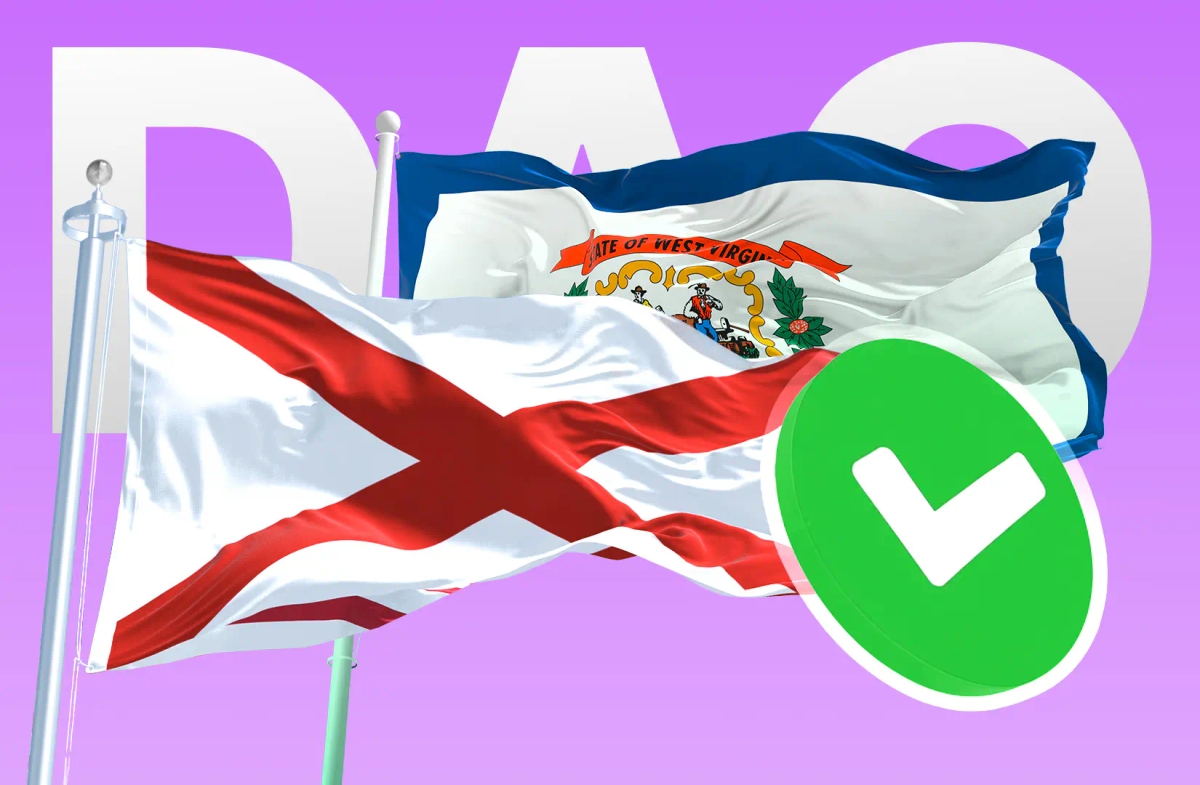
Last week, Alabama and West Virginia joined Wyoming — which signed its version of the so-called Decentralised Unincorporated Nonprofit Organization Act into law in 2024 — by signing their own versions of the DUNA Act.
That’s a big deal. It means that DAOs have been granted legal existence. This will allow them to more easily work with regular businesses, appear in court, pay taxes, and reduce legal risks — and still remain supposedly decentralised.
“This is forward-looking policymaking at its best,” Miles Jennings, head of policy and general council at a16z crypto, said. “It embraces innovation, protects participants, and empowers internet-native communities to compete with big tech incumbents. And it comes at a pivotal moment in the effort to make the US the crypto capital of the world.“
The idea is that this gives DAOs a chance to stand on equal footing with centralised entities like companies. It is a huge weight of their shoulders for DAOs at a time when the DAO model has come under scrutiny.
A DAO is a community of token holders who can vote and propose amendments to a specific DeFi protocol. Their proponents envisage these organisations as a way to break away from the top-down structures of centralised companies.
But because of the lack of legal status, many protocols were forced to form foundations that were supposed to act as neutral stalwarts for the projects, Jennings and Aiden Slavin, policy partner at a16z crypto, wrote on April 4.
In some cases, that helped foster decentralisation and diffused risks, but in others they created opacity, inefficiencies and limited growth, Jennings and Slavin wrote.
They have also — as DL News has repeatedly reported — contributed to protracted internal squabbling that has eroded trust in these DAOs.
More states signing their versions of the DUNA Act could change that.
“With the United States moving towards legislative clarity, the separation and fiction of foundations is no longer necessary,” Jennings and Slavin wrote.
Top DeFi stories of the week 🤖


This week in DeFi governance ⚖️
VOTE: Lido DAO weighs in on plan to use 10,000 stETH to buy back LDO token
ANNOUNCEMENT: Aave DAO adviser Chaos Labs leaves over risk ‘misalignment’
VOTE: Arbitrum DAO mulls improvements to its audit programme
Post of the week 💥
Ethereum’s next upgrade, Hegota, is coming in the latter half of 2026.