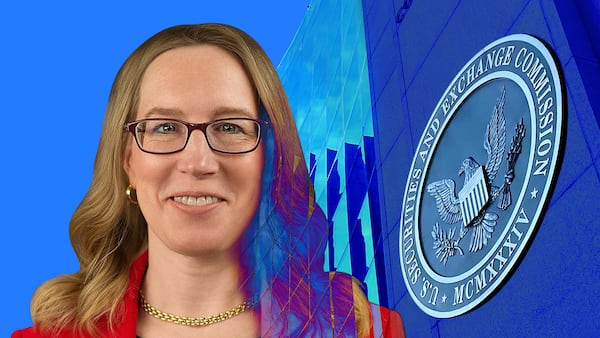


- Citadel Securities urged the SEC to require that certain DeFi protocols register with the agency.
- Registration exemptions could fragment equity markets, the firm said.
- DeFi developers have long argued registration requirements would be a death knell for the industry.
Citadel Securities, one of the largest market makers in the US, has urged the Securities and Exchange Commission to require that certain DeFi protocols and related businesses register as exchanges and broker-dealers.
In a letter to the agency on Tuesday, Citadel said an exemption from such registration requirements, when paired with the tokenisation of equities, could create “a ‘shadow’ U.S. equity market,” fragmenting liquidity and undermining investor protections.
The letter is the latest example of traditional financial firms’ increasingly combative approach to light-touch crypto regulation.
Banks have come out against a perceived loophole in recently passed stablecoin legislation that allows issuers to reward stablecoin holders.
The alleged loophole could, the banks have argued, drain them of their deposit base and, in turn, their ability to lend.
Moreover, the letter comes at a time when lawmakers and the SEC are considering relaxing rules that have limited the integration of traditional financial markets with crypto technology.
Senators are locked in negotiations over a crypto market structure bill that would largely hand industry oversight to the Commodity Futures Trading Commission.
And SEC Chair Paul Atkins is embarking on a deregulatory campaign dubbed “Project Crypto,” which could include exemptions from specific regulatory requirements.
‘Often inaccurate’
Citadel’s letter inflamed DeFi proponents, who have long argued that registration requirements would functionally kill decentralised finance.
Registered exchanges and broker-dealers are subject to a suite of regulations that can only be fulfilled by centralised entities, DeFi proponents say — an impossibility for self-executing software programs that cannot be unilaterally shut off or modified.
In a July letter to SEC Commissioner Hester Peirce, venture capital firm Andreessen Horowitz argued DeFi protocols that enable peer-to-peer trading of tokenised equities should be exempt from the SEC’s registration requirements.
While proponents argue that DeFi protocols enable peer-to-peer exchange, that belief is “often inaccurate,” according to Citadel.
That’s because users frequently do engage with intermediaries when trading on decentralised exchanges, Citadel said.
The SEC’s definition of a regulated exchange or broker-dealer is broad, covering “any organization, association, or group of persons” that matches buyers and sellers of securities.
Protocol developers, decentralised autonomous organisations, and the various foundations established to support protocol growth fall into that definition, Citadel argued, citing as an example Uniswap’s creation of a legal entity in Wyoming.
Additionally, websites that provide easy access to DeFi protocols often charge fees, much like traditional brokers, according to Citadel.
“The original American stock exchange was simply market participants transacting around a Buttonwood tree pursuant to an agreed set of rules,” Citadel wrote.
“Despite concerted efforts to persuade the Commission otherwise, a DeFi trading protocol that allows market participants to transact pursuant to an agreed set of rules enforced by code is not fundamentally different.”
Registration exemptions would boost DeFi protocols at the expense of traditional trading venues, the firm added.
“Granting broad exemptive relief to facilitate the trading of a tokenized share via DeFi protocols would create two separate regulatory regimes for the trading of the same security. This outcome would be the exact opposite of the ‘technology-neutral’ approach taken by the Exchange Act, and would instead preference one technology over all others.”
Crypto lawyers and DeFi developers were incensed.
“Citadel just declared war on Project Crypto, taking up arguments made by Gensler in his failed attempt to regulate DeFi,” J.W. Verret, a professor of law at George Mason University, wrote on X.
“The opposition letters will be extensive.”
Aleks Gilbert is DL News’ New York-based DeFi correspondent. You can reach him at aleks@dlnews.com.